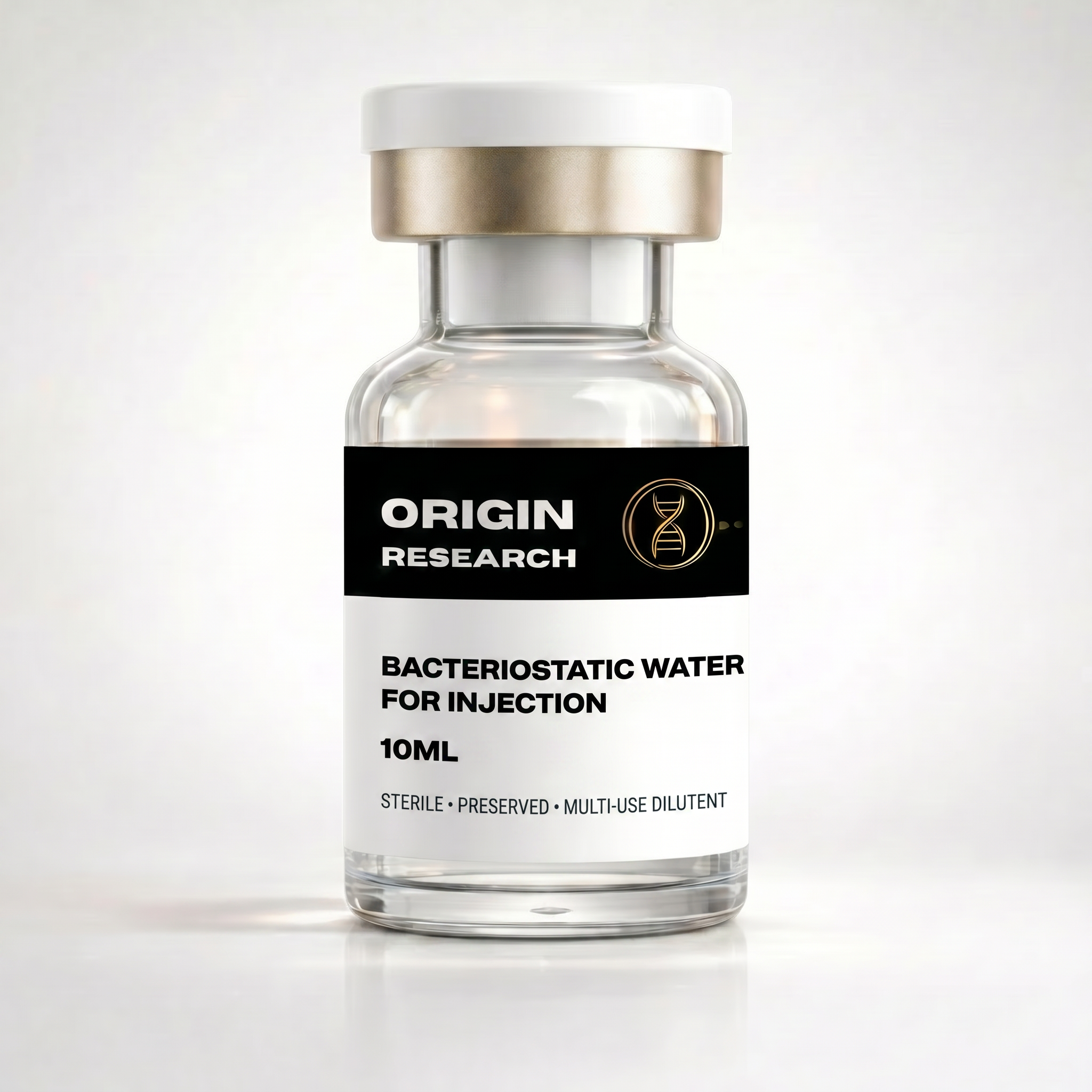
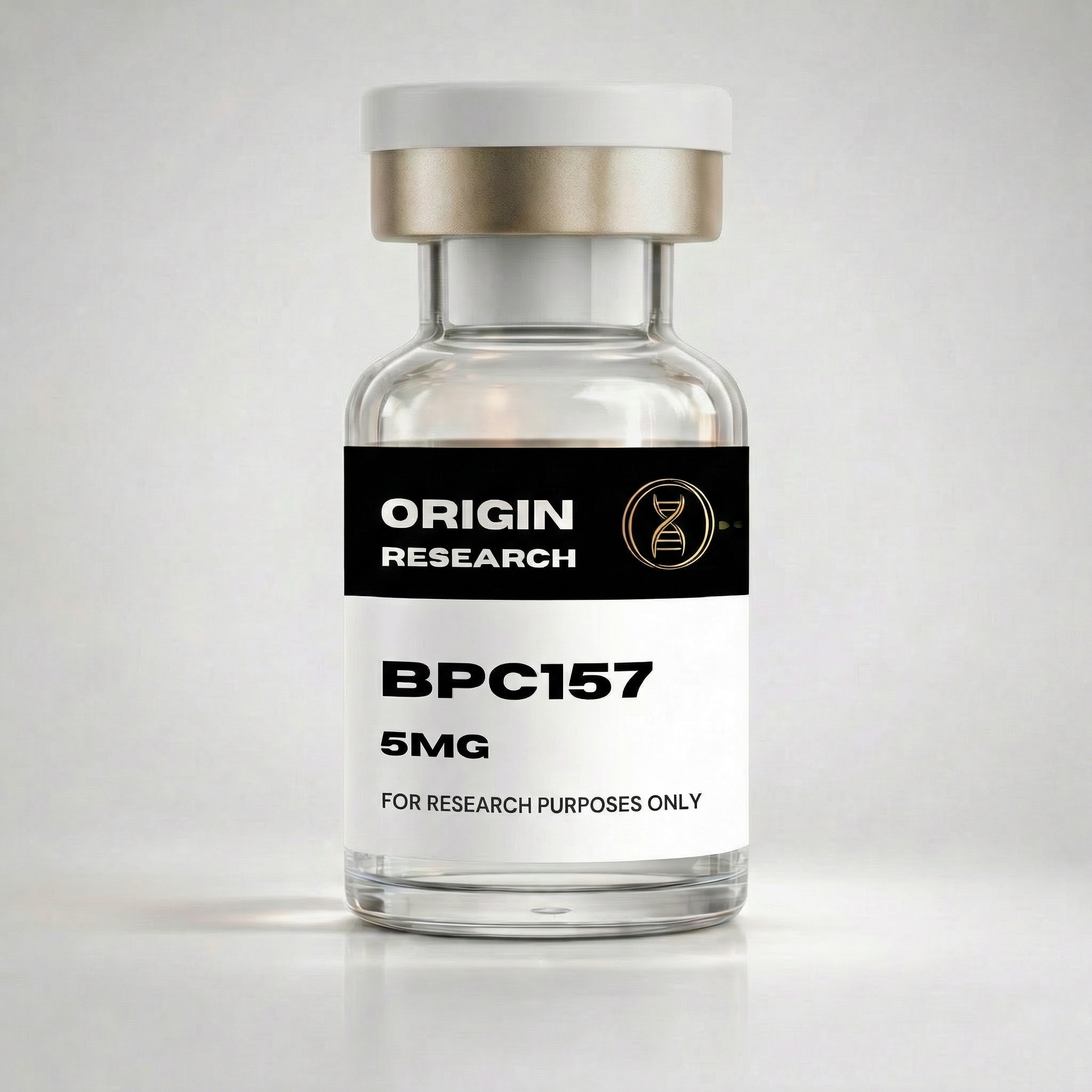
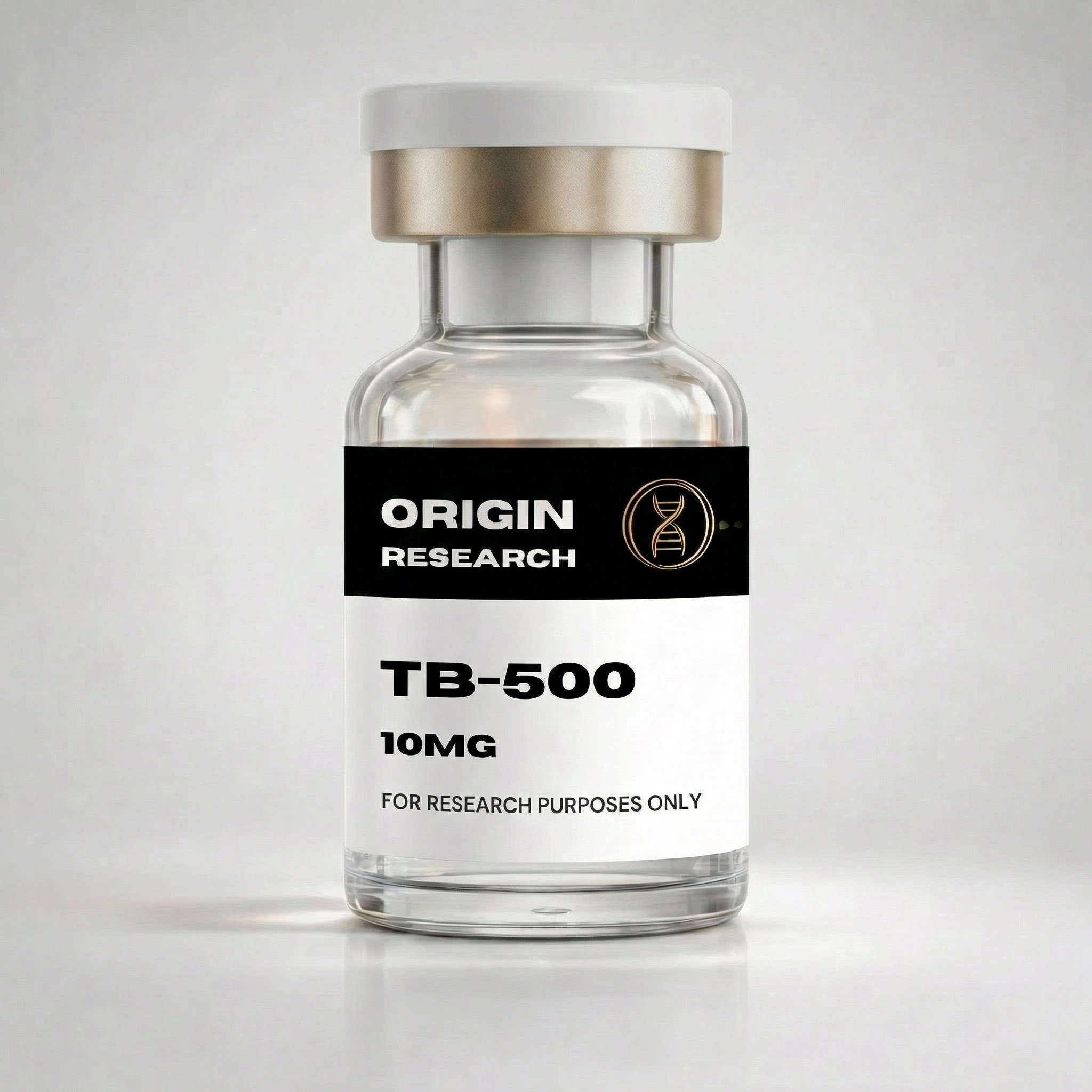
Bacteriostatic water or sterile water? It is one of the most common questions a research buyer asks before reconstituting a vial, and one of the most consequential choices made at the bench. The two diluents share the same water-for-injection base. They differ in one critical respect: bacteriostatic water contains 0.9 percent benzyl alcohol as a preservative, while sterile water contains no preservative.
That difference governs:
- How long the reconstituted vial can be used.
- How many times the vial can be safely punctured.
- Whether the diluent is compatible with certain peptide sequences and downstream procedures.
This guide compares the two diluents across the criteria that matter for a research laboratory, identifies which workflows call for which diluent, and addresses the edge cases where the choice is less obvious. The frame is research-material handling for compounds supplied under a Research Use Only model. The examples reference peptides typical of the Origin Research catalog (including BPC-157 and TB-500), where the technical documentation specifies the recommended diluent for each item and the buyer is expected to verify before reconstitution.
The short answer: bacteriostatic water is the default for multi-puncture, multi-week workflows. Sterile water is the default for single-use aliquoting or for peptides with documented benzyl alcohol incompatibility. The supplier's technical sheet is the source of truth for any specific peptide.
What bacteriostatic water is and how it works
Bacteriostatic water for injection is sterile water formulated with 0.9 percent benzyl alcohol as a preservative. Benzyl alcohol is an aromatic alcohol with documented bacteriostatic activity against a broad spectrum of common microbial contaminants. The mechanism is disruption of microbial cell membranes at the concentrations used in preserved formulations.
In practical terms, that preservative allows the same vial to be punctured repeatedly over roughly 28 days without progressive microbial colonisation. The 28-day window is the standard reference figure in pharmaceutical handling literature and the basis for most laboratory protocols that rely on bacteriostatic water as the reconstitution diluent for multi-use peptide vials.
A few logistics worth knowing:
- Bacteriostatic water is supplied in sealed vials, typically 10 mL or 30 mL.
- The 28-day clock starts at first puncture, not at the manufacturer's expiry date.
- Sources include medical supply chains, laboratory suppliers, and certain peptide suppliers that stock it as a companion product.
[Origin Research](https://originlabsresearch.com) stocks bacteriostatic water as a companion item so research buyers can source the diluent alongside the peptide order rather than chasing it down separately.
The mental model: benzyl alcohol does not stabilise the peptide. It stabilises the vial against contamination from repeated punctures. The peptide's chemical stability still depends on temperature, pH, and the sequence itself.
What sterile water is and where it wins
Sterile water for injection is purified water that has been sterilised by autoclaving or filtration. No preservative. Any microbial introduction during a puncture is not inhibited, so the working life of a punctured vial is effectively a single use.
Sterile water is the right choice in three main scenarios:
- Single-use aliquoting. The entire reconstituted volume is divided into single-use portions immediately, with each portion frozen for later single-use thawing. The vial never lives in a multi-puncture state, so the bacteriostatic protection of benzyl alcohol is not needed.
- Peptides with documented benzyl alcohol incompatibility. Certain sequences show adverse interactions with benzyl alcohol (accelerated degradation, aggregation). For these, the supplier's technical documentation specifies sterile water without preservative.
- Procedures sensitive to benzyl alcohol. Some cell culture applications and certain assays cannot tolerate benzyl alcohol in the final preparation.
In any of those three cases, sterile water is correct and bacteriostatic water would be wrong.
Quick rule: if the workflow does not involve repeated punctures of the same vial, the bacteriostatic protection is not buying anything. Sterile water is fine, and may actually be required.
Practical comparison: working life, vial size, procurement
Laying the two side by side on the criteria that drive real procurement decisions:
Working life after first puncture - Bacteriostatic water: ~28 days under refrigeration. - Sterile water: single use per puncture.
Common vial sizes - Both: 10 mL and 30 mL formats. - 30 mL is more economical per millilitre. - 10 mL is more appropriate for labs that do not consume diluent fast enough to use a 30 mL vial within its working life.
Procurement - Both are generally available through laboratory supply channels. - Bacteriostatic water sometimes requires a slightly more involved sourcing path in certain jurisdictions due to its preserved status.
Cost - Per-millilitre cost difference is small. - Cost rarely drives the choice.
The driver of the choice is almost always:
- The workflow requirement (multi-puncture or single-use).
- The peptide compatibility (benzyl alcohol tolerated or not).
Not the price tag.
Peptide compatibility and the supplier's technical sheet
The single most reliable source for diluent selection on any specific peptide is the supplier's technical sheet for that peptide. A competent supplier publishes, per catalog item:
- Recommended diluent
- Recommended reconstitution volume range
- Resulting concentration calculations
- Any documented incompatibilities
The buyer should consult the sheet before reconstitution. The buyer should not default to a diluent based on general practice without checking.
Suppliers that do not publish per-item diluent guidance are leaving the buyer to make an uninformed call. That is a documentation gap and a soft red flag.
For most research peptides in the Origin Research catalog, the recommended diluent is bacteriostatic water for multi-puncture vial use under refrigeration. This is the case for BPC-157 and TB-500 in their standard catalog presentations. For specific peptides where the literature documents incompatibility with benzyl alcohol, or where single-use aliquoting is the recommended storage strategy, sterile water is specified.
The verification step takes about a minute. It prevents the kind of diluent-peptide mismatch that can compromise an entire vial.
Edge cases: acetic acid solutions and saline
Bacteriostatic water and sterile water cover the vast majority of research peptide reconstitution scenarios. Two other diluents show up in the literature for specific edge cases.
Dilute acetic acid solutions (typically 0.1 to 1 percent) - Referenced for hydrophobic peptide sequences that resist dissolution in neutral aqueous diluent. - Acetic acid lowers the solution pH and can solubilise sequences with clustered hydrophobic residues. - Use is sequence-specific. Only adopt when the supplier's technical sheet or published literature for that peptide specifies it.
Sodium chloride 0.9 percent (normal saline) - Referenced for downstream research procedures where isotonicity of the final preparation is required. - Generally introduced as a downstream dilution step rather than as the primary reconstitution diluent. - Primary reconstitution typically still uses bacteriostatic water or sterile water.
Neither is a default reconstitution diluent for research peptides. Both are specialty diluents whose use is dictated by specific protocol requirements documented in advance.
Documenting the diluent choice
Whichever diluent goes in, the choice must be recorded on the vial label and in the laboratory log at the moment of reconstitution.
On the vial label:
- Diluent type
- Diluent volume added
- Reconstitution date
- Resulting concentration
In the laboratory log:
- All of the above
- Peptide vial lot number
- Diluent vial lot number
Total time required: about thirty seconds. The most common error this practice prevents is the situation where a researcher returns to a previously reconstituted vial weeks later and cannot recall which diluent was used. Without the label, there is no way to know whether the vial holds bacteriostatic water with its 28-day working life or sterile water with its single-use working life.
The conservative response to an unlabelled vial is to discard it. That is a complete waste of the material. The correct response is to label every vial at the moment of reconstitution.
The diluent lot number matters too. If a buyer later identifies a problem with a specific lot of bacteriostatic water, the buyer needs to know which reconstituted peptide vials used that lot. The laboratory log is the only reliable source of that information.
Research-grade labs treat this as routine, not as overhead. The practice becomes muscle memory for any bench worker who handles reconstitution regularly. Origin Research provides standard label templates and reconstitution log examples for buyers establishing a documentation practice for the first time.
Concentration math and the reconstitution volume decision
The diluent volume added at reconstitution determines the final concentration of the working solution, which determines every downstream aspiration volume in the protocol. Getting the math right at reconstitution prevents a class of errors that propagates silently through the rest of the workflow.
The basic formula:
- Final concentration (mg/mL) = peptide mass in vial (mg) / diluent volume added (mL)
A 5 mg vial reconstituted with 2 mL of diluent produces a 2.5 mg/mL working solution. A 5 mg vial reconstituted with 1 mL produces a 5 mg/mL working solution. Same peptide, same vial, half the diluent, double the concentration. Every aspiration draws half as much volume for the same delivered mass.
The practical considerations when choosing a reconstitution volume:
- The supplier's recommended range. Most technical sheets specify a recommended reconstitution volume range. Inside the range, dissolution is reliable. Outside, the peptide may not dissolve fully or the resulting solution may be too dilute to draw practical aspiration volumes from.
- Aspiration ergonomics. Very small aspiration volumes (below approximately 0.05 mL) are hard to measure accurately with standard insulin syringes. Choosing a reconstitution volume that produces aspiration volumes in the 0.1 to 0.5 mL range usually improves precision.
- Working life budget. A higher-concentration solution at the same vial size means the vial gets used up faster on the same protocol, which can put the working life inside the 28-day refrigerated window.
- Sterile water versus bacteriostatic water. Single-use aliquoting workflows with sterile water often use smaller per-aliquot volumes than refrigerated multi-puncture workflows with bacteriostatic water.
The corrective practice is to do the math before the diluent is added, write the resulting concentration on the vial label, and confirm the planned aspiration volume against the protocol. A two-minute calculation at reconstitution prevents the much larger problem of discovering, halfway through an experiment, that the aspiration volumes do not produce the intended delivered mass.
Common diluent mistakes and how to avoid them
A short catalog of the diluent errors that show up most often at the bench, and the fixes that prevent them:
- Defaulting to bacteriostatic water without checking. Some peptides do not tolerate benzyl alcohol. Defaulting can compromise the entire vial. Fix: check the supplier's technical sheet for each peptide before reconstitution.
- Using bacteriostatic water past its 28-day post-puncture life. The benzyl alcohol protection is consumed. Contamination risk is no longer controlled. Fix: mark the first-puncture date on every bacteriostatic water vial and rotate stock first-in, first-out.
- Using sterile water for a multi-puncture workflow. Each puncture introduces contamination risk that is not inhibited. The working solution may seem fine for the first few aspirations and then degrade. Fix: match the diluent to the workflow, not the other way around.
- Mixing diluent lots within a single vial. Topping up a partially used vial with fresh diluent introduces complications around concentration and contamination history. Fix: never top up. Reconstitute fresh when the working solution runs low.
- Reconstituting at the wrong volume. The supplier's technical sheet specifies a recommended reconstitution volume range. Going outside it can produce a concentration that does not match the planned protocol or a solution that does not fully dissolve. Fix: read the sheet, do the math, then add the diluent.
- Assuming all bacteriostatic water is equivalent. Different manufacturers may use slightly different formulations, and some are sourced from outside medical-grade supply chains. Fix: source bacteriostatic water from a supplier whose product is properly labeled and stored, such as the companion bacteriostatic water sold alongside the Origin Research catalog.
None of these mistakes is dramatic in isolation. They become a problem when they go undetected for weeks and the researcher cannot reconstruct what happened. Documenting the diluent choice at the moment of reconstitution closes most of these failure modes before they start.
References
- [1] Meyer BK, Ni A, Hu B, Shi L (2007). Antimicrobial preservative use in parenteral products: past and present. Journal of Pharmaceutical Sciences, 96(12), 3155-3167.
- [2] United States Pharmacopeial Convention (2020). USP Monograph: Bacteriostatic Water for Injection. United States Pharmacopeia.
- [3] United States Pharmacopeial Convention (2020). USP Monograph: Sterile Water for Injection. United States Pharmacopeia.
- [4] Manning MC, Chou DK, Murphy BM, Payne RW, Katayama DS (2010). Stability of protein pharmaceuticals: an update. Pharmaceutical Research, 27(4), 544-575.
Frequently asked questions
What is the main difference between bacteriostatic water and sterile water?
Bacteriostatic water contains 0.9 percent benzyl alcohol as a preservative, allowing multi-puncture vial use for about 28 days. Sterile water contains no preservative and supports only single-use reconstitution per puncture.
When is bacteriostatic water the preferred diluent?
For any research protocol that draws multiple aspirations from a single reconstituted vial over a multi-week period under refrigeration.
When is sterile water preferred over bacteriostatic water?
For single-use aliquoting workflows, peptides with documented benzyl alcohol incompatibility, and research procedures sensitive to benzyl alcohol in the final preparation.
How long can bacteriostatic water be used after first puncture?
About 28 days under refrigerated conditions. The working life is anchored to the documented bacteriostatic activity of benzyl alcohol against common microbial contaminants.
Where should the diluent recommendation for a specific peptide be verified?
On the supplier's technical sheet for that specific catalog item. Competent suppliers publish per-item diluent guidance, and the buyer should verify before reconstitution rather than defaulting to general practice.
Are acetic acid or saline ever used as reconstitution diluents?
Acetic acid at low molarity is referenced for hydrophobic peptide sequences that resist dissolution in neutral aqueous diluent. Saline is generally used as a downstream dilution step rather than the primary reconstitution diluent.
Does the cost difference between bacteriostatic water and sterile water typically drive the choice?
No. The cost difference at the per-millilitre level is small. The driver is the workflow requirement and the peptide compatibility, not the cost.