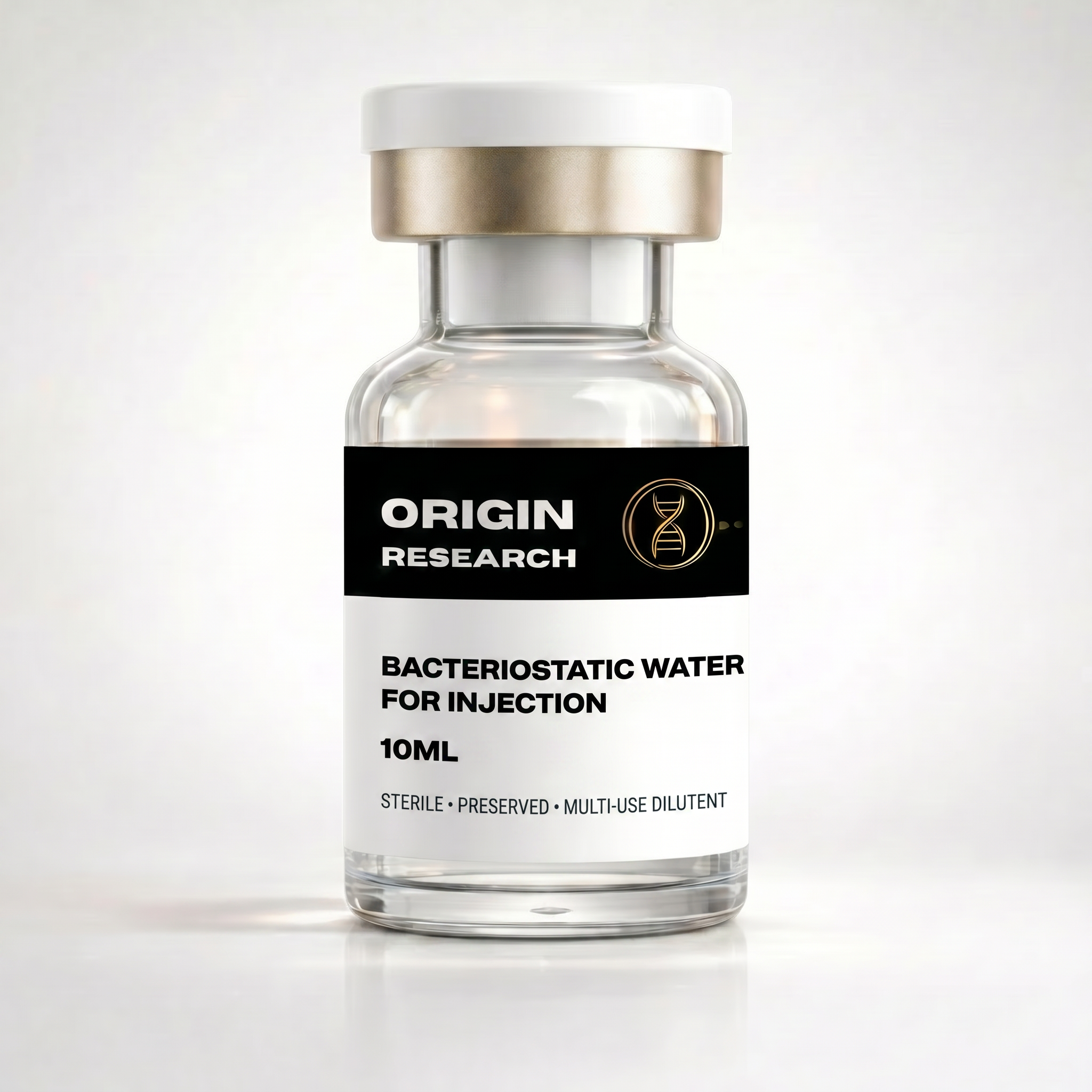
Bacteriostatic water for injection is the diluent most commonly referenced for reconstituting lyophilised research peptides. The product is sterile water containing 0.9 percent benzyl alcohol as a bacteriostatic preservative, supplied in sealed vials with rubber septums designed for multiple aspirations over an extended working period. Understanding what bacteriostatic water is, how it differs from other sterile diluents, and when each type should be used has been referenced in pharmaceutical handling literature as a baseline competency for laboratory personnel who reconstitute and aspirate peptides for in vitro and animal-model research. For research laboratories sourcing material from originlabsresearch.com, the choice of diluent at the moment of reconstitution affects the working life of the resulting solution, the sterility margin during repeated puncture of the vial, and in some cases the chemical compatibility with the peptide being reconstituted. This guide explains the composition of bacteriostatic water, the role of benzyl alcohol as a bacteriostatic agent, the distinction between bacteriostatic water and sterile water for injection without preservative, the shelf life of bacteriostatic water after opening, and the practical scenarios in which each diluent is appropriate within a research-use-only framework. The information is supplied for research purposes only and does not constitute medical, clinical, or veterinary advice. Research personnel should verify the compatibility of the chosen diluent with the specific peptide and in vitro or animal-model protocol in question.
Composition of bacteriostatic water for injection
Bacteriostatic water for injection is a pharmaceutical product produced under USP or equivalent pharmacopeial standards, consisting of sterile water containing 0.9 percent by volume benzyl alcohol as a bacteriostatic preservative. The product is supplied in glass or plastic vials of various volumes, most commonly 10 milliliter, 20 milliliter, and 30 milliliter sizes, with sealed rubber septums that permit repeated aspiration through a sterile needle without compromising the contents. The water component is purified to pharmaceutical grade, free of pyrogens, particulates, and microbial contamination at the time of manufacture. The benzyl alcohol is added during compounding as the bacteriostatic agent and is present at the labelled 0.9 percent concentration throughout the shelf life of the product. The resulting solution is clear, colourless, and odourless to faintly aromatic from the benzyl alcohol. Bacteriostatic water is distinct from several other water-based pharmaceutical products. Sterile water for injection without preservative is also purified to pharmaceutical grade but contains no bacteriostatic agent, and is supplied as a single-use product because it offers no microbial protection after the first puncture. Water for injection is a bulk pharmaceutical grade water used as a starting material in formulation, not packaged for direct use as a diluent. Sterile water for irrigation is a non-pyrogenic water intended for external use and is not suitable for parenteral preparation. Purified water and distilled water sold for laboratory use generally do not meet the pyrogen and sterility standards required for diluent use with research peptides destined for in vitro or animal-model work.
How benzyl alcohol provides bacteriostatic protection
Benzyl alcohol is an aromatic alcohol with antimicrobial properties that has been studied extensively in pharmaceutical preservation literature. The compound disrupts microbial cell membranes through partitioning into the lipid bilayer, where it interferes with membrane integrity and inhibits the growth and reproduction of bacteria, fungi, and certain viruses. The 0.9 percent concentration in bacteriostatic water has been established as an effective bacteriostatic level that inhibits the growth of common contaminating organisms while remaining within the pharmacopeial limits for preservative content. The term bacteriostatic indicates that benzyl alcohol slows or prevents microbial growth but does not necessarily kill organisms that may be introduced into the vial. The distinction between bacteriostatic and bactericidal is important for understanding the working life of a punctured vial. A vial of bacteriostatic water that has been punctured and exposed to ambient air will not become contaminated under typical laboratory conditions because the benzyl alcohol prevents the growth of any organisms that enter the vial. However, the protection has limits, and prolonged use of a single vial beyond the labelled 28-day window allows for the gradual accumulation of contamination at levels that can exceed the bacteriostatic capacity. The recommended practice is for laboratory personnel to date the vial at the moment of first puncture and to discard the vial 28 days later regardless of remaining volume. Some peptides have documented incompatibility with benzyl alcohol, including certain longer peptides where the alcohol has been associated with aggregation or precipitation in in vitro stability studies, and these specific cases call for the use of preservative-free sterile water for injection instead.
Bacteriostatic water versus sterile water for injection
The choice between bacteriostatic water and sterile water for injection without preservative depends on the planned use pattern of the reconstituted vial within the research protocol. Bacteriostatic water is appropriate when the reconstituted peptide will be used over multiple aspirations across a working period of up to 28 days, since the benzyl alcohol provides the necessary microbial protection for repeated puncture of the same vial. This use pattern is the most common in research peptide handling, and bacteriostatic water is therefore the default diluent for most catalog peptides at Origin Research. Sterile water for injection without preservative is appropriate in three specific scenarios. The first is single-use aliquoting protocols, where the reconstituted peptide is immediately divided into multiple small aliquots that are each used once and discarded. In this scenario the bacteriostatic protection is not needed because the vial is not punctured repeatedly, and the absence of benzyl alcohol simplifies the diluent composition. The second is reconstitution of peptides with documented incompatibility with benzyl alcohol, where the alcohol has been associated with aggregation or precipitation. The third is downstream research procedures that require absolute control over the diluent composition for chemical or biological reasons, such as in vitro cell culture work where benzyl alcohol cytotoxicity could confound the experimental readout. For these scenarios, sterile water for injection without preservative is the appropriate choice, with the understanding that the vial must be either used immediately or aliquoted and frozen, since no microbial protection is provided after the first puncture.
Shelf life and storage of bacteriostatic water
Bacteriostatic water has two distinct shelf life considerations: the shelf life of the sealed unopened vial, and the working life of the vial after the first puncture. The sealed unopened vial has a labelled expiry date typically 24 to 36 months from manufacture, set by the manufacturer based on stability data for the sterile water and the benzyl alcohol preservative. The vial should be stored at room temperature, away from direct light, and within the temperature range specified on the label, typically 15 to 30 degrees Celsius. Refrigeration is not required for unopened vials and is not recommended due to the risk of microscopic crystallisation effects at lower temperatures. After the first puncture, the working life of the vial is 28 days under typical laboratory conditions, with the vial stored at room temperature or under refrigeration depending on institutional preference. The 28-day window is based on the bacteriostatic capacity of the benzyl alcohol at the labelled concentration, and is referenced consistently across pharmaceutical handling literature. The vial should be marked with the date of first puncture and discarded 28 days later, regardless of the remaining volume. Use beyond the 28-day window increases the risk of microbial contamination that can exceed the bacteriostatic capacity. Stock of bacteriostatic water for laboratory use should be ordered in vial sizes that match the expected consumption rate, since larger vials offer no advantage if the contents cannot be consumed within the 28-day window. Common stock sizes are 10 milliliter and 20 milliliter, with 30 milliliter vials available for higher-throughput laboratories.
Practical scenarios and diluent selection
Several practical scenarios illustrate the selection of bacteriostatic water versus other diluents in research peptide workflows. Scenario one: a laboratory is reconstituting a 10 milligram vial of a catalog peptide for a protocol that will use the material over approximately three weeks across multiple aspirations. Bacteriostatic water is the appropriate choice, since the working life of the protocol fits within the 28-day window and multiple puncture protection is needed. Scenario two: a laboratory is reconstituting a 50 milligram vial of a peptide for an animal-model protocol that will run over six months. Bacteriostatic water would not be appropriate as the sole storage strategy because the working life exceeds 28 days. The appropriate strategy is to reconstitute in sterile water for injection without preservative, immediately aliquot into single-use cryogenic vials, and freeze for thaw on demand. Scenario three: in vitro cell culture work where the reconstituted peptide will be added directly to cell culture medium. Sterile water for injection without preservative or 0.9 percent sodium chloride may be more appropriate than bacteriostatic water, since benzyl alcohol at the levels present in bacteriostatic water can affect cell viability at the high dilution endpoints typical of cell culture protocols. Scenario four: a laboratory is reconstituting a hydrophobic peptide that has poor solubility in aqueous diluent. Low-molarity acetic acid, typically 0.01 to 0.1 molar, may be required to achieve dissolution, with the understanding that the resulting solution is no longer at neutral pH. Scenario five: a laboratory is reconstituting a peptide for an immediate single-use in vitro protocol where the entire vial will be consumed within hours. Sterile water for injection without preservative is appropriate and offers a simpler chemical environment for the brief working period.
References
- [1] United States Pharmacopeia (2020). USP monograph: Bacteriostatic Water for Injection. USP-NF.
- [2] Meyer BK, Ni A, Hu B, Shi L (2007). Antimicrobial preservative use in parenteral products: past and present. Journal of Pharmaceutical Sciences. PMID 17518360
- [3] Akers MJ (2010). Sterile drug products: formulation, packaging, manufacturing, and quality. Informa Healthcare.
- [4] Lam P, Stewart RJ, Tredwell GD, Bingham SE (2011). Benzyl alcohol as a preservative in injectable formulations. Journal of Pharmaceutical Sciences.
Frequently asked questions
What is bacteriostatic water?
Bacteriostatic water for injection is sterile water containing 0.9 percent benzyl alcohol as a bacteriostatic preservative, supplied in sealed multi-puncture vials for use as a diluent in pharmaceutical and research peptide reconstitution.
How is bacteriostatic water different from sterile water?
Sterile water for injection without preservative contains no bacteriostatic agent and offers no microbial protection after the first puncture. Bacteriostatic water contains benzyl alcohol which protects against microbial growth for up to 28 days after opening.
How long can a bacteriostatic water vial be used after opening?
The labelled working life of an opened bacteriostatic water vial is 28 days at room temperature or under refrigeration. The vial should be marked with the date of first puncture and discarded 28 days later.
Are there peptides that should not be reconstituted with bacteriostatic water?
Yes. Some peptides have documented incompatibility with benzyl alcohol, including longer peptides where the alcohol has been associated with aggregation or precipitation. Sterile water for injection without preservative is used in these cases.
Can distilled water from the laboratory tap be used as a diluent?
No. Laboratory distilled water and purified water generally do not meet the pyrogen and sterility standards required for diluent use with research peptides. Pharmaceutical-grade bacteriostatic water or sterile water for injection is the appropriate choice.
Does bacteriostatic water need to be refrigerated?
Unopened vials are stored at room temperature within the range specified on the label, typically 15 to 30 degrees Celsius. After opening, both room temperature and refrigerated storage are acceptable depending on institutional preference.
What vial sizes are commonly available?
Bacteriostatic water is commonly available in 10 milliliter, 20 milliliter, and 30 milliliter vials, with the choice driven by expected consumption within the 28-day working window.