
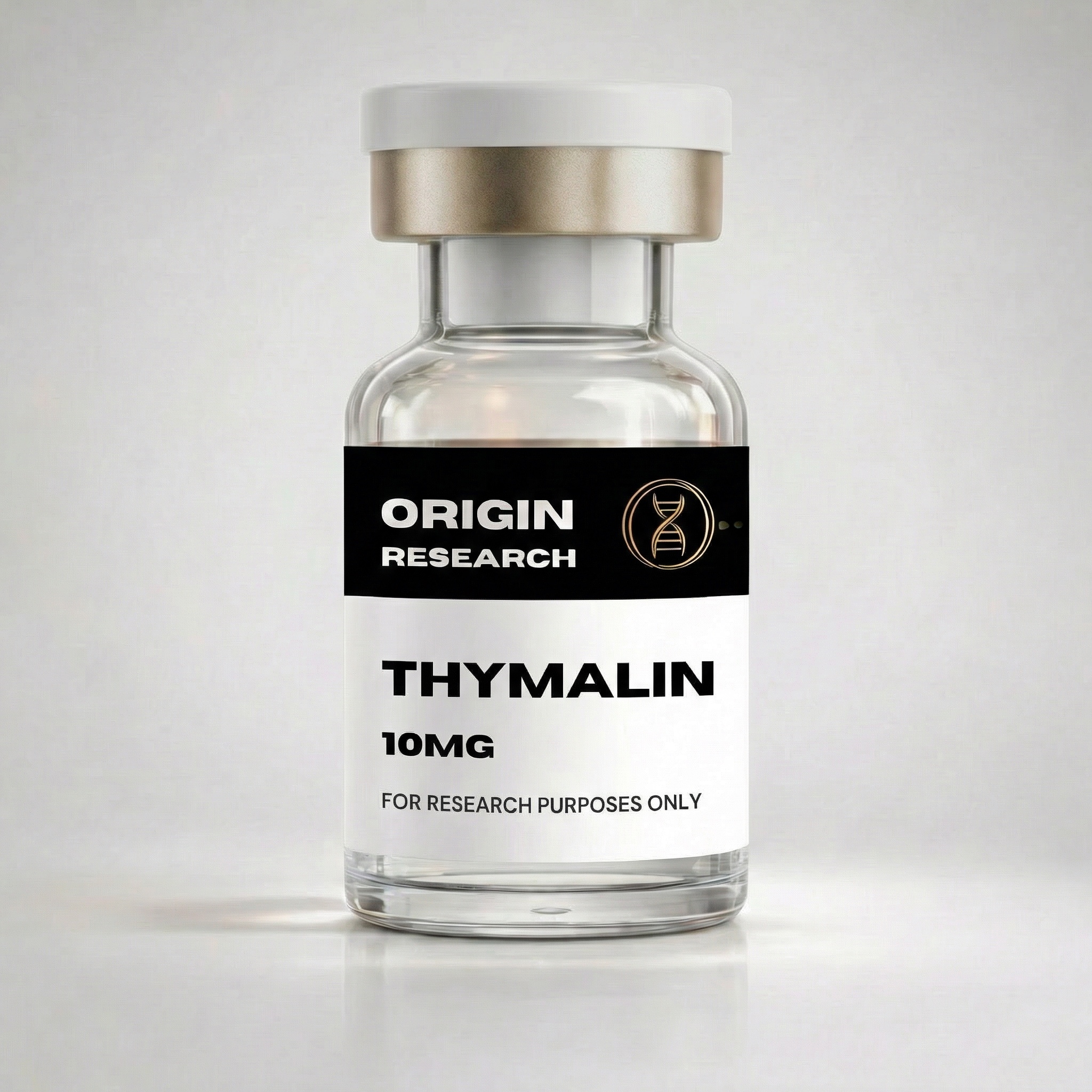
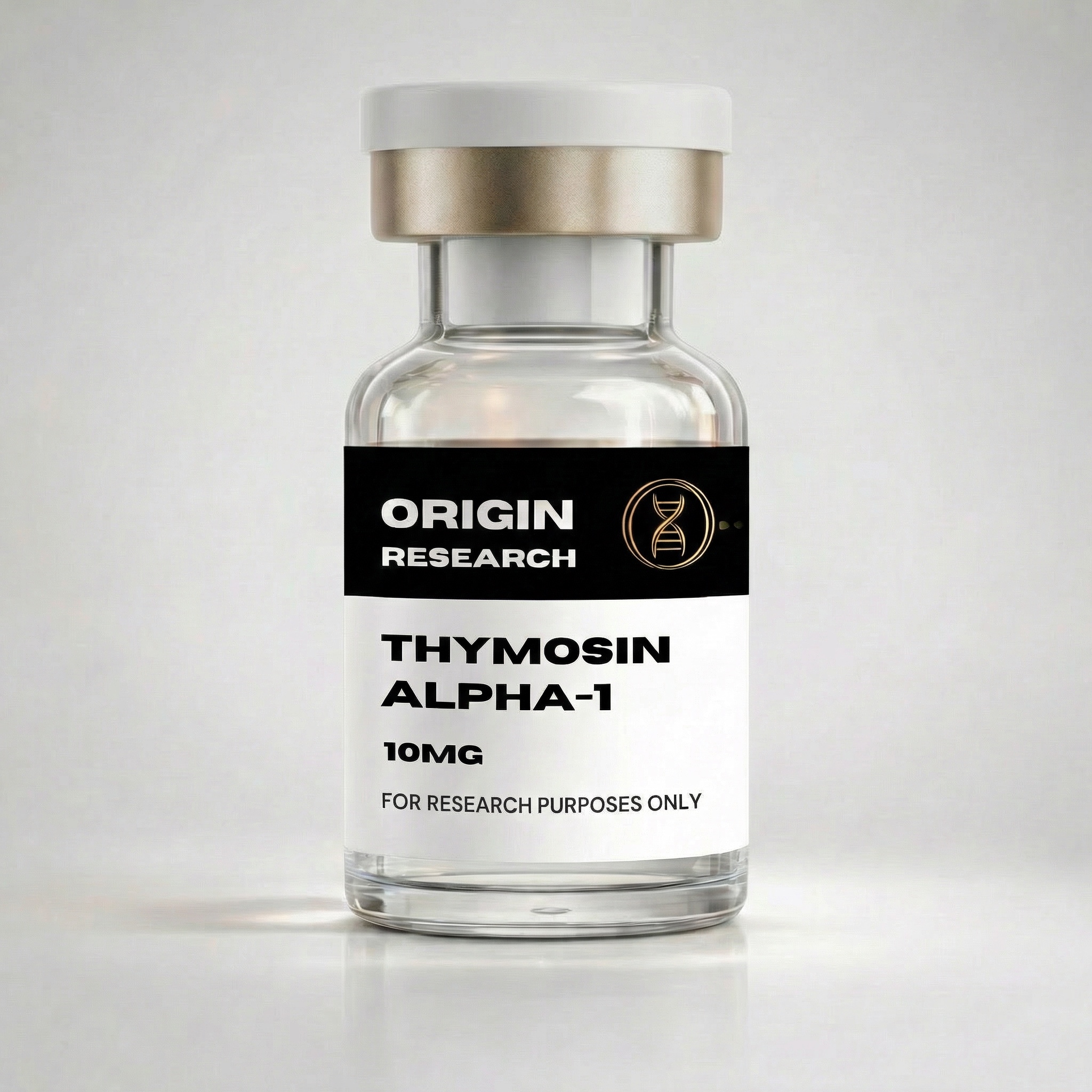
Thymalin and Thymosin Alpha-1 are two thymic-derived bioregulator reference compounds that have been investigated in published preclinical literature relating to immune-pathway and thymus-research models. They share a common origin in the thymus gland and overlap in the broader immunopeptide literature, but they differ substantially in size, sequence, and primary research framing. Thymalin is a dipeptide preparation that has been characterized in the Khavinson bioregulator literature, supplied as a Glu-Trp dipeptide for in vitro reference work and investigated in immune-pathway and thymus-restoration preclinical models in rodents (Khavinson, Neuro Endocrinol Lett 2002, PMID: 12163861; Anisimov et al., Mech Ageing Dev 2007, PMID: 17433413). Thymosin Alpha-1 is a 28-amino-acid acetylated polypeptide with the sequence Ac-SDAAVDTSSEITTKDLKEKKEVVEEAEN, first characterized by Goldstein and colleagues in the 1970s and investigated in published preclinical literature relating to T-cell maturation, immune-pathway research, and adjuvant-research models (Goldstein et al., Proc Natl Acad Sci U S A 1977, PMID: 70490; Garaci et al., Ann N Y Acad Sci 2007, PMID: 17435122). This page is supplied for licensed laboratory professionals comparing the two for in vitro reference work. Neither peptide is authorized for human consumption, supplementation, or therapeutic use in any jurisdiction we serve. Materials supplied through originlabsresearch.com are sold strictly for in vitro research, reference standards, and analytical chemistry purposes.
Overview
Sequence and structural background
Thymalin is the simplest of the thymic bioregulator preparations supplied as reference material, with its active component identified in the Khavinson literature as the Glu-Trp dipeptide. The Khavinson bioregulator framework developed several short-peptide products derived from thymus extracts, each associated with a specific small peptide motif identified by the St. Petersburg group. Thymalin sits in that family alongside other tissue-specific bioregulator peptides developed using the same methodology. Because the active component is only two residues, Thymalin is among the shortest reference peptides in the catalog and is straightforward to verify analytically. Thymosin Alpha-1 is a much larger and more structurally defined peptide. Its 28-residue sequence Ac-SDAAVDTSSEITTKDLKEKKEVVEEAEN was first reported by Goldstein and colleagues in the 1970s after fractionation of thymosin fraction 5, a thymic extract that had been the subject of earlier immune-research work (Goldstein et al., Proc Natl Acad Sci U S A 1977, PMID: 70490). The N-terminal acetyl group is integral to the peptide's identity, and reference standards must be verified to contain the acetylated form. The two peptides therefore sit at opposite ends of the thymic-peptide size spectrum: a two-residue Khavinson bioregulator dipeptide and a 28-residue Goldstein polypeptide. They are linked by their shared thymus origin but are otherwise structurally and historically distinct.
Primary preclinical research applications
Thymalin has been investigated in published preclinical literature originating largely from the St. Petersburg Institute of Bioregulation and Gerontology. Rodent studies have examined the dipeptide in immune-research and thymus-restoration models, with some work also exploring its activity in ageing-research rodent cohorts (Anisimov et al., Mech Ageing Dev 2007, PMID: 17433413). Much of this literature appears in Russian-language journals with English summaries available through Bull Exp Biol Med, Mech Ageing Dev, and Neuro Endocrinol Lett. Thymosin Alpha-1 has been investigated across a substantially larger English-language preclinical literature focused on T-cell maturation, immune-pathway research, and adjuvant-pathway research models (Garaci et al., Ann N Y Acad Sci 2007, PMID: 17435122). Published preclinical work has examined Thymosin Alpha-1 in T-lymphocyte differentiation cell-culture systems, in immune-modulation rodent models, and in adjuvant-research preclinical literature. The two literatures share a thymus-research framing and an immune-pathway orientation, but the assays and the depth of mechanistic detail differ. Investigators reviewing the field should consult the primary publications for both peptides and avoid assuming that a protocol designed around one will translate to the other. Selection between the two reference standards should be guided by which body of preclinical literature most closely matches the planned research question.
Reference-standard handling and analytical considerations
Both peptides are supplied as lyophilized reference material and follow standard short or medium-peptide handling conventions, but the analytical and storage considerations differ because of the substantial size difference. Thymalin, as a dipeptide-based bioregulator preparation, is straightforward to characterize by mass spectrometry, with no unusual residues to complicate identification. Reconstitution with sterile or bacteriostatic water is typical, with aliquoting recommended to avoid repeated freeze-thaw cycles. Storage at -20 degrees Celsius for long-term reference stocks is conventional. Thymosin Alpha-1, with its 28 residues and N-terminal acetylation, requires more involved analytical characterization. The acetylated form must be confirmed by mass spectrometry, because the unmodified form has a different mass and a different reported activity profile in the published literature. HPLC purity is documented on the certificate of analysis, and reference-standard quality control typically includes amino-acid analysis or peptide-mapping data for confirmation of the longer sequence. The vial size difference (10mg for Thymalin versus 5mg for Thymosin Alpha-1) reflects typical laboratory working quantities for each peptide as reported in their respective preclinical literatures. None of the handling guidance presented here is medical instruction. Both peptides are supplied strictly for in vitro research, reference-standard work, and analytical chemistry purposes, as reported in the cited literature.
Side by side
| Thymalin | Thymosin Alpha-1 | |
|---|---|---|
| Sequence | Glu-Trp dipeptide | Ac-SDAAVDTSSEITTKDLKEKKEVVEEAEN |
| Length | 2 amino acids | 28 amino acids |
| Modification | None | N-terminal acetylation |
| Vial size | 10mg | 5mg |
| Origin | Khavinson bioregulator framework | Goldstein thymosin fraction 5 work |
| Primary research field | Thymus-restoration and immune-pathway research | T-cell maturation and adjuvant-pathway research |
| Foundational citation | Anisimov 2007; Khavinson 2002 | Goldstein 1977; Garaci 2007 |
| Analytical complexity | Standard dipeptide analysis | 28-residue plus acetyl verification |
| Status | In vitro research reference only | In vitro research reference only |
When researchers choose which
When investigators choose between Thymalin and Thymosin Alpha-1 as reference standards, the decision is driven by which body of preclinical literature is most relevant to the planned work and by the depth of analytical infrastructure available. Research groups working within the Khavinson bioregulator tradition, with rodent studies in immune-research, thymus-restoration, or short-peptide bioregulator models, have generally turned to Thymalin, because the dipeptide is the established reference standard for that literature. The small size of the active peptide and the straightforward analytical verification make Thymalin well suited to laboratories with standard HPLC and mass-spectrometry capability. Research groups working within the Goldstein and Garaci tradition, with cell-culture systems examining T-cell maturation, adjuvant-pathway preclinical models, or detailed immune-research literature, have generally turned to Thymosin Alpha-1, because the 28-residue acetylated polypeptide is the reference compound documented across that body of work. The acetylated form must be confirmed by mass spectrometry, so laboratories selecting Thymosin Alpha-1 should ensure they can verify the modification or rely on rigorous certificate-of-analysis documentation. Both peptides are supplied at vial sizes that reflect typical laboratory working quantities for the published literature, and selection should follow the primary references. Neither peptide is authorized for human consumption, supplementation, or therapeutic use in any jurisdiction we serve, and the choice between them should be guided exclusively by which preclinical literature matches the planned research question and by laboratory analytical capability.
Frequently asked questions
Are Thymalin and Thymosin Alpha-1 the same thing?
No. Thymalin is a dipeptide bioregulator preparation with the Glu-Trp active component, while Thymosin Alpha-1 is a 28-amino-acid acetylated polypeptide. They share a thymus-research origin but differ substantially in structure, size, and primary research framing.
Why is the acetylation on Thymosin Alpha-1 important?
The N-terminal acetyl group is integral to the peptide's identity. The unmodified form has a different mass and a different reported activity profile in the published literature, so reference standards must be verified to contain the acetylated form.
Are these peptides authorized for human use?
No. Both are supplied strictly as in vitro research reference standards. Neither is authorized for human consumption, supplementation, or therapeutic use in any jurisdiction we serve.
Where can I read the foundational research?
Thymalin is referenced in Khavinson, Neuro Endocrinol Lett 2002 (PMID: 12163861) and Anisimov et al., Mech Ageing Dev 2007 (PMID: 17433413). Thymosin Alpha-1 is referenced in Goldstein et al., Proc Natl Acad Sci U S A 1977 (PMID: 70490) and Garaci et al., Ann N Y Acad Sci 2007 (PMID: 17435122).
Why are the vial sizes different?
Reference vial sizes reflect typical laboratory working quantities for each peptide as reported in the primary literature. Thymalin is supplied at 10mg per vial, and Thymosin Alpha-1, which is used at smaller working quantities in published preclinical models, is supplied at 5mg per vial.
Can one peptide substitute for the other in an immune-research protocol?
No. Although both have been examined in immune-pathway research, they differ substantially in structure and in the assays reported in the published literature. A protocol designed around one cannot be transferred to the other without consulting the primary literature.