
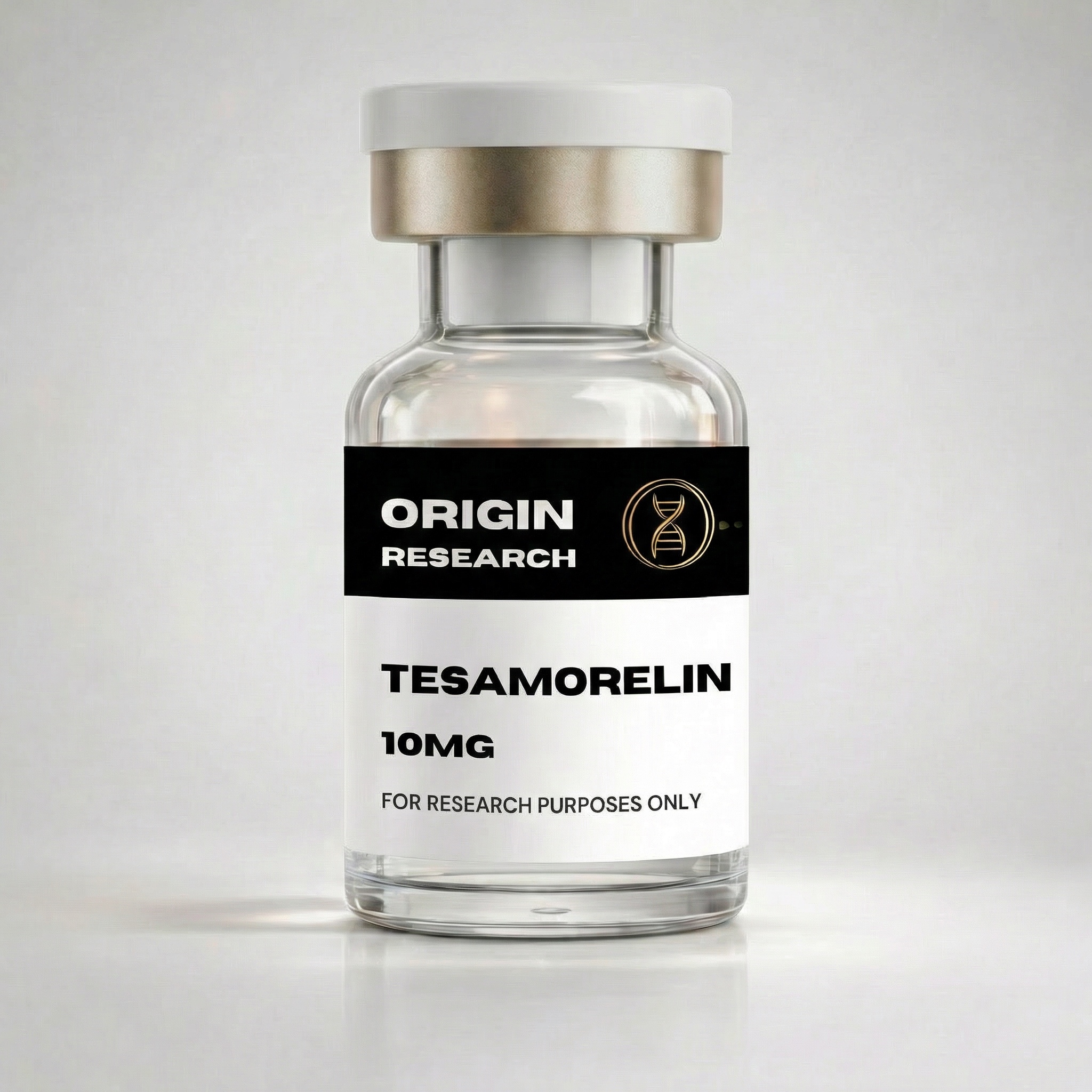
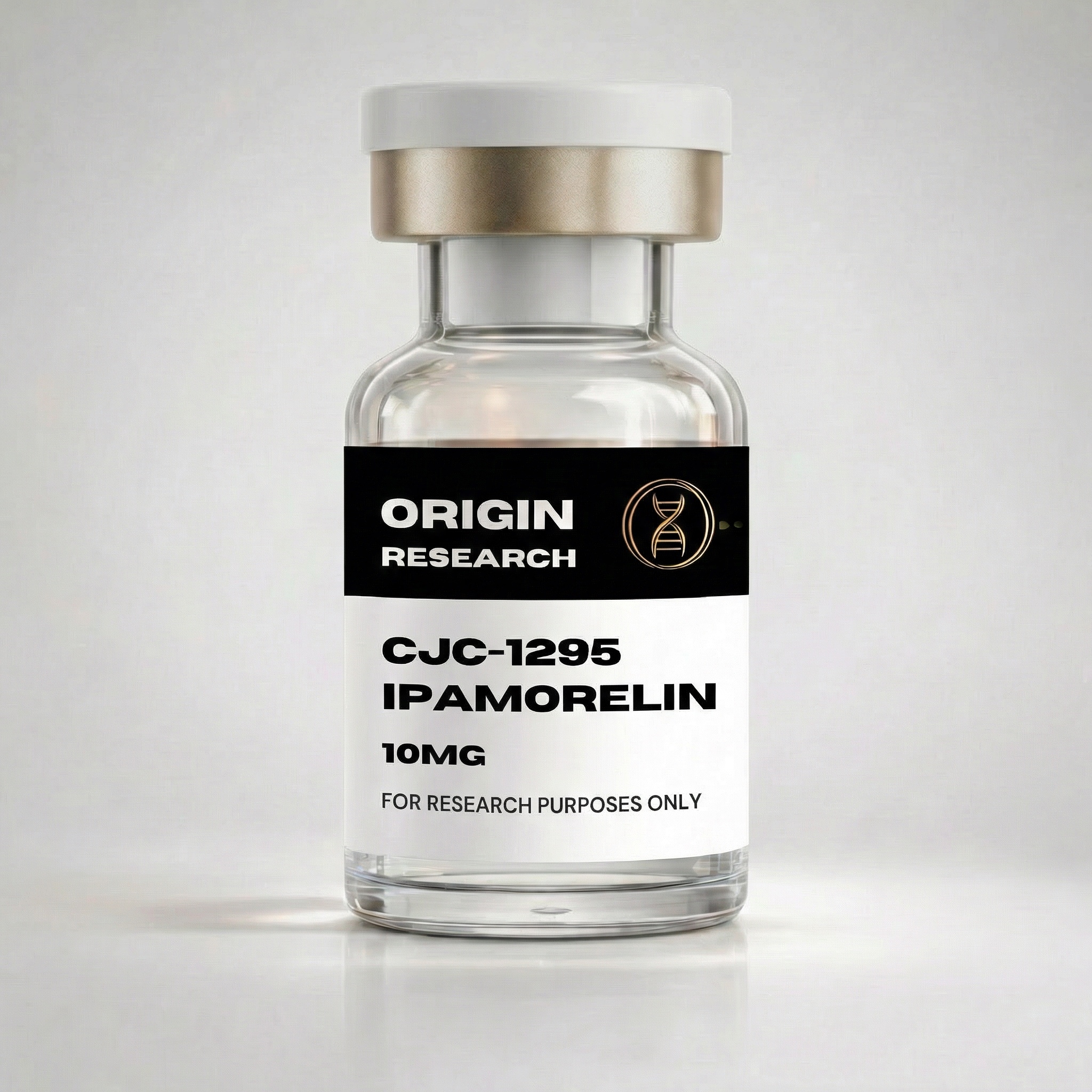
Tesamorelin and CJC-1295 with DAC are both engineered GHRH analogs designed to overcome the rapid DPP-IV-mediated clearance of native GHRH, and they represent two distinct chemical strategies for extending GHRH receptor activation in the somatotropic axis literature. Tesamorelin is a hexenoyl-modified GHRH 1-44 analog in which a trans-3-hexenoyl group is attached to the N-terminal tyrosine, conferring resistance to N-terminal protease cleavage and producing a half-life suitable for daily subcutaneous research dosing (Falutz et al., N Engl J Med, 2007, PMID 17634461). CJC-1295 with DAC is a tetra-substituted GHRH 1-29 conjugated to an albumin-binding drug affinity complex linker, producing a 6-8 day half-life via covalent serum albumin tethering (Teichman et al., J Clin Endocrinol Metab, 2006, PMID 16352683). Researchers compare them because both achieve sustained GHRH receptor activation but through fundamentally different engineering approaches and with different dosing-interval profiles. Tesamorelin has the deepest clinical-research dataset of any GHRH analog due to its FDA-approved indication for HIV-associated lipodystrophy and the multi-year visceral adipose tissue research surrounding that population. CJC-1295 with DAC dominates preclinical and exploratory research on weekly GHRH dosing. The comparison is most relevant for research groups investigating GHRH receptor pharmacology with daily-versus-weekly dosing trade-offs, or for laboratories selecting a GHRH backbone for stacked protocols with a ghrelin-receptor agonist.
Overview
Engineering strategy comparison
Tesamorelin and CJC-1295 with DAC solve the same problem (rapid GHRH degradation) through different chemistry. Tesamorelin retains the full 44-amino-acid native GHRH sequence and adds a single hexenoyl modification to the N-terminus, blocking DPP-IV access to the susceptible cleavage site. This minimalist approach preserves native receptor binding geometry while producing a half-life of approximately 26-38 minutes following subcutaneous administration, sufficient for once-daily dosing protocols (Falutz et al., N Engl J Med, 2007). CJC-1295 with DAC takes a more aggressive engineering approach: the peptide is truncated to GHRH 1-29, four residues are substituted to confer protease resistance throughout the sequence, and a maleimidopropionic acid drug affinity complex linker is attached to the C-terminal lysine. The DAC linker covalently bonds to cysteine-34 of circulating albumin, effectively tethering the peptide to an abundant 67-kDa carrier protein and dramatically extending plasma residence to 6-8 days (Teichman et al., J Clin Endocrinol Metab, 2006). The result is two compounds with overlapping pharmacology but very different dosing profiles. Tesamorelin produces a daily pulse-like elevation of GHRH receptor activation, while CJC-1295 with DAC produces tonic, continuous receptor exposure. Researchers selecting between them should consider whether the engineering strategy itself is relevant to the research question, since the hexenoyl modification preserves more of the native GHRH structural identity, while the DAC-albumin conjugation introduces a substantial pharmacology variable beyond receptor activation alone.
Research applications side by side
The two peptides occupy substantially different research literatures. Tesamorelin has the most extensive clinical-research dataset of any GHRH analog, anchored by phase 3 trials in HIV-associated lipodystrophy that reported visceral adipose tissue reduction measured by CT scan (Falutz et al., N Engl J Med, 2007). Follow-on research has examined hepatic steatosis endpoints, IGF-1 trajectories and cardiovascular surrogate markers in HIV cohorts and in non-HIV obesity research contexts (Stanley et al., JAMA, 2014, PMID 25160895). Tesamorelin is the only GHRH analog with regulatory approval in any indication, which has driven a clinical-research corpus that CJC-1295 with DAC lacks. CJC-1295 with DAC research is dominated by pharmacokinetic characterisation studies in healthy adult cohorts, with publications documenting GH and IGF-1 trajectories following single and repeated subcutaneous doses (Teichman et al., J Clin Endocrinol Metab, 2006; Ionescu and Frohman, J Clin Endocrinol Metab, 2006). It has been investigated heavily in preclinical animal models and in stacked-arm research designs combining GHRH and ghrelin-receptor agonist pharmacology. For researchers focused on visceral adipose tissue endpoints, hepatic IGF-1 production or any clinical-research context, Tesamorelin is the more cited reference compound. For studies on sustained GHRH receptor occupancy, weekly dosing schedules or experimental somatotropic axis pharmacology in animal models, CJC-1295 with DAC is the more commonly used tool. The two are occasionally compared head-to-head in pharmacokinetic-modelling research.
Pharmacokinetic and dosing-interval comparison
The dosing-interval difference between these two peptides is the most practically important distinction. Tesamorelin has been studied in human subcutaneous protocols at daily doses with consistent steady-state IGF-1 elevation reported across multi-week windows (Falutz et al., N Engl J Med, 2007). The 26-38 minute plasma half-life supports a daily-administration model that produces a pulse-like daily GH elevation followed by clearance, which has been interpreted in the literature as a more physiologically natural dosing pattern than tonic exposure. CJC-1295 with DAC, with its 6-8 day half-life, supports weekly or twice-weekly dosing protocols that produce sustained tonic GHRH receptor occupancy. The pharmacokinetic literature on CJC-1295 with DAC has reported elevated IGF-1 levels persisting for more than two weeks after a single dose, indicating that even with weekly dosing intervals, there is no return to baseline between administrations (Teichman et al., J Clin Endocrinol Metab, 2006). For research designs that require defined-window GHRH receptor activation followed by clearance for endpoint measurement, Tesamorelin is the appropriate compound because its dosing can be timed precisely against blood-draw windows. For designs that require continuous receptor exposure across multi-week observation periods, CJC-1295 with DAC reduces administration burden in animal protocols. Both are supplied lyophilised by originlabsresearch.com with global dispatch and lot-specific HPLC and mass spectrometry COA documentation. Researchers running comparison arms should standardise reconstitution, refrigeration and freeze-thaw protocols across both.
Side by side
| Tesamorelin | CJC-1295 | |
|---|---|---|
| Vial size | 10mg lyophilised | 5mg lyophilised |
| Peptide identity | Hexenoyl-modified GHRH 1-44 | Tetra-substituted GHRH 1-29 with DAC linker |
| Plasma half-life | Approximately 26-38 minutes | Approximately 6-8 days |
| Receptor target | GHRH receptor (class B GPCR) | GHRH receptor (class B GPCR) |
| Engineering strategy | N-terminal hexenoyl protection | Substitutions + albumin-binding DAC linker |
| Typical dosing interval studied | Daily SC | Weekly or twice-weekly SC |
| Clinical-research depth | Phase 3 trials, FDA-approved indication | Phase 1 PK studies, preclinical use |
| Primary research domain | Visceral adipose tissue, HIV-lipodystrophy, hepatic IGF-1 | Sustained GHRH activation, weekly dosing pharmacology |
| Dosing-interval profile | Daily pulse-like activation | Continuous tonic receptor occupancy |
| COA on file | HPLC and MS, global dispatch | HPLC and MS, global dispatch |
When researchers choose which
When researchers choose between Tesamorelin and CJC-1295 with DAC, the decision is shaped by three factors: dosing interval feasibility, research domain alignment and depth of available comparator literature. Tesamorelin is the appropriate compound for any research design that requires daily administration with defined-window GHRH receptor activation, particularly when visceral adipose tissue endpoints, hepatic IGF-1 production or HIV-cohort comparator data are relevant to the study. Its extensive clinical-research dataset makes it the only GHRH analog where investigators can reference phase 3 trial data for context, and its daily-dosing pulse-like exposure pattern is the closest engineered analog to native GHRH pulsatility while still being clinically practical. CJC-1295 with DAC is the appropriate selection for research designs that benefit from weekly or twice-weekly administration, sustained tonic receptor exposure across multi-week observation windows or extended pharmacokinetic characterisation work. Animal protocols where daily injection introduces handling-stress confounds often favour CJC-1295 with DAC for its reduced administration burden. Stacked-arm research with ghrelin-receptor agonists such as Ipamorelin is common with both peptides, although CJC-1295 with DAC is the more frequently paired GHRH backbone in tonic-stack designs and Tesamorelin is more commonly paired in daily-stack designs. Investigators comparing GHRH engineering strategies themselves (hexenoyl protection versus substitution-plus-DAC) sometimes run both in parallel to characterise pharmacology differences attributable to the chemistry. Both are supplied lyophilised by originlabsresearch.com with global dispatch and lot-specific COA documentation. Selection should always be matched to study-endpoint timing and dosing-interval feasibility.
Frequently asked questions
Which has more clinical-research data?
Tesamorelin has substantially more clinical-research data, anchored by phase 3 trials in HIV-associated lipodystrophy and follow-on visceral adipose tissue and hepatic steatosis research. CJC-1295 with DAC has a smaller, primarily pharmacokinetic-characterisation dataset and is more commonly used in preclinical animal research.
Can they be stacked with Ipamorelin?
Yes, both have been investigated in stacked research designs with the ghrelin-receptor agonist Ipamorelin. Originlabsresearch.com also stocks pre-blended Tesamorelin/Ipamorelin and CJC-1295/Ipamorelin combinations for stacked-arm protocols.
What other GHRH analogs does the catalog carry?
Originlabsresearch.com stocks Tesamorelin 10mg, CJC-1295 with DAC 5mg, CJC-1295 no DAC, Sermorelin 5mg and pre-blended CJC-1295/Ipamorelin and Tesamorelin/Ipamorelin combinations. All ship with HPLC and mass spectrometry COA documentation.
Does originlabsresearch.com ship both peptides worldwide?
Yes, both are dispatched from from global stock with tracked shipping. Both ship lyophilised at ambient temperature and should be transferred to -20C storage on arrival.
Is a certificate of analysis included with each vial?
Yes, every lot of Tesamorelin 10mg and CJC-1295 with DAC 5mg ships with lot-specific HPLC purity and mass spectrometry confirmation. COA documents are available on request prior to purchase.
Which is better suited to weekly-interval research?
CJC-1295 with DAC is engineered specifically for weekly or twice-weekly dosing intervals due to its 6-8 day half-life. Tesamorelin's shorter half-life requires daily administration to maintain steady-state receptor activation in published protocols.