
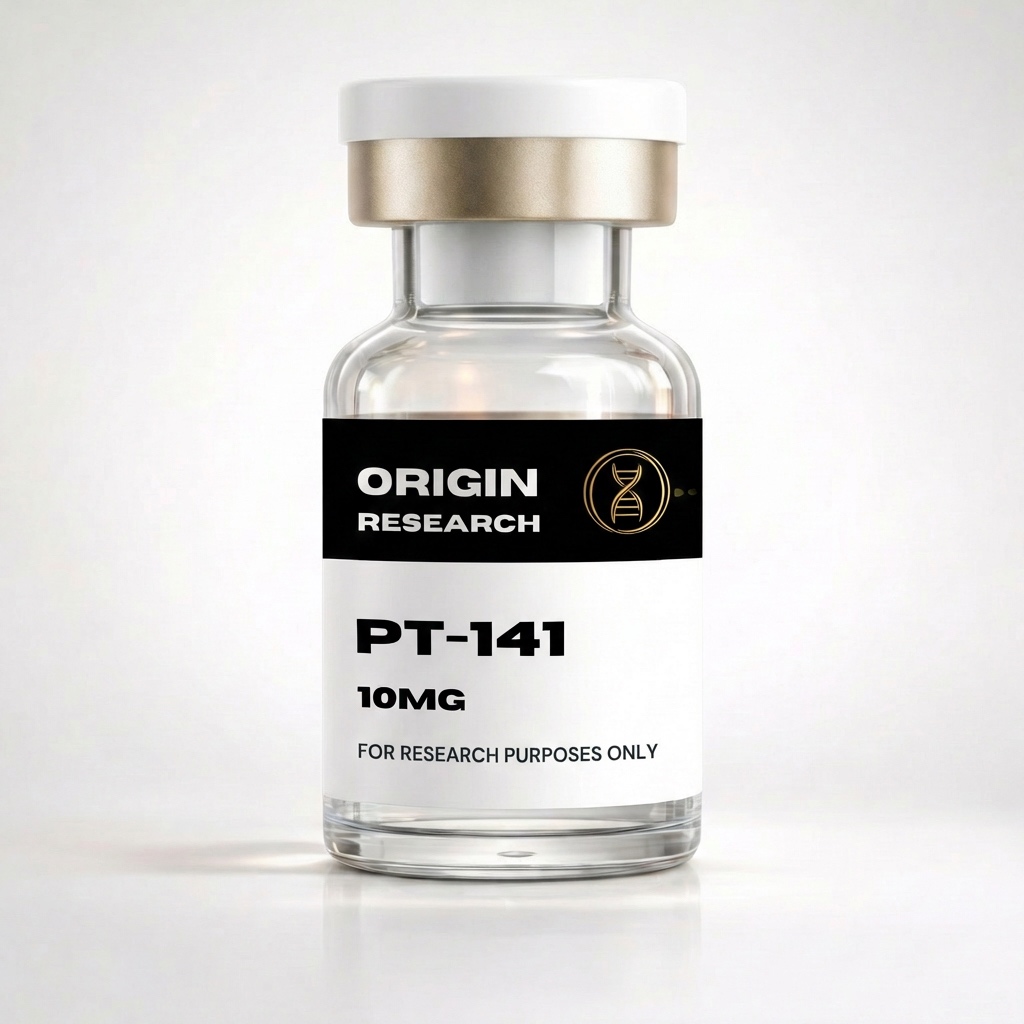
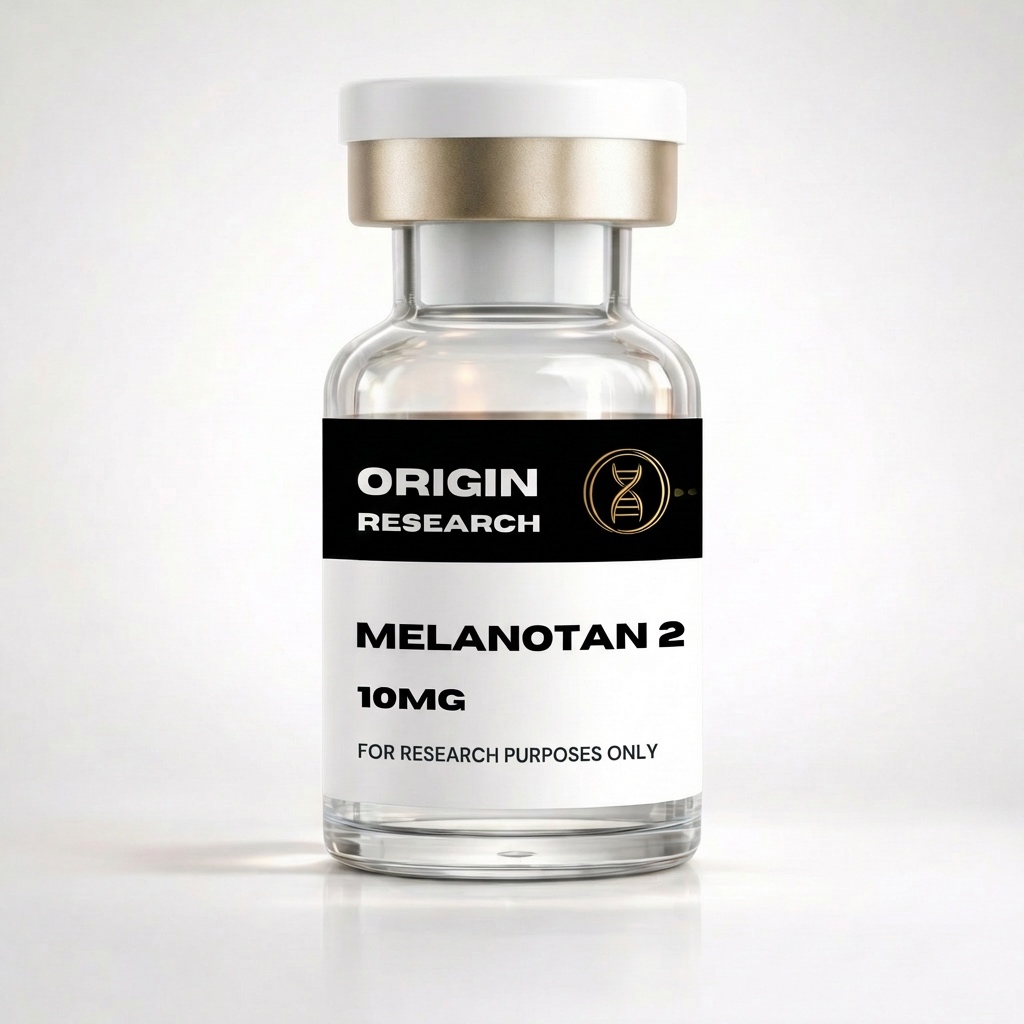
PT-141 and Melanotan II are two synthetic melanocortin agonist peptides with closely related sequences but distinct research applications. Both peptides are seven-residue cyclic melanocortin analogues derived from earlier research on alpha-MSH and the melanocortin receptor family, and they are frequently compared because they share much of the same backbone chemistry. The principal structural difference is at the C-terminus: PT-141, also known as bremelanotide, carries a free carboxylic acid (-OH) terminus, while Melanotan II carries an amidated (-NH2) terminus. That single distinction maps onto a meaningful divergence in published preclinical research applications. PT-141 has been investigated principally in CNS-pathway and melanocortin-4-receptor (MC4R) preclinical models, particularly in rodent studies relevant to central-nervous-system melanocortin signalling in animal models (Molinoff et al., Ann N Y Acad Sci 2003, PMID: 12860654). Melanotan II has been investigated principally in melanogenesis-pathway research, with rodent and cell-culture studies examining MC1R-mediated pigmentation signalling in research models (Dorr et al., Life Sci 1996, PMID: 8632717). This page is supplied for licensed laboratory professionals comparing the two for in vitro reference work. Neither peptide is authorized for human consumption, supplementation, or therapeutic use in any jurisdiction we serve. Materials supplied through originlabsresearch.com are sold strictly for in vitro research, reference standards, and analytical chemistry purposes.
Overview
Structural relationship between the two peptides
PT-141 and Melanotan II are best understood as a structural pair. Both are cyclic heptapeptide analogues of the melanocortin-active core of alpha-MSH, sharing the His-D-Phe-Arg-Trp pharmacophore that has been characterized in melanocortin-receptor literature as essential for receptor binding (Hruby et al., J Med Chem 1987, PMID: 3027339). The cyclic constraint, introduced through a lactam bridge between specific side chains, increases peptide stability and receptor selectivity. The single most important difference between the two peptides is the C-terminal modification. Melanotan II terminates in an amide group (-NH2), while PT-141 terminates in a free carboxylic acid (-OH). PT-141 is sometimes described in the published literature as the C-terminal de-amidated metabolite of Melanotan II, and indeed PT-141 was developed after research observed the metabolic conversion of Melanotan II in animal models. That structural relationship matters because it shifts receptor-binding profile and tissue distribution in research systems. The difference appears small on paper but is significant in the published preclinical literature, where the two peptides are associated with separate research fields. Investigators evaluating either peptide as a reference standard should be aware that even though the sequences look almost identical in catalog descriptions, the C-terminal chemistry distinguishes them sufficiently that they should be treated as separate compounds with separate primary references.
Distinct preclinical research applications
Despite their shared melanocortin-agonist scaffold, PT-141 and Melanotan II appear in different sections of the published preclinical literature. PT-141 has been investigated principally in CNS-pathway preclinical research, with rodent studies examining central melanocortin signalling and MC4R-related circuits (Molinoff et al., Ann N Y Acad Sci 2003, PMID: 12860654). The compound has been studied in CNS-research literature relevant to central melanocortin pathway investigations in animal models, and is most commonly cited in MC4R-pathway research. Melanotan II has been investigated principally in melanogenesis-pathway research. Published rodent and cell-culture work has examined Melanotan II in MC1R-mediated pigmentation signalling, with studies in melanocyte cultures and in dermal-research preclinical models (Dorr et al., Life Sci 1996, PMID: 8632717; Hadley and Dorr, Peptides 2006, PMID: 16019104). Melanotan II is also cited in broader melanocortin-receptor literature because of its agonist activity across multiple receptor subtypes in research models. The literatures intersect at the molecular level (both peptides engage melanocortin receptors) but diverge in their primary research framing. A reference-standard purchaser should consult the primary publications associated with the specific research question rather than assume that the two peptides are interchangeable in pathway-focused study designs.
Reference-standard handling and analytical considerations
Both peptides are supplied as lyophilized reference material and follow standard short-peptide handling conventions. Reconstitution with sterile or bacteriostatic water is conventional, with aliquoting recommended to avoid repeated freeze-thaw cycles. The cyclic structure of both peptides gives them improved stability relative to linear melanocortin analogues, but storage at -20 degrees Celsius for long-term reference stocks remains the convention. Mass spectrometry identity confirmation is essential for both peptides, because the C-terminal modification difference is the principal way to distinguish them analytically. The mass difference between the -OH and -NH2 terminal forms is small but detectable by accurate-mass spectrometry, and reference-standard quality-control workflows must confirm the correct terminal form for the labelled product. HPLC purity records are included on the certificate of analysis, and investigators may also see UV-spectrum data for the tryptophan-containing core. Reconstituted solution colour is generally pale or clear for both peptides. None of the handling guidance presented here is medical instruction. The peptides are not authorized for human consumption, supplementation, or therapeutic use in any jurisdiction we serve, and these notes describe standard laboratory practice for in vitro reference work as reported in the cited primary literature.
Side by side
| PT-141 | Melanotan II | |
|---|---|---|
| Compound class | Cyclic heptapeptide melanocortin agonist | Cyclic heptapeptide melanocortin agonist |
| C-terminal group | Free carboxylic acid (-OH) | Amide (-NH2) |
| Relationship | C-terminal de-amidated form | Parent amidated compound |
| Vial size | 10mg | 10mg |
| Primary research field | CNS-pathway and MC4R research | Melanogenesis and MC1R research |
| Foundational citation | Molinoff et al., Ann N Y Acad Sci 2003 | Dorr et al., Life Sci 1996 |
| Shared pharmacophore | His-D-Phe-Arg-Trp core | His-D-Phe-Arg-Trp core |
| Analytical distinction | Mass spectrometry C-terminal verification | Mass spectrometry C-terminal verification |
| Status | In vitro research reference only | In vitro research reference only |
When researchers choose which
When investigators choose between PT-141 and Melanotan II as reference standards, the decision hinges on which receptor subtype and which research field the planned protocol engages. Research groups working on MC4R-related preclinical models, central melanocortin signalling in animal models, or CNS-pathway rodent studies have generally turned to PT-141, because the literature associated with bremelanotide is concentrated in those areas. The free C-terminal carboxylic acid form is the structure referenced in that body of work, and a protocol designed around PT-141 specifically requires PT-141 rather than its amidated analogue. Research groups working on melanogenesis-pathway research, MC1R-mediated cell-culture assays, melanocyte studies, or dermal-pigmentation preclinical models have generally turned to Melanotan II, because the published literature for those applications is built around the amidated form. A second consideration is analytical traceability. Because the two peptides differ only in their C-terminal group, careful mass spectrometry verification is essential for quality control. Laboratories with rigorous mass-spectrometry workflows can confidently distinguish the two reference standards. Investigators without that capability should rely on certificate-of-analysis documentation from the supplier. Neither peptide is authorized for human consumption, supplementation, or therapeutic use in any jurisdiction we serve, and selection should be guided exclusively by the published preclinical literature relevant to the receptor subtype under investigation. The two peptides are structurally close but are not interchangeable in protocol design.
Frequently asked questions
How are PT-141 and Melanotan II structurally related?
Both are cyclic heptapeptide melanocortin agonists sharing the same His-D-Phe-Arg-Trp pharmacophore. The principal difference is at the C-terminus: PT-141 carries a free carboxylic acid (-OH), while Melanotan II carries an amide (-NH2). PT-141 has been described in published literature as the C-terminal de-amidated form of Melanotan II.
Are they studied for the same purposes?
No. PT-141 has been investigated principally in CNS-pathway and MC4R-related preclinical research, while Melanotan II has been investigated principally in melanogenesis-pathway and MC1R-related preclinical research. The literatures overlap at the receptor level but diverge in application.
Are these peptides authorized for human use?
No. Both are supplied strictly as in vitro research reference standards. Neither is authorized for human consumption, supplementation, or therapeutic use in any jurisdiction we serve.
How are the two peptides distinguished analytically?
Mass spectrometry is the principal analytical method for distinguishing the two. The mass difference between the -OH and -NH2 terminal forms is small but detectable, and reference-standard quality control confirms the correct terminal form for each labelled product.
Where can I read the foundational research?
PT-141 is referenced in Molinoff et al., Ann N Y Acad Sci 2003 (PMID: 12860654). Melanotan II is referenced in Dorr et al., Life Sci 1996 (PMID: 8632717) and Hadley and Dorr, Peptides 2006 (PMID: 16019104). The shared pharmacophore is discussed in Hruby et al., J Med Chem 1987 (PMID: 3027339).
Can one peptide substitute for the other in a melanocortin protocol?
Not without careful review of the primary literature. The C-terminal modification shifts the receptor profile and the tissue distribution in research models. Protocols designed around one peptide should not be transferred to the other without consulting the original publications.