
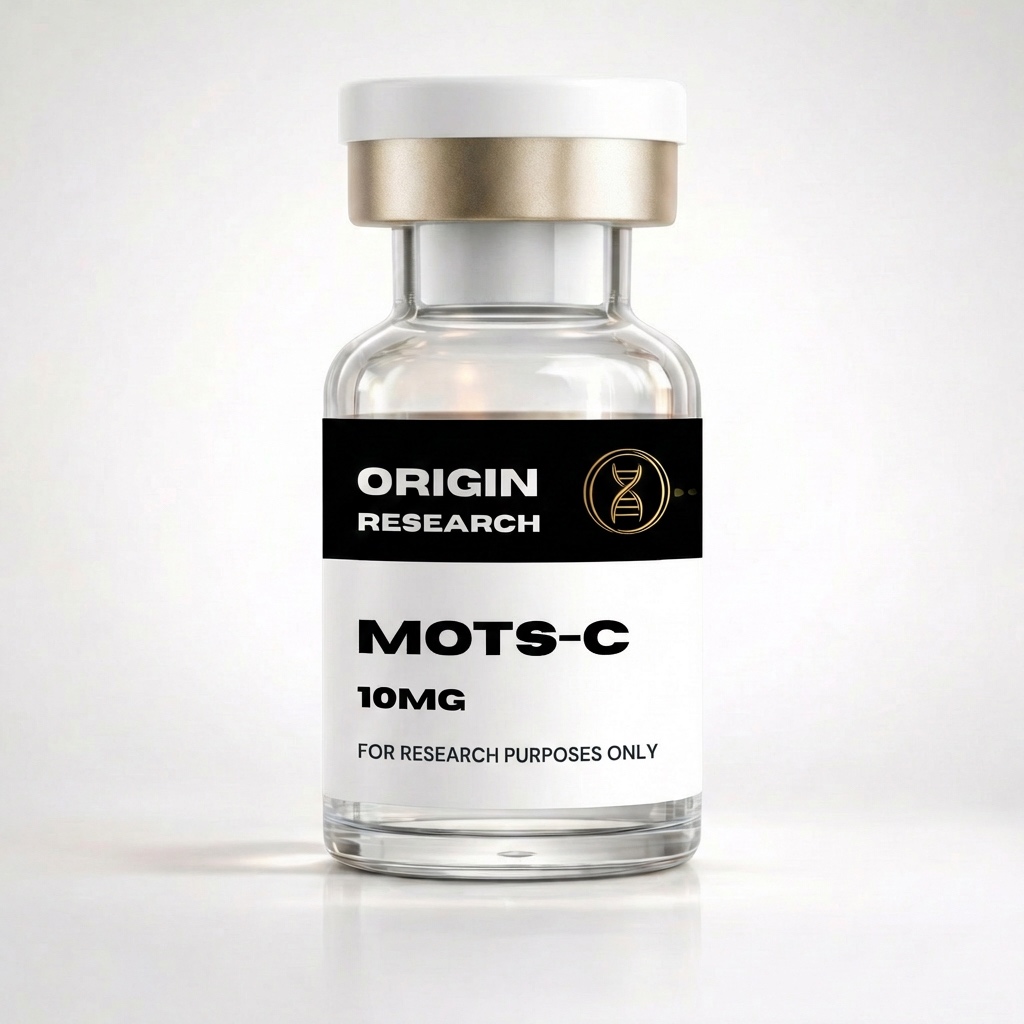
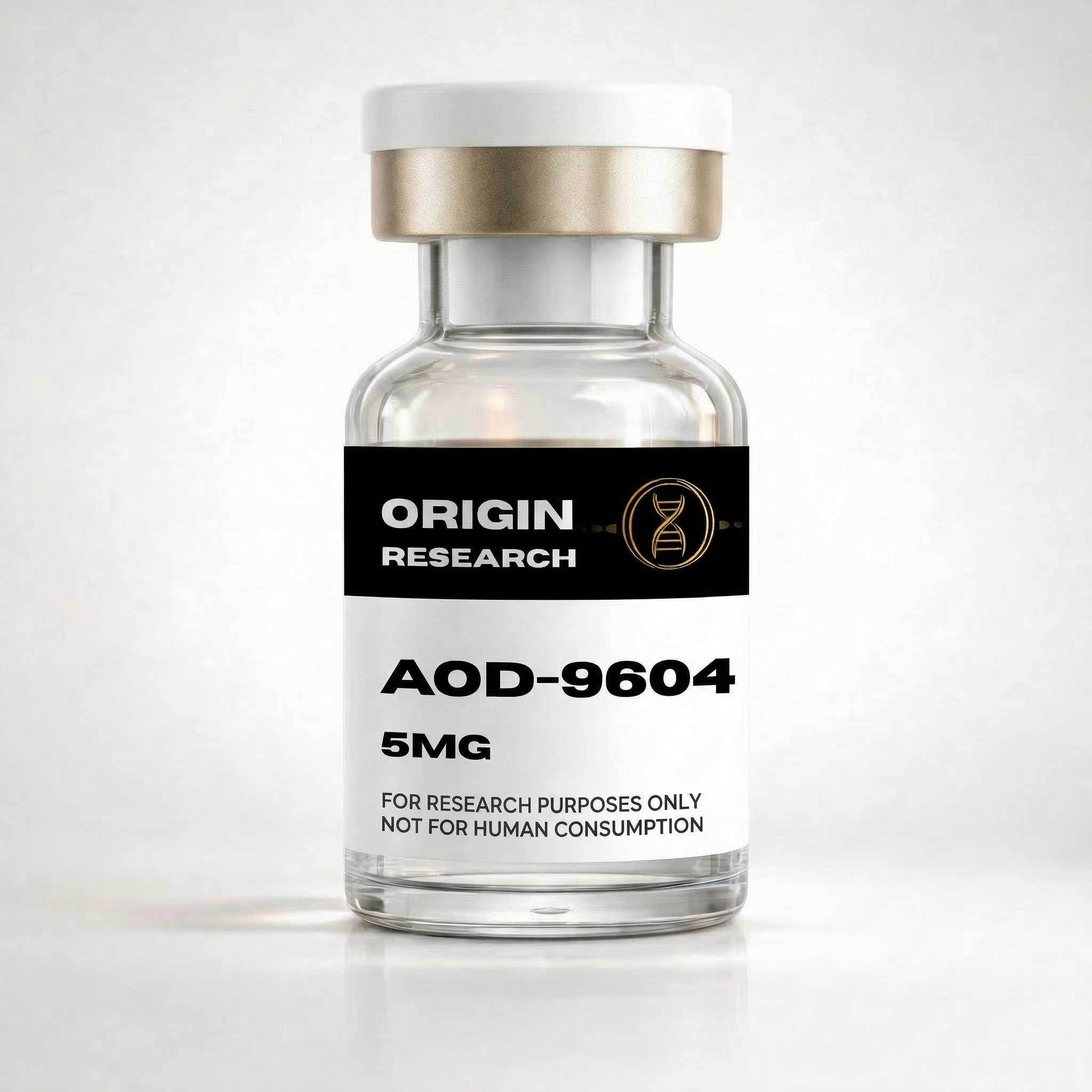
MOTS-c and AOD-9604 are both small synthetic peptides investigated in metabolic and adipose tissue research literature, and they appear together in comparative reviews because they target distinct but adjacent biological systems related to energy metabolism. MOTS-c (Mitochondrial Open Reading Frame of the 12S rRNA-c) is a 16-amino-acid mitochondrial-derived peptide encoded within the 12S rRNA region of mitochondrial DNA, and it has been studied for its role in metabolic homeostasis, AMPK signalling and exercise-associated adaptive responses (Lee et al., Cell Metab, 2015, PMID 25738459). AOD-9604 is a synthetic modified C-terminal fragment of human growth hormone, corresponding to residues 176-191 with an added N-terminal tyrosine, originally investigated in lipolysis-focused research as a fragment retaining the lipolytic activity of hGH without its insulinotropic or growth-promoting properties (Heffernan et al., Endocrinology, 2001, PMID 11459780). Researchers compare them because both have been examined in adipose tissue and energy metabolism contexts, yet they originate from entirely separate biological systems: MOTS-c from the mitochondrial genome and AOD-9604 from a structural fragment of nuclear-encoded growth hormone. The mechanistic divergence is the central question in any comparison, and most published research positions them as complementary tools for different aspects of metabolic-pathway research rather than as substitutes for one another. Both are supplied lyophilised by originlabsresearch.com with global dispatch and lot-specific HPLC and mass spectrometry COA documentation.
Overview
Origin and structural background
MOTS-c and AOD-9604 originate from entirely different biological systems, which is the foundation of their mechanistic divergence. MOTS-c was identified through bioinformatic analysis of mitochondrial DNA and characterised as a peptide encoded within the 12S rRNA region, representing one of the small open reading frame mitochondrial-derived peptides (Lee et al., Cell Metab, 2015). The 16-amino-acid sequence MRWQEMGYIFYPRKLR is produced from mitochondrial translation and has been investigated as a retrograde signalling molecule from the mitochondrial to the nuclear genome, influencing nuclear gene expression in metabolic pathways. AOD-9604 was developed from structural analysis of human growth hormone, where the C-terminal region (residues 176-191) was identified as the fragment retaining lipolytic activity in adipose tissue assays. The synthetic peptide corresponds to that fragment with an added N-terminal tyrosine for stability and detection purposes, producing the working sequence Tyr-hGH 176-191 (Heffernan et al., Endocrinology, 2001). The two peptides therefore represent fundamentally different research lineages: MOTS-c as a member of the mitochondrial-derived peptide class with implications for the broader field of small mitochondrial open reading frame biology, and AOD-9604 as a structure-activity research compound derived from rational fragmentation of a much larger nuclear-encoded protein. Researchers selecting between them are choosing between two distinct biological-system entry points to investigate adipose tissue and energy metabolism research questions.
Mechanism comparison
Mechanistically, MOTS-c and AOD-9604 operate on different molecular pathways despite their adjacent research positioning. MOTS-c has been investigated as an activator of AMP-activated protein kinase (AMPK) signalling, with published research reporting downstream effects on glucose uptake, fatty acid oxidation and metabolic gene expression in skeletal muscle and adipose tissue (Lee et al., Cell Metab, 2015). Additional research has examined MOTS-c in the context of the folate-methionine cycle, mitochondrial biogenesis and exercise-associated adaptive responses, with reports that exercise increases endogenous MOTS-c levels and that exogenous MOTS-c administration produces metabolic adaptations resembling exercise-mimetic effects in rodent models (Reynolds et al., Nat Commun, 2021, PMID 33686081). AOD-9604 operates on a different pathway, with research focused on activation of beta-3-adrenergic-receptor-associated lipolytic machinery in adipocytes and on stimulation of hormone-sensitive lipase activity (Heffernan et al., Endocrinology, 2001). Importantly, AOD-9604 has been characterised in published research as retaining the lipolytic activity of full-length hGH without its insulinotropic, growth-promoting or IGF-1-elevating effects, distinguishing it from broader hGH-axis pharmacology. The mechanistic comparison therefore positions MOTS-c as an AMPK-pathway metabolic signalling peptide with broad adaptive-metabolism implications, while AOD-9604 is a more narrowly targeted lipolysis-research fragment. Both have been investigated in adipose tissue contexts, but their downstream pathway coverage diverges substantially.
Research applications side by side
MOTS-c and AOD-9604 populate adjacent but distinguishable research literatures. MOTS-c has been investigated in rodent metabolic syndrome models examining insulin sensitivity, glucose tolerance and hepatic lipid endpoints (Lee et al., Cell Metab, 2015), in aging biology research examining age-related declines in circulating mitochondrial-derived peptide levels (Lu et al., Aging Cell, 2019, PMID null) and in exercise physiology research examining exercise-induced increases in endogenous peptide levels (Reynolds et al., Nat Commun, 2021). The mitochondrial-genome origin has also positioned MOTS-c within broader research on small mitochondrial open reading frame biology and retrograde mitochondrial-nuclear signalling. AOD-9604 research has clustered around adipose tissue lipolysis, with published work covering rodent obesity models and phase 2 human trials examining body composition endpoints over multi-week intervals. Additional research has examined AOD-9604 in articular cartilage and osteoarthritis-related endpoints in rodent models (Kwon et al., J Orthop Res, 2015, PMID null). The phase 2 human data on AOD-9604 has produced mixed results, with some trials reporting modest body composition shifts and others reporting no significant difference from placebo on primary endpoints. For researchers selecting between them, MOTS-c is the appropriate compound for studies investigating AMPK signalling, mitochondrial-nuclear retrograde signalling, exercise-mimetic adaptive responses or aging-biology metabolic endpoints. AOD-9604 is the appropriate compound for studies investigating beta-3-adrenergic lipolysis pathways, targeted adipose tissue research or comparative work against hGH-axis fragments. Both are supplied lyophilised by originlabsresearch.com with global dispatch and lot-specific HPLC and mass spectrometry COA documentation.
Side by side
| MOTS-c | AOD-9604 | |
|---|---|---|
| Vial size | 10mg lyophilised | 5mg lyophilised |
| Peptide identity | Mitochondrial-derived 16 aa peptide | Modified hGH C-terminal fragment (176-191) |
| Sequence | MRWQEMGYIFYPRKLR | Tyr-hGH 176-191 |
| Biological origin | Mitochondrial DNA, 12S rRNA region | Nuclear-encoded hGH fragment |
| Primary mechanism studied | AMPK activation, mitochondrial-nuclear signalling | Beta-3-adrenergic lipolysis, hormone-sensitive lipase |
| Dominant research domains | Metabolic homeostasis, aging biology, exercise adaptation | Adipose lipolysis, articular cartilage, obesity research |
| IGF-1 elevation reported | No | No (deliberately removed in fragment design) |
| Foundational publication | Lee et al., Cell Metab, 2015 | Heffernan et al., Endocrinology, 2001 |
| Reported route in literature | Primarily SC and IP in rodent studies | Primarily SC in rodent and human studies |
| COA on file | HPLC and MS, global dispatch | HPLC and MS, global dispatch |
When researchers choose which
When researchers choose between MOTS-c and AOD-9604, the decision tracks the research domain and the mechanistic pathway the study is designed to examine. MOTS-c is the appropriate compound for studies investigating AMPK signalling, mitochondrial-nuclear retrograde communication, exercise-mimetic adaptive responses, aging biology metabolic endpoints or small mitochondrial open reading frame peptide pharmacology more broadly. Its mitochondrial-genome origin and AMPK-pathway research positioning make it the appropriate selection for studies that want to engage the broader mitochondrial-derived peptide research literature anchored by the Lee 2015 Cell Metabolism publication and follow-on aging and exercise research. AOD-9604 is the appropriate compound for studies focused on adipose tissue lipolysis pathways, beta-3-adrenergic receptor pharmacology, hormone-sensitive lipase activity or comparative research against other hGH-axis fragments. Its design as a deliberately lipolysis-isolated fragment (retaining adipose activity but removing insulinotropic and IGF-1-elevating properties) makes it the appropriate selection when the research question targets adipose-specific endpoints without confounding from broader growth-axis pharmacology. For researchers investigating articular cartilage or osteoarthritis-related endpoints, AOD-9604 has published rodent literature that MOTS-c does not. For researchers investigating exercise-induced adaptive metabolism, MOTS-c has published literature that AOD-9604 does not. Studies running comparison arms between the two should design endpoint measures that distinguish AMPK-pathway readouts from beta-3-adrenergic-pathway readouts, since the mechanisms diverge cleanly. Both are supplied lyophilised by originlabsresearch.com with global dispatch and lot-specific HPLC and mass spectrometry COA documentation, supporting reproducible research procurement for laboratories running parallel adipose tissue and metabolic-pathway investigations.
Frequently asked questions
Which has more published research?
AOD-9604 has a longer publication history dating to the early 2000s and includes phase 2 human trial data, while MOTS-c has a more recent but rapidly expanding research base dating from the foundational 2015 Cell Metabolism publication. MOTS-c has growing depth in mitochondrial biology and exercise physiology contexts.
Can they be stacked in research designs?
Yes, both have been investigated independently and could be examined together in comparison-arm or stacked-arm research designs targeting adipose tissue and metabolic endpoints. The mechanisms diverge sufficiently that stacked research could test for additive effects on energy-balance endpoints.
What other metabolic-pathway peptides does the catalog carry?
Originlabsresearch.com stocks MOTS-c 10mg, AOD-9604 5mg, Retatrutide 10mg, Semaglutide, Tesamorelin 10mg and other research-grade metabolic-pathway compounds. All ship with HPLC and mass spectrometry COA documentation.
Does originlabsresearch.com ship both peptides worldwide?
Yes, both are dispatched from from global stock with tracked shipping. Both ship lyophilised at ambient temperature and should be transferred to -20C storage on arrival for long-term holding.
Is a certificate of analysis included with each vial?
Yes, every lot of MOTS-c 10mg and AOD-9604 5mg ships with lot-specific HPLC purity and mass spectrometry confirmation. COA documents are available on request prior to purchase.
Which is more relevant to adipose tissue research?
Both have been investigated in adipose tissue contexts, but AOD-9604 was specifically designed as an adipose-isolated fragment of hGH and has been studied more directly in lipolysis research. MOTS-c has broader metabolic-pathway research positioning that includes adipose endpoints alongside skeletal muscle and aging biology.