
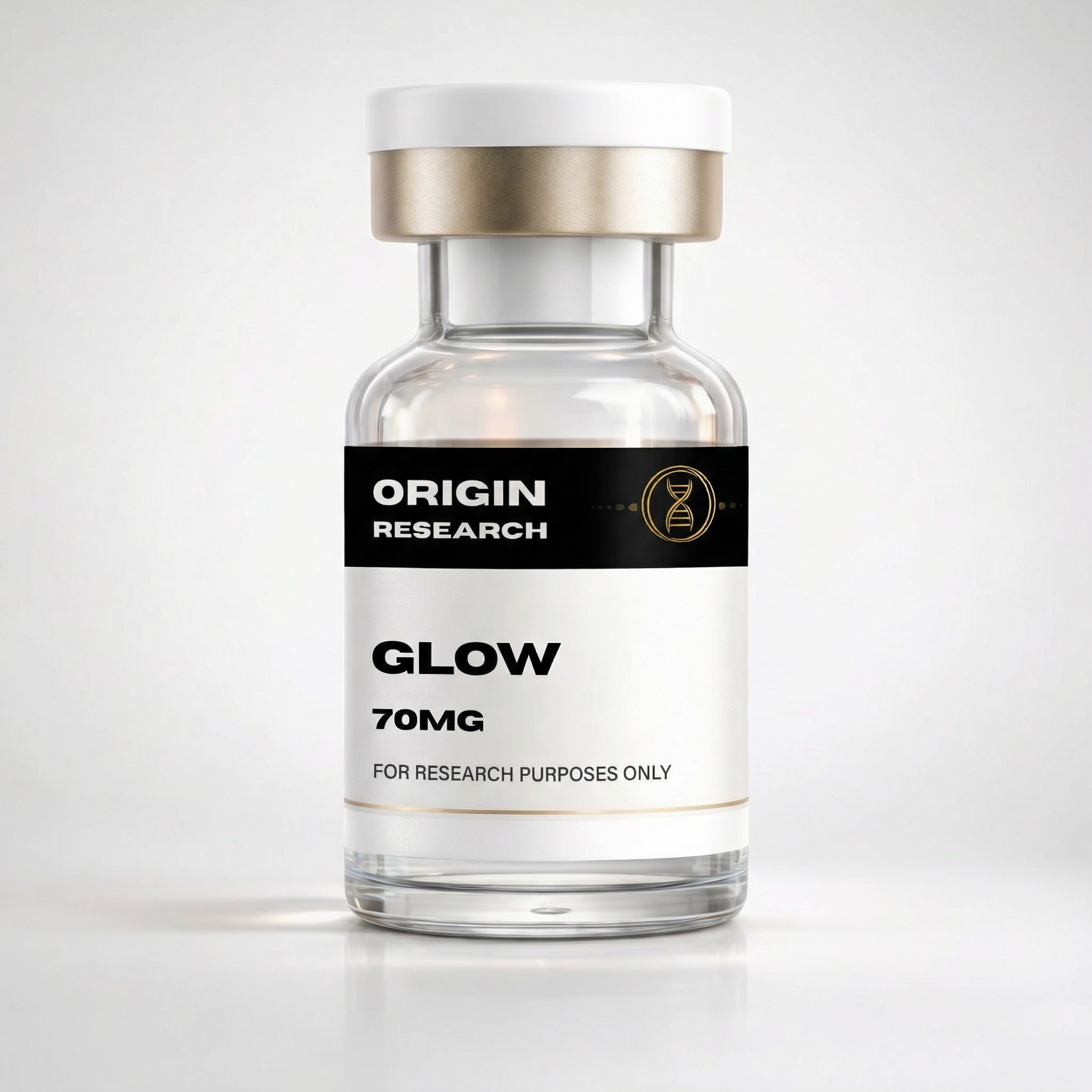
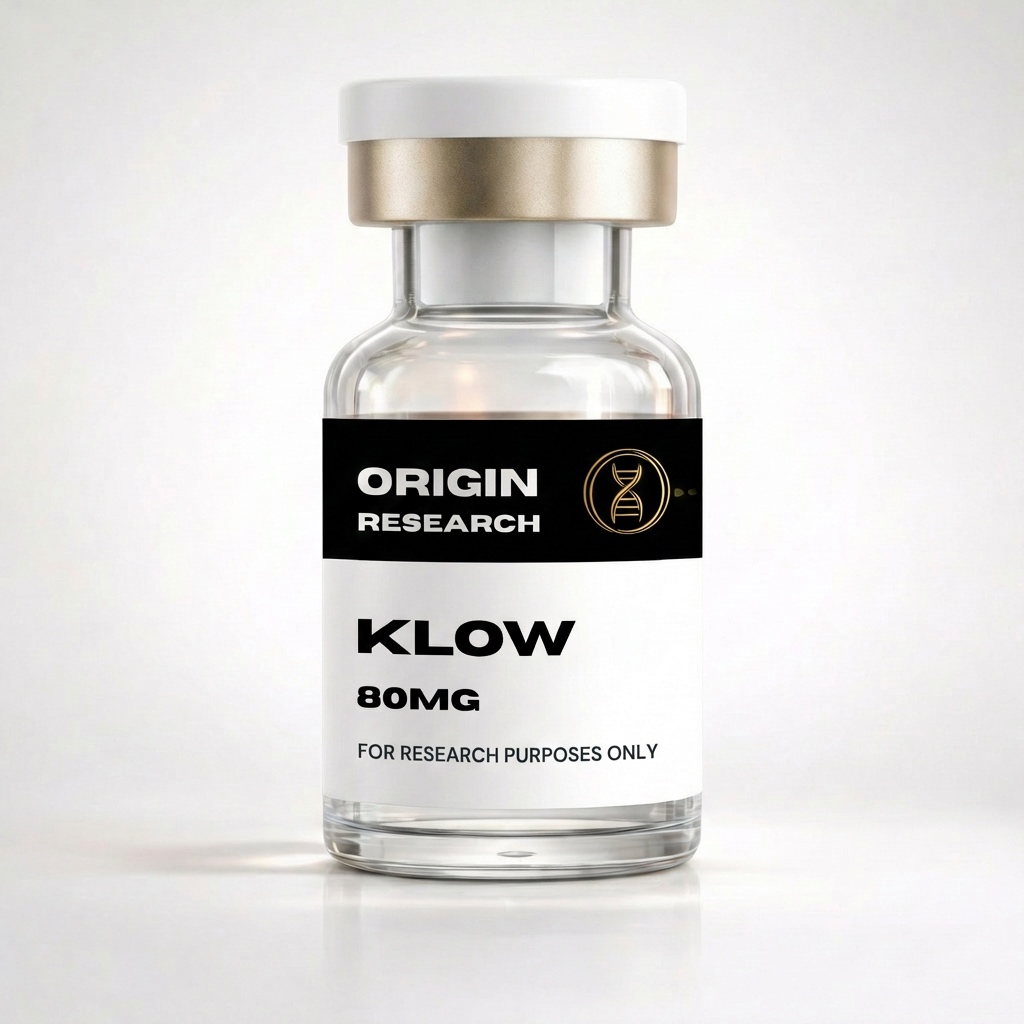
GLOW Stack and KLOW Stack are two pre-blended laboratory reference compositions supplied for in vitro research and reference-standard work, frequently encountered in the same dermal-research and tissue-repair literature reading lists. GLOW combines three peptides that have been studied independently in published preclinical work: GHK-Cu, a copper tripeptide investigated in dermal-research and collagen-pathway studies (Pickart et al., Biomed Res Int 2015, PMID: 26236731); BPC-157, a 15-amino-acid pentadecapeptide examined in gastric and tissue-repair preclinical models (Sikiric et al., Curr Pharm Des 2018, PMID: 29278206); and TB-500, the synthetic actin-binding fragment derived from thymosin beta-4 studied in tissue-repair literature (Goldstein et al., Ann N Y Acad Sci 2012, PMID: 22950500). KLOW takes that same three-peptide GLOW composition and adds KPV, the lysine-proline-valine tripeptide fragment of alpha-MSH that has been investigated in epithelial-research and inflammation-pathway models (Brzoska et al., Endocr Rev 2008, PMID: 18638709). The result is a four-peptide reference blend rather than three. Investigators usually compare the two because the practical question is whether a project benefits from the additional KPV chemistry or whether the three-peptide GLOW format is sufficient for the planned in vitro work. This page is supplied for licensed laboratory professionals reviewing the literature for either composition. Neither blend is authorized for human consumption, supplementation, or therapeutic use in any jurisdiction we serve. Materials supplied through originlabsresearch.com are sold strictly for in vitro research, reference standards, and analytical chemistry. Investigators should consult the primary literature for each component peptide before designing a protocol involving either blend.
Overview
Composition and chemistry of each blend
GLOW Stack contains three peptides with distinct chemistries. GHK-Cu is a copper-bound tripeptide (glycyl-histidyl-lysine) studied in dermal-research and collagen-pathway literature (Pickart et al., Biomed Res Int 2015, PMID: 26236731). BPC-157 is a 15-residue synthetic pentadecapeptide derived from a partial sequence of body protection compound and examined in gastric-mucosa and tendon-repair preclinical models (Sikiric et al., Curr Pharm Des 2018, PMID: 29278206). TB-500 is a synthetic peptide corresponding to the actin-binding region of thymosin beta-4 and has been investigated in tissue-repair and angiogenesis-pathway research (Goldstein et al., Ann N Y Acad Sci 2012, PMID: 22950500). KLOW Stack contains all three of those plus KPV, a three-residue lysine-proline-valine tripeptide that has been characterized in epithelial and inflammation-pathway models. KPV is the C-terminal fragment of alpha-melanocyte-stimulating hormone (alpha-MSH) and has been investigated as a melanocortin-pathway derivative without the pigmentation activity associated with longer melanocortin peptides (Brzoska et al., Endocr Rev 2008, PMID: 18638709). The compositional difference is therefore not a substitution but an addition: KLOW is GLOW plus KPV, supplied at a slightly higher total peptide mass per vial to accommodate the additional component.
Published preclinical research overlap
All four peptides have been studied in adjacent areas of preclinical research, which is why they appear together in reference-standard blends. GHK-Cu has been investigated in dermal-fibroblast cultures and in skin-research models for collagen-pathway, hair-follicle, and copper-transport research (Pickart et al., Biomed Res Int 2015, PMID: 26236731). BPC-157 has been examined across a sizeable preclinical literature covering gastric mucosa, ligament and tendon repair models, and angiogenesis research in rodents (Sikiric et al., Curr Pharm Des 2018, PMID: 29278206). TB-500 has been investigated in cardiac-repair, dermal-wound, and corneal-repair preclinical models, with mechanistic work centred on G-actin sequestration (Goldstein et al., Ann N Y Acad Sci 2012, PMID: 22950500). KPV has been studied in epithelial and gastrointestinal inflammation-pathway models, including IBD-research rodent systems (Dalmasso et al., Gastroenterology 2008, PMID: 18164316). The fact that these literatures intersect in dermal, gastrointestinal, and tissue-repair research is why investigators reading across the field sometimes evaluate pre-blended reference standards. The blends do not represent a single tested combination in published clinical literature; they are supplied as laboratory reference compositions only. Researchers should treat the primary literature for each component as the starting point and avoid extrapolating from single-peptide data to combined reference behaviour without performing the appropriate controls.
Reference-standard handling and quality considerations
Both blends are supplied as lyophilized peptide reference material and follow the same general laboratory handling conventions as their component peptides. Reconstitution is typically performed with sterile or bacteriostatic water, with aliquoting recommended to avoid repeated freeze-thaw cycles that can degrade peptide integrity. GHK-Cu, as a copper-coordinated peptide, has its own pH and stability considerations that are documented in the dermal-research literature and that should be considered when reconstituting any blend containing it. Quality control for blends is more involved than for single peptides because identity and purity must be confirmed for each component. Laboratories purchasing these reference standards typically request mass spectrometry data and composition records as part of the certificate of analysis. KLOW, with its additional KPV component, has a slightly different total composition profile and a higher total peptide mass per vial, which should be considered when calculating working concentrations. None of this guidance is medical instruction. The blends are not authorized for human consumption, supplementation, or therapeutic use, and the handling notes provided here describe standard laboratory practice for in vitro reference work as reported in the cited primary literature.
Side by side
| GLOW Stack (GHK-Cu, BPC-157, TB-500) | KLOW Stack (GHK-Cu, BPC-157, TB-500, KPV) | |
|---|---|---|
| Composition | GHK-Cu + BPC-157 + TB-500 | GHK-Cu + BPC-157 + TB-500 + KPV |
| Number of peptides | 3 | 4 |
| Vial size | 70mg total | 80mg total |
| Added component | Not applicable | KPV (Lys-Pro-Val) |
| KPV background | Not present | C-terminal fragment of alpha-MSH |
| Primary research fields | Dermal, tissue-repair, angiogenesis-pathway | Dermal, tissue-repair, epithelial inflammation-pathway |
| Foundational references | Pickart 2015; Sikiric 2018; Goldstein 2012 | Pickart 2015; Sikiric 2018; Goldstein 2012; Brzoska 2008 |
| Reconstitution | Sterile or bacteriostatic water | Sterile or bacteriostatic water |
| Status | In vitro research reference only | In vitro research reference only |
When researchers choose which
When investigators choose between GLOW and KLOW reference compositions, the practical question is whether their planned in vitro work calls for the additional KPV chemistry. Research groups working on dermal-fibroblast cultures, collagen-pathway studies, or tissue-repair cellular models often turn first to GLOW, because the three component peptides are documented in literatures that overlap most directly with skin-research and connective-tissue protocols. The vial format is supplied for laboratories that prefer to handle a single reference standard rather than reconstituting GHK-Cu, BPC-157, and TB-500 separately. Research groups whose protocols extend into epithelial-inflammation models, gastrointestinal-research cell systems, or melanocortin-derivative reference work have sometimes selected KLOW, because the inclusion of KPV brings a fourth chemistry into the same vial. KPV has been studied in inflammation-pathway models and gives investigators a single reference standard that spans both the dermal-tissue-repair literature of GLOW and the epithelial-inflammation literature associated with KPV. Neither blend should be regarded as a tested clinical combination; both are laboratory reference compositions, and investigators must read the primary literature for each component before designing studies. Selection should also account for the higher total peptide mass in KLOW, which affects working-concentration calculations. Neither blend is authorized for human consumption, supplementation, or therapeutic use in any jurisdiction we serve, and the choice between them should be guided exclusively by published preclinical research relevance and laboratory-handling preference.
Frequently asked questions
Is KLOW Stack just GLOW Stack with KPV added?
Yes. KLOW contains the same three peptides as GLOW (GHK-Cu, BPC-157, TB-500) with the addition of KPV. The total peptide mass per vial is correspondingly higher at 80mg, compared with 70mg for GLOW.
Are these blends authorized for human use?
No. Both blends are supplied strictly as in vitro research reference standards. Neither is authorized for human consumption, supplementation, or therapeutic use in any jurisdiction we serve.
Where can I read about each component peptide?
GHK-Cu has been studied by Pickart and colleagues (Biomed Res Int 2015, PMID: 26236731), BPC-157 by Sikiric and colleagues (Curr Pharm Des 2018, PMID: 29278206), TB-500 by Goldstein and colleagues (Ann N Y Acad Sci 2012, PMID: 22950500), and KPV in melanocortin-pathway reviews including Brzoska et al. (Endocr Rev 2008, PMID: 18638709).
Why are these supplied as blends instead of separate vials?
Pre-blended reference compositions are supplied for laboratories that prefer to handle a single vial rather than reconstituting multiple peptides separately. The individual component peptides are also available as separate reference standards.
Has the GLOW or KLOW combination been studied in clinical trials?
These specific blends are not clinical-trial formulations. They are laboratory reference compositions assembled from peptides that have each been investigated separately in preclinical literature. There is no published clinical-trial evidence supporting the blend itself.
What documentation should accompany the blends?
Standard practice includes a certificate of analysis with identity and purity data for each component peptide, composition records, storage instructions, and lot information.