
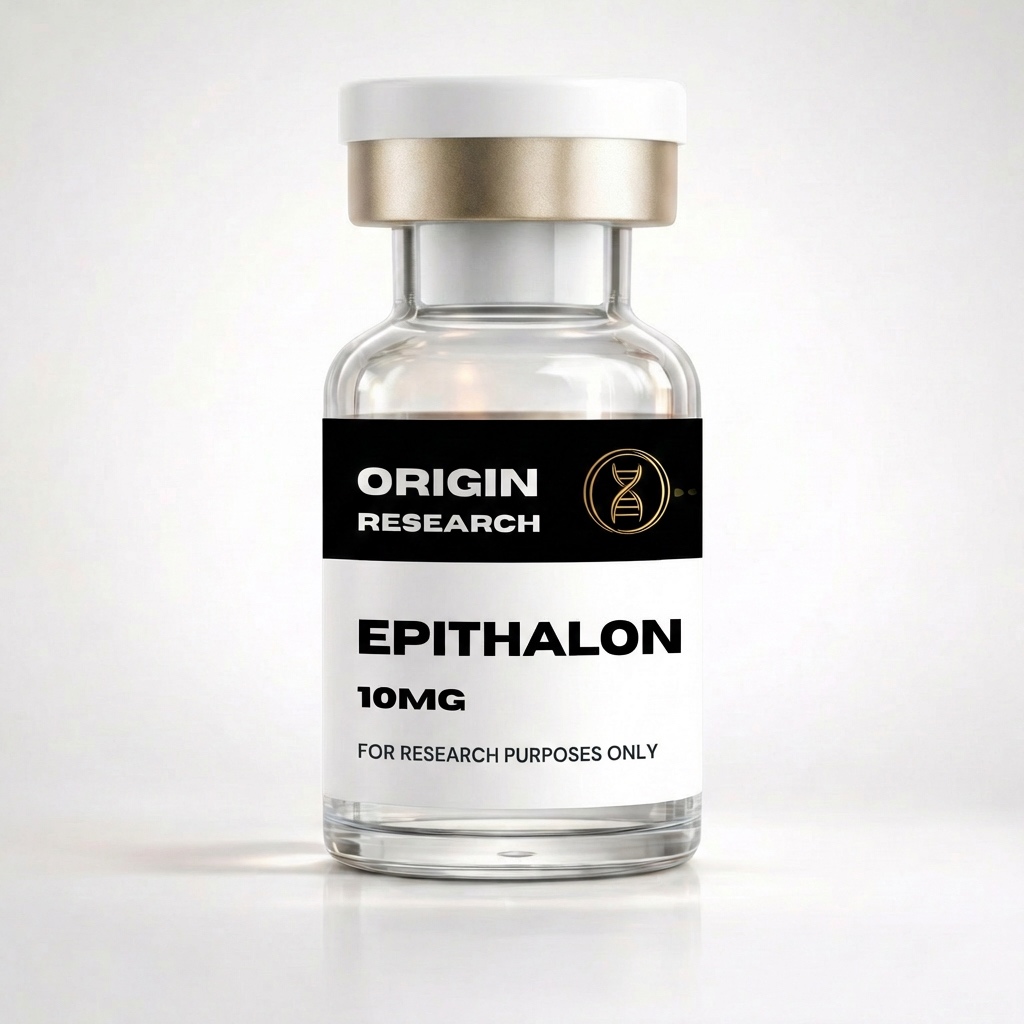
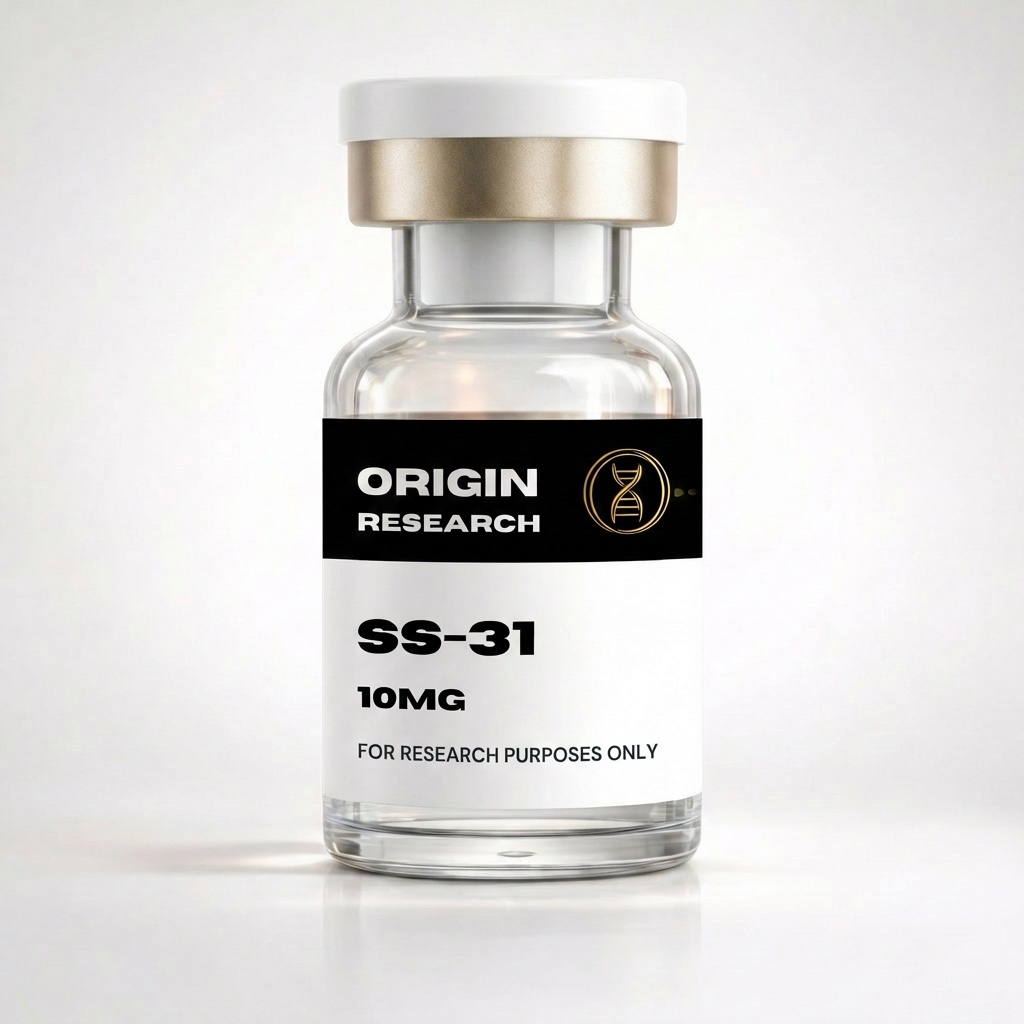
Epithalon and SS-31 are two short synthetic peptides that have been investigated in adjacent areas of ageing-pathway and mitochondrial-research literature. Epithalon, also written as epitalon, is the tetrapeptide Ala-Glu-Asp-Gly (AEDG), developed by Khavinson and colleagues at the St. Petersburg Institute of Bioregulation and Gerontology and investigated in preclinical literature relating to telomere-pathway research, pineal-gland research, and longevity-research rodent models (Khavinson, Neuro Endocrinol Lett 2002, PMID: 12163861). SS-31, also known as elamipretide or Bendavia, is the mitochondrial-targeted tetrapeptide D-Arg-Dmt-Lys-Phe-NH2, developed by Hazel Szeto and Peter Schiller and investigated in mitochondrial-research literature for its targeting of the inner mitochondrial membrane and cardiolipin binding in research models (Szeto et al., Br J Pharmacol 2014, PMID: 24571589). Both peptides are tetrapeptides of similar length but are otherwise structurally and mechanistically distinct. They are sometimes compared because both have been examined in ageing-research contexts, but the underlying pathways are different: Epithalon is studied in telomere and pineal pathway literature, while SS-31 is studied in mitochondrial-membrane and cardiolipin pathway literature. This page is supplied for licensed laboratory professionals comparing the two for in vitro reference work. Neither peptide is authorized for human consumption, supplementation, or therapeutic use in any jurisdiction we serve. Materials supplied through originlabsresearch.com are sold strictly for in vitro research, reference standards, and analytical chemistry purposes.
Overview
Structural background and design history
Epithalon was developed by the Khavinson group as a synthetic tetrapeptide based on the amino-acid composition of the natural pineal extract epithalamin, which had been studied in earlier Russian-language gerontology literature. The sequence Ala-Glu-Asp-Gly was derived through an analytical process that aimed to identify a short bioregulator-class peptide derived from larger pineal-extract starting material. The peptide is supplied as a standard L-amino-acid tetrapeptide with no unusual modifications, which makes it relatively straightforward to characterize by mass spectrometry and HPLC. SS-31, by contrast, was designed by Szeto and Schiller using a structure-based approach to target the inner mitochondrial membrane. The sequence D-Arg-Dmt-Lys-Phe-NH2 contains a D-amino acid (D-arginine) and a non-canonical residue (dimethyltyrosine, Dmt) along with C-terminal amidation, all of which contribute to the peptide's targeting characteristics. The Szeto-Schiller (SS) family of mitochondrial-targeted peptides was developed specifically to deliver short cationic peptides to the inner mitochondrial membrane, where they have been investigated for their binding to cardiolipin in research models (Szeto et al., Br J Pharmacol 2014, PMID: 24571589). The structural sophistication of SS-31 reflects this design intent: the modifications are not cosmetic but are integral to the peptide's mitochondrial-targeting function as reported in published literature.
Published preclinical research applications
Epithalon has been investigated in published preclinical literature focused on telomere-pathway and telomerase-activity rodent studies, with mechanistic work examining telomere-length parameters in rodent cell-culture systems (Khavinson et al., Bull Exp Biol Med 2003, PMID: 14523544). The peptide is also cited in pineal-gland and circadian-pathway research and in broader gerontology literature originating from the St. Petersburg Institute. Much of the foundational work appears in Russian-language journals with English-language summaries available through Bull Exp Biol Med and Neuro Endocrinol Lett. SS-31 has been investigated across a substantially larger English-language preclinical literature focused on mitochondrial-research applications. Published work has examined SS-31 in cardiac ischemia-reperfusion preclinical models in rodents, renal mitochondrial-research models, and skeletal-muscle mitochondrial-function studies in animal models (Birk et al., J Am Soc Nephrol 2014, PMID: 23949806; Siegel et al., J Cardiovasc Pharmacol 2013, PMID: 23921302). Mechanistic work has focused on the peptide's binding to cardiolipin and its effect on inner-mitochondrial-membrane stability in preclinical models. The two literatures occupy adjacent corners of ageing-research framing but engage fundamentally different molecular targets. Epithalon's primary research field is telomere and pineal biology, while SS-31's primary research field is mitochondrial membrane and cardiolipin biology.
Reference-standard handling and analytical considerations
Both peptides are supplied as lyophilized reference material and follow standard short-peptide handling conventions. Reconstitution with sterile or bacteriostatic water is typical, with aliquoting recommended to avoid repeated freeze-thaw cycles. Epithalon is a standard L-amino-acid tetrapeptide and is easy to characterize by HPLC and mass spectrometry, with no unusual residues to complicate identification. SS-31, with its D-arginine, dimethyltyrosine, and amidated C-terminus, has a distinctive mass-spectrometry signature and requires more careful confirmation of all three structural features in quality-control workflows. Reference-standard certificates of analysis for SS-31 typically include mass spectrometry data showing the correct mass for the modified sequence, along with HPLC purity. Storage at -20 degrees Celsius for long-term stocks is conventional for both peptides. SS-31's targeting characteristics in mitochondrial-research models depend on the integrity of its non-canonical residues, so reference standards must be characterized carefully to ensure the correct structural form. None of the handling guidance presented here is medical instruction. Both peptides are supplied strictly for in vitro research, reference-standard work, and analytical chemistry, and the notes here describe standard laboratory practice as reported in the cited primary literature.
Side by side
| Epithalon | SS-31 | |
|---|---|---|
| Sequence | Ala-Glu-Asp-Gly (AEDG) | D-Arg-Dmt-Lys-Phe-NH2 |
| Length | 4 amino acids | 4 amino acids |
| Modifications | Standard L-amino acids | D-Arg, Dmt, C-terminal amide |
| Vial size | 10mg | 10mg |
| Developer | Khavinson group, St. Petersburg | Szeto and Schiller |
| Primary research field | Telomere-pathway and pineal research | Mitochondrial-membrane and cardiolipin research |
| Foundational citation | Khavinson 2002; Khavinson 2003 | Szeto 2014; Birk 2014 |
| Analytical complexity | Standard tetrapeptide analysis | Verification of D-residue, Dmt, amide |
| Status | In vitro research reference only | In vitro research reference only |
When researchers choose which
When investigators choose between Epithalon and SS-31 as reference standards, the decision is driven entirely by the cellular pathway and the research field under study. Research groups working on telomere-pathway models, telomerase-activity assays, pineal-gland research, or gerontology-rodent literature in the Khavinson tradition have generally turned to Epithalon, because the AEDG tetrapeptide is the established reference standard for those applications and the primary literature is concentrated in that body of work. The structural simplicity of the peptide and its standard L-amino-acid composition make it straightforward to verify analytically. Research groups working on mitochondrial-membrane research, cardiolipin-binding studies, cardiac ischemia-reperfusion preclinical models, renal mitochondrial research, or skeletal-muscle mitochondrial-function studies have generally turned to SS-31, because elamipretide is the reference compound documented across that English-language preclinical literature. The peptide's D-arginine, dimethyltyrosine, and amidated C-terminus are integral to its mitochondrial-targeting function as reported in research models, and any reference standard used must be verified to contain all three structural features. A second consideration is analytical infrastructure. Laboratories without rigorous mass-spectrometry capability should rely on certificate-of-analysis documentation for both peptides, but particularly for SS-31 where verification of the modifications is essential. Neither peptide is authorized for human consumption, supplementation, or therapeutic use in any jurisdiction we serve, and selection should be guided exclusively by the published preclinical literature.
Frequently asked questions
Are Epithalon and SS-31 the same kind of peptide?
No. Both are tetrapeptides, but they engage fundamentally different biological pathways. Epithalon is studied in telomere-pathway and pineal research, while SS-31 is studied in mitochondrial-membrane and cardiolipin research. They are not interchangeable.
Why does SS-31 contain D-amino acids and a non-canonical residue?
SS-31 was designed with specific structural modifications, including D-arginine, dimethyltyrosine, and a C-terminal amide, to target the inner mitochondrial membrane and cardiolipin. These features are integral to its targeting characteristics as reported in published literature (Szeto et al., Br J Pharmacol 2014, PMID: 24571589).
Are these peptides authorized for human use?
No. Both are supplied strictly as in vitro research reference standards. Neither is authorized for human consumption, supplementation, or therapeutic use in any jurisdiction we serve.
Where was Epithalon developed?
Epithalon was developed by Khavinson and colleagues at the St. Petersburg Institute of Bioregulation and Gerontology. Much of the foundational research appears in Russian-language journals with English-language summaries (Khavinson, Neuro Endocrinol Lett 2002, PMID: 12163861).
What analytical methods are used to verify SS-31?
Mass spectrometry is essential for verifying the modified residues (D-arginine, dimethyltyrosine, C-terminal amide), and HPLC is used for purity assessment. Reference-standard certificates of analysis confirm all three structural features.
Can one peptide substitute for the other in an ageing-research protocol?
No. Although both have been examined in ageing-research contexts, they target different molecular pathways. A protocol designed around Epithalon cannot be transferred to SS-31, and vice versa, without consulting the primary literature.