
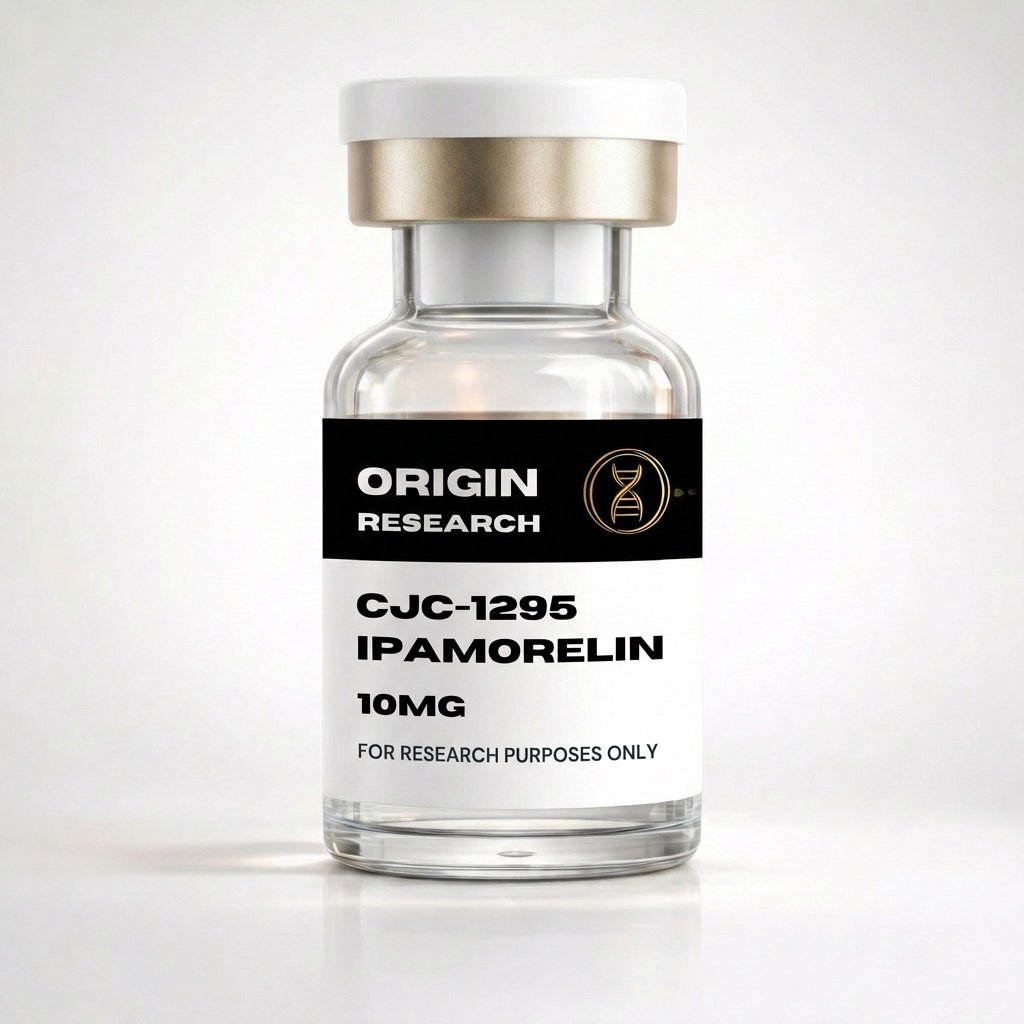
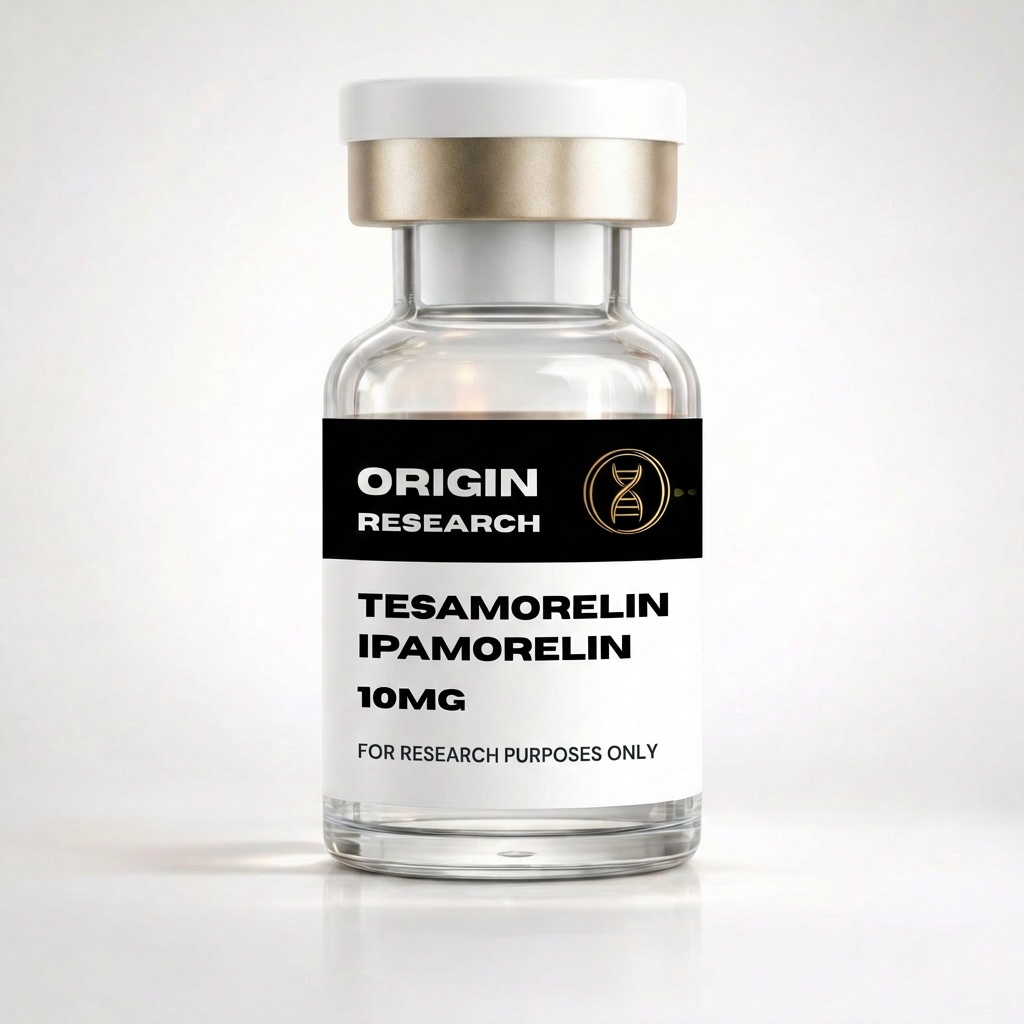
CJC-1295/Ipamorelin and Tesamorelin/Ipamorelin are two pre-blended GHRH-plus-secretagogue research formulations that share an identical ghrelin-receptor agonist component but differ in their GHRH analog backbone. Both blends combine a GHRH receptor agonist with the selective GHS-R1a agonist Ipamorelin to leverage the supra-additive GH release that has been documented when both receptor pathways are activated simultaneously on anterior pituitary somatotrophs (Bowers, J Pediatr Endocrinol Metab, 1996, PMID null). The defining difference is the GHRH side: CJC-1295 with DAC is a long-acting tetra-substituted GHRH 1-29 with a 6-8 day plasma half-life via covalent albumin binding (Teichman et al., J Clin Endocrinol Metab, 2006, PMID 16352683), while Tesamorelin is a hexenoyl-modified GHRH 1-44 with a 26-38 minute half-life designed for daily dosing (Falutz et al., N Engl J Med, 2007, PMID 17634461). Researchers compare these blends because the choice of GHRH backbone determines the pharmacokinetic profile of the entire stack: the CJC-1295/Ipamorelin combination produces tonic background GHRH receptor activation with daily Ipamorelin pulse-amplification, while the Tesamorelin/Ipamorelin combination produces daily pulse-like GHRH activation alongside Ipamorelin pulses. Both blends are supplied as 10mg lyophilised vials by originlabsresearch.com with global dispatch and lot-specific HPLC and mass spectrometry COA documentation, simplifying procurement for stacked-arm research.
Overview
Pharmacokinetic backbone comparison
The pharmacokinetic profile of these two blends is determined by their GHRH backbone, since the Ipamorelin component is identical and contributes the same 2-hour half-life pulse-like exposure to both. CJC-1295 with DAC produces a plasma half-life of approximately 6-8 days due to its covalent serum-albumin binding, which means a single weekly administration of the CJC-1295/Ipamorelin blend produces sustained GHRH receptor occupancy across the entire dosing interval (Teichman et al., J Clin Endocrinol Metab, 2006). The Ipamorelin component clears within hours, leaving the CJC-1295 with DAC component as the sustained background, and the next administration adds another Ipamorelin pulse on top of an unchanged GHRH backbone. Tesamorelin produces a plasma half-life of approximately 26-38 minutes, which means a single daily administration of the Tesamorelin/Ipamorelin blend produces a discrete GHRH receptor activation pulse alongside the Ipamorelin pulse, with both components clearing within hours and returning to baseline overnight (Falutz et al., N Engl J Med, 2007). The next daily administration produces a fresh paired pulse on each receptor pathway. The result is two stacking configurations with very different pulse architectures: tonic-plus-pulse for the CJC-1295/Ipamorelin blend, and paired-daily-pulses for the Tesamorelin/Ipamorelin blend. Researchers should select based on whether the study endpoint requires sustained GHRH receptor exposure across the dosing interval or whether discrete daily pulses with overnight clearance are the design goal.
Research applications side by side
These two blends populate distinct sub-literatures within stacked-arm GHRH-plus-secretagogue research. The CJC-1295/Ipamorelin combination dominates preclinical animal-model research and exploratory human research where the design priority is sustained tonic GHRH receptor activation with manageable dosing frequency. Animal protocols that benefit from reduced injection handling stress, IGF-1 set-point shift research, and chronic-exposure pharmacology studies all favour the CJC-1295 with DAC backbone. The Tesamorelin/Ipamorelin combination is the appropriate research selection when the comparator literature draws on Tesamorelin's clinical-research dataset, particularly for visceral adipose tissue endpoints, hepatic IGF-1 production research and HIV-cohort comparator work (Falutz et al., N Engl J Med, 2007; Stanley et al., JAMA, 2014). Tesamorelin's regulatory-approval history in HIV-associated lipodystrophy gives it a substantially deeper clinical-research anchor for studies that want to reference adipose tissue or hepatic outcomes. For receptor-synergy mechanistic research, both blends produce supra-additive GH release relative to either component alone, consistent with the foundational Bowers work on GHRH and GHRP synergy (Bowers, J Pediatr Endocrinol Metab, 1996). For studies designed around daily-versus-weekly dosing trade-offs, comparing the two blends head-to-head can isolate the pharmacokinetic-architecture contribution to study endpoints. Both are supplied lyophilised by originlabsresearch.com with global dispatch and lot-specific HPLC and mass spectrometry COA documentation, simplifying matched-purity comparison-arm research between the two stacks.
Engineering and selectivity differences in the GHRH component
The two GHRH backbones differ not only in half-life but in engineering approach, which has implications for research interpretation. Tesamorelin retains the full 44-amino-acid native GHRH sequence and adds a single hexenoyl modification to the N-terminal tyrosine to block DPP-IV cleavage, preserving native receptor-binding geometry and producing a clinically practical daily-dosing pulse-like profile (Falutz et al., N Engl J Med, 2007). CJC-1295 with DAC takes a more aggressive approach: the peptide is truncated to GHRH 1-29, four residues are substituted to confer broader protease resistance, and a maleimidopropionic acid drug affinity complex linker is attached to the C-terminal lysine to covalently tether the peptide to serum albumin (Teichman et al., J Clin Endocrinol Metab, 2006). The structural identity of Tesamorelin is closer to native GHRH, while CJC-1295 with DAC introduces a substantial pharmacology variable through the albumin-conjugation architecture. The Ipamorelin component is identical between the two blends: a pentapeptide GHS-R1a agonist characterised for its selectivity profile, with no reported cortisol, prolactin, ACTH or aldosterone elevation at functional doses (Raun et al., Eur J Endocrinol, 1998). For research designs that require preservation of native GHRH structural identity in the receptor activation pathway, the Tesamorelin/Ipamorelin blend is the appropriate choice. For research designs that prioritise sustained receptor exposure regardless of the engineering pathway used to achieve it, the CJC-1295/Ipamorelin blend is the appropriate choice.
Side by side
| CJC-1295/Ipamorelin Blend | Tesamorelin/Ipamorelin Blend | |
|---|---|---|
| Total blend size | 10mg combined lyophilised | 10mg combined lyophilised |
| GHRH component | CJC-1295 with DAC (tetra-substituted GHRH 1-29 + DAC) | Tesamorelin (hexenoyl GHRH 1-44) |
| Secretagogue component | Ipamorelin (GHS-R1a agonist) | Ipamorelin (GHS-R1a agonist) |
| GHRH backbone half-life | Approximately 6-8 days | Approximately 26-38 minutes |
| Typical dosing interval | Weekly GHRH, daily Ipamorelin overlay | Daily blend administration |
| Pulse architecture | Tonic GHRH + daily ghrelin pulse | Daily paired GHRH + ghrelin pulses |
| Native GHRH structural identity | Truncated 1-29 with substitutions | Full-length 1-44 with N-terminal modification |
| Clinical-research depth of GHRH side | Phase 1 PK studies | Phase 3 trials, FDA-approved indication |
| Common research domains | Sustained activation, animal protocols, IGF-1 set-point | Visceral adipose tissue, daily-stack synergy |
| COA on file | HPLC and MS, global dispatch | HPLC and MS, global dispatch |
When researchers choose which
When researchers choose between the CJC-1295/Ipamorelin and Tesamorelin/Ipamorelin blends, the decision is shaped by the pharmacokinetic profile of the GHRH side and by which clinical-research dataset the study wants to reference. The CJC-1295/Ipamorelin blend is the appropriate selection when the research design requires sustained tonic GHRH receptor activation over multi-day windows alongside daily pulse-amplification on the ghrelin pathway. Animal protocols that benefit from reduced injection handling stress, IGF-1 set-point shift research, weekly-dosing convenience studies, and exploratory pharmacology work in healthy adult cohorts all favour the CJC-1295 with DAC backbone. The Tesamorelin/Ipamorelin blend is the appropriate selection when the research design requires daily pulse-like GHRH activation paired with daily Ipamorelin administration, particularly when the comparator literature draws on Tesamorelin's clinical-research dataset for visceral adipose tissue, hepatic IGF-1 or HIV-cohort context. Studies that want to preserve the structural identity of native GHRH in the receptor activation pathway also favour Tesamorelin, since it retains the full 1-44 sequence with only a minimal N-terminal modification. For research designs that specifically compare the two stacks head-to-head, both blends are supplied as 10mg lyophilised vials by originlabsresearch.com with lot-matched HPLC and mass spectrometry COA paperwork, enabling matched-purity dual-arm protocols. Researchers should standardise reconstitution, refrigeration and freeze-thaw protocols across both vials and design endpoint blood-draw timing around the pharmacokinetic differences between the two GHRH backbones to avoid confounding pulse-architecture interpretation with measurement-window artefacts.
Frequently asked questions
Which blend has more clinical-research depth on the GHRH side?
The Tesamorelin/Ipamorelin blend uses Tesamorelin as the GHRH backbone, which has the deepest clinical-research dataset of any GHRH analog, anchored by phase 3 trials in HIV-associated lipodystrophy. CJC-1295 with DAC has a smaller, primarily pharmacokinetic-characterisation dataset on its GHRH side.
Are the Ipamorelin components identical?
Yes, the Ipamorelin component is the same selective GHS-R1a agonist pentapeptide in both blends and contributes the same approximately 2-hour half-life pulse-like exposure to each.
Can both blends be used in stacked-arm research?
Yes, both blends can be investigated head-to-head in comparison-arm research designs that examine the contribution of the GHRH backbone to overall stack pharmacokinetics. Both ship with lot-matched HPLC and mass spectrometry COA documentation from originlabsresearch.com.
Does originlabsresearch.com ship both blends worldwide?
Yes, both blends are dispatched from from global stock with tracked shipping. Both ship lyophilised at ambient temperature and should be transferred to -20C storage on arrival for long-term holding.
Is a certificate of analysis included with each vial?
Yes, every lot of both blends ships with lot-specific HPLC purity and mass spectrometry confirmation covering both peptide components. COA documents are available on request prior to purchase.
Which is preferred for daily-dosing research designs?
The Tesamorelin/Ipamorelin blend is the appropriate selection for daily-dosing protocols because both components have comparable short half-lives and clear overnight. The CJC-1295/Ipamorelin blend uses a weekly GHRH backbone with daily Ipamorelin overlay.