
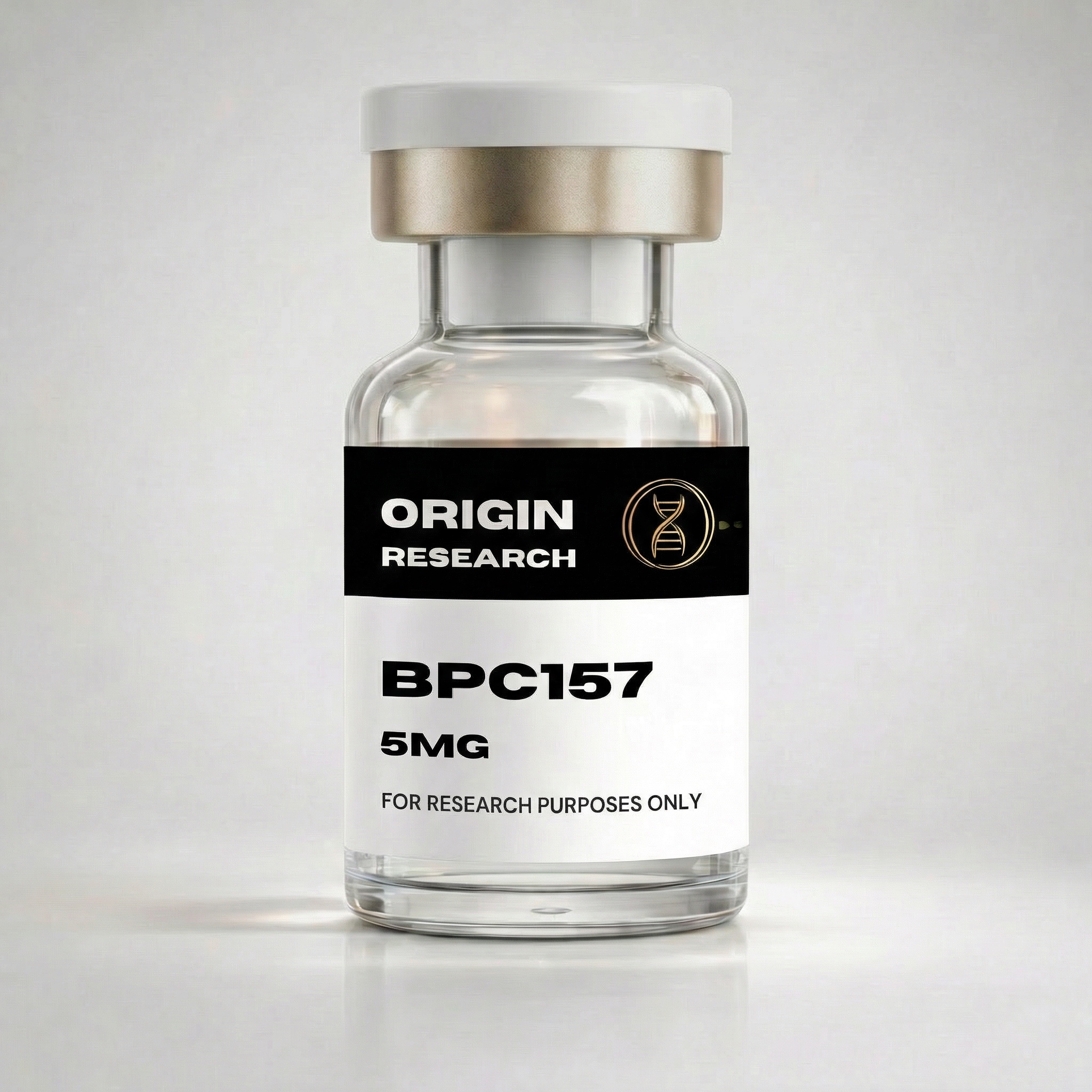
BPC-157 injectable vials and BPC-157 oral capsules deliver the same pentadecapeptide sequence, GEPPPGKPADDAGLV, but they are formulated for distinct research applications. The lyophilised 5mg injection vial has been the format used in the bulk of the published preclinical literature, including the Sikiric group's gastrointestinal, tendon and central nervous system studies. The 30 x 500mcg oral capsule format reflects a separate line of research interest centred on gastrointestinal-luminal exposure, since the parent peptide was originally identified in gastric juice and has been investigated for stability across the gastric environment. Researchers compare the two formats because the same molecule is delivered via fundamentally different pharmacokinetic routes: parenteral administration produces systemic exposure with a defined Cmax and clearance curve, while oral administration produces high local luminal concentration with reduced and harder-to-characterise systemic exposure. The comparative literature frames this as a route question rather than a compound question, and several rodent studies have examined oral BPC-157 in colitis and ileitis models alongside injected comparator arms (Sikiric et al., Curr Pharm Des, 2010, PMID 20388123). For laboratories worldwide running parallel protocols on gut-local versus systemic endpoints, having both formats from a single supplier such as originlabsresearch.com simplifies lot matching and certificate of analysis comparison. The choice between formats is dictated by whether the research endpoint requires measurable plasma concentration or gut-luminal contact with intestinal mucosa.
Overview
Route of administration and exposure profile
The fundamental divergence between these two formats is the exposure profile each produces. BPC-157 5mg injection vials, once reconstituted, are administered parenterally and produce a defined systemic exposure curve. Published rodent pharmacokinetic work has reported relatively rapid absorption from subcutaneous sites with clearance over a multi-hour window (Vukojevic et al., Eur J Pharmacol, 2018, PMID null). This exposure profile supports research designs that measure peripheral endpoints, central nervous system endpoints or multi-organ outcomes where the peptide must reach distant tissues via circulation. BPC-157 oral capsules deliver 500mcg of the same peptide per unit directly to the gastrointestinal lumen. Research on oral BPC-157 has reported activity in gut models despite limited systemic absorption, which has been interpreted as a local mucosal effect rather than a classical pharmacokinetic exposure. This interpretation aligns with the peptide's origin in gastric juice and with stability data suggesting partial resistance to gastric pepsin. Researchers selecting between formats should ask whether the endpoint requires measurable plasma BPC-157 or whether luminal contact suffices. Tendon, ligament, brain and corneal endpoints require the injection format. Colitis, ileitis, gastric ulcer and esophagogastric models can be investigated with either format, although the published literature uses both routes and reports endpoints separately. For dose-response studies and pharmacokinetic characterisation, the injection format is the appropriate choice; for luminal-exposure studies and chronic gut-protocol designs, capsules are the practical format.
Research applications side by side
The two formats overlap in some research domains and diverge in others. The injection format has been used in tendon transection studies measuring tensile load to failure and collagen organisation (Krivic et al., J Orthop Res, 2008, PMID 18404734), in MCL injury models, in traumatic brain injury rodent designs and in corneal alkali burn studies. None of these endpoints can be reached meaningfully via oral capsule administration, since the peptide must enter systemic circulation to act on distant tissues. The oral capsule format has been investigated primarily in gastrointestinal research, including DSS-induced colitis, indomethacin-induced enteropathy, esophagogastric anastomosis and short-bowel syndrome models. Some of these studies have run parallel arms with injection administration to compare effect size between routes (Sikiric et al., J Physiol Pharmacol, 2018). In central nervous system research, oral BPC-157 has been examined in rodent serotonergic and dopaminergic models, with investigators interpreting effects through a gut-brain axis lens rather than direct systemic delivery (Boban Blagaic et al., Eur J Pharmacol, 2005). For researchers designing studies that compare local versus systemic effects, running paired oral and injection arms is the most informative approach. Both formats should be sourced from the same supplier with matching lot documentation to minimise variability. Originlabsresearch.com supplies both with lot-specific certificate of analysis paperwork, allowing investigators to reference the same purity grade across route-comparison protocols. Veterinary preclinical work in equine and canine populations has used the injection format almost exclusively, given the dosing precision required.
Stability, storage and handling differences
Format-specific handling requirements should be factored into research planning. The 5mg lyophilised injection vial is shipped at ambient temperature, should be transferred to -20C for long-term storage and reconstituted with bacteriostatic or sterile water immediately before use. Reconstituted solutions are typically stored refrigerated at 2-8C and used within a defined window, with researchers advised to log reconstitution date, diluent volume and freeze-thaw count for reproducibility. Oral capsules contain pre-measured 500mcg doses of BPC-157 in a stable solid matrix and are shipped at ambient temperature with no requirement for cold-chain handling once in laboratory possession. Capsule integrity should be preserved by storing the container sealed at room temperature away from direct light and humidity. Stability studies on solid-form BPC-157 have reported good shelf life across multi-month windows under standard storage, although researchers should refer to lot-specific certificate of analysis documentation for expiration data. Cross-format comparison protocols should standardise the source lot and verify HPLC purity matching between the injection vial and the capsule batch. Both formats supplied by originlabsresearch.com include mass spectrometry confirmation of sequence identity and HPLC purity data. Researchers running route-comparison studies should be aware that capsule dosing is fixed at 500mcg increments, whereas injection dosing is fully titratable from microgram to milligram ranges within the 5mg vial total. This dosing granularity difference is itself a study-design variable.
Side by side
| BPC-157 | BPC-157 Capsules | |
|---|---|---|
| Format | 5mg lyophilised injection vial | 30 x 500mcg oral capsules |
| Peptide sequence | GEPPPGKPADDAGLV | GEPPPGKPADDAGLV |
| Molecular weight | 1419.55 Da | 1419.55 Da |
| Route of administration | Parenteral (SC, IP, IM) | Oral |
| Primary research domain | Systemic, tendon, CNS, multi-organ | GI lumen, mucosal protection, gut-brain axis |
| Dose titration | Microgram to milligram, fully titratable | Fixed 500mcg per capsule |
| Cold storage requirement | Lyophilised at -20C, reconstituted at 2-8C | Ambient temperature, sealed container |
| Reconstitution required | Yes, bacteriostatic or sterile water | No |
| Plasma exposure profile | Defined, characterisable | Limited systemic, primarily luminal |
| COA on file | HPLC and MS, global dispatch | HPLC and MS, global dispatch |
When researchers choose which
When researchers choose between BPC-157 injection and BPC-157 capsules, the question is always about route and endpoint, never about molecule identity, since the sequence is identical. Studies investigating tendon repair, ligament transection, traumatic brain injury, corneal wound endpoints or any peripheral tissue beyond the gut should use the 5mg injection vial. The injection format is the only route capable of producing systemic plasma exposure sufficient to reach those tissues, and it is the format used in the bulk of the published comparator literature for those domains. Pharmacokinetic characterisation studies, dose-response curves and any protocol requiring titratable microgram dosing also require the injection format because of its dosing granularity. The oral capsule format is appropriate when the research question focuses on gastrointestinal mucosa, gut-luminal exposure, intestinal transit, colitis severity scoring, NSAID-enteropathy modelling or any endpoint where local contact with the gut wall is the primary mechanism of interest. Capsules are also appropriate for chronic gut-protocol designs where daily injection would introduce confounding stress variables in animal models. For investigators running route-comparison arms, both formats should be procured together with lot-matched COA documentation to minimise inter-lot purity variation. Capsules cannot replace injection for systemic-endpoint research, and injection is impractical for chronic luminal-exposure protocols where capsule dosing is more reproducible. Many laboratories carry both formats and select based on the specific study being run, treating them as complementary research tools rather than interchangeable products. Originlabsresearch.com dispatches both from from global stock.
Frequently asked questions
Is the molecule identical between formats?
Yes, both formats deliver the same 15-amino-acid pentadecapeptide GEPPPGKPADDAGLV with identical molecular weight 1419.55 Da. The difference is exclusively in route of administration, dosing format and resulting exposure profile.
Can capsules replace injection in tendon research?
No, tendon and ligament endpoints require systemic exposure to reach the target tissue, which is achieved through the injection format. The capsule format produces limited systemic exposure and is not appropriate for non-gut tissue endpoints.
Are both formats covered by certificate of analysis documentation?
Yes, every lot of both the 5mg injection vial and the 30-capsule oral pack ships with lot-specific HPLC purity and mass spectrometry confirmation. COA documents are available on request prior to purchase.
What is the recommended storage difference?
Injection vials should be stored at -20C lyophilised and transferred to 2-8C once reconstituted, with logged reconstitution dates. Oral capsules are stable at ambient temperature in their sealed container and do not require cold-chain handling.
Does originlabsresearch.com ship both formats together?
Yes, both formats can be ordered in the same shipment with combined global dispatch. Lot-matched COA paperwork is provided when both are ordered for route-comparison research.
Which format is used more in the published literature?
The injection format dominates the published preclinical literature on BPC-157, particularly in tendon, ligament, CNS and corneal research. The oral format appears primarily in gastrointestinal-specific studies and in route-comparison arms within multi-format gut protocols.