
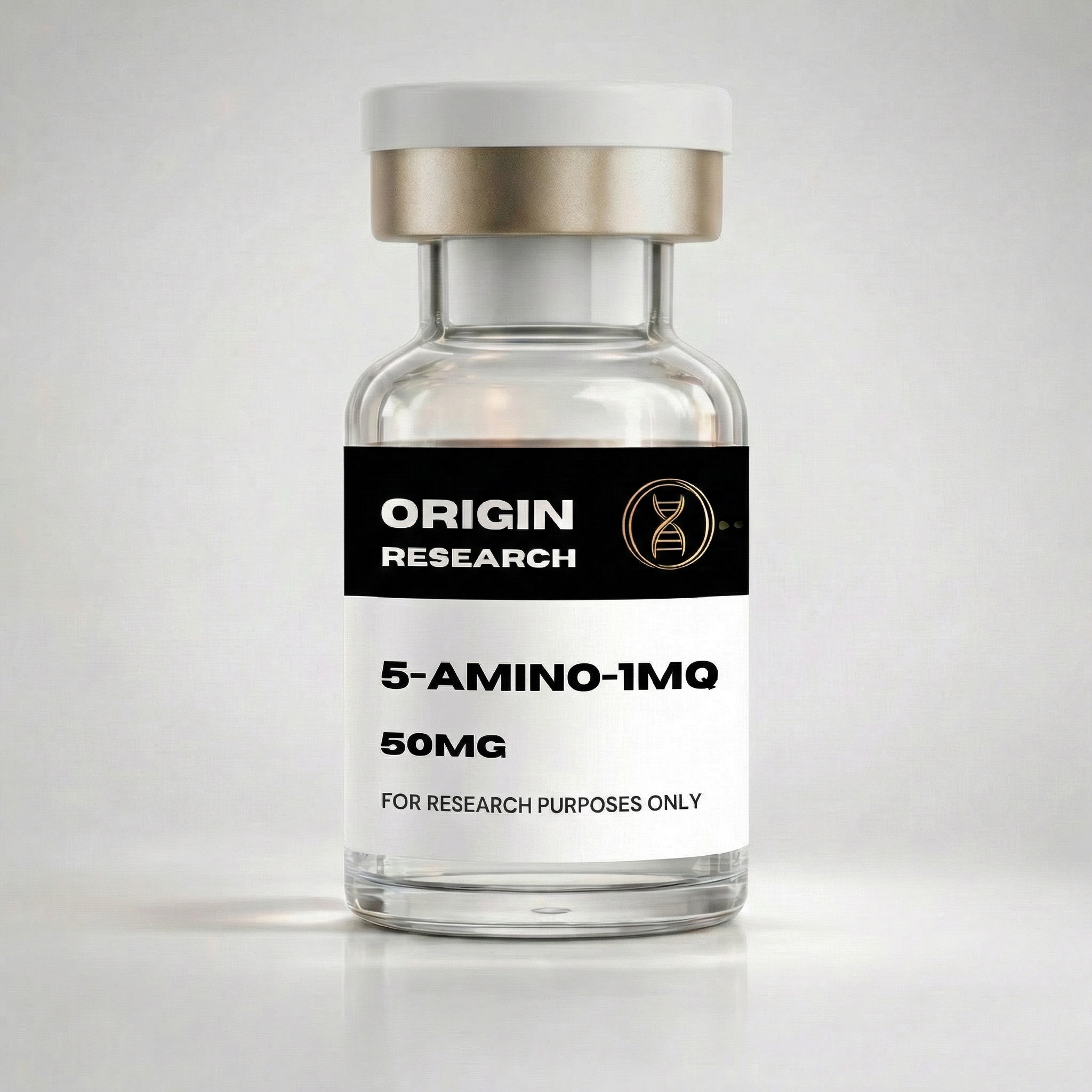
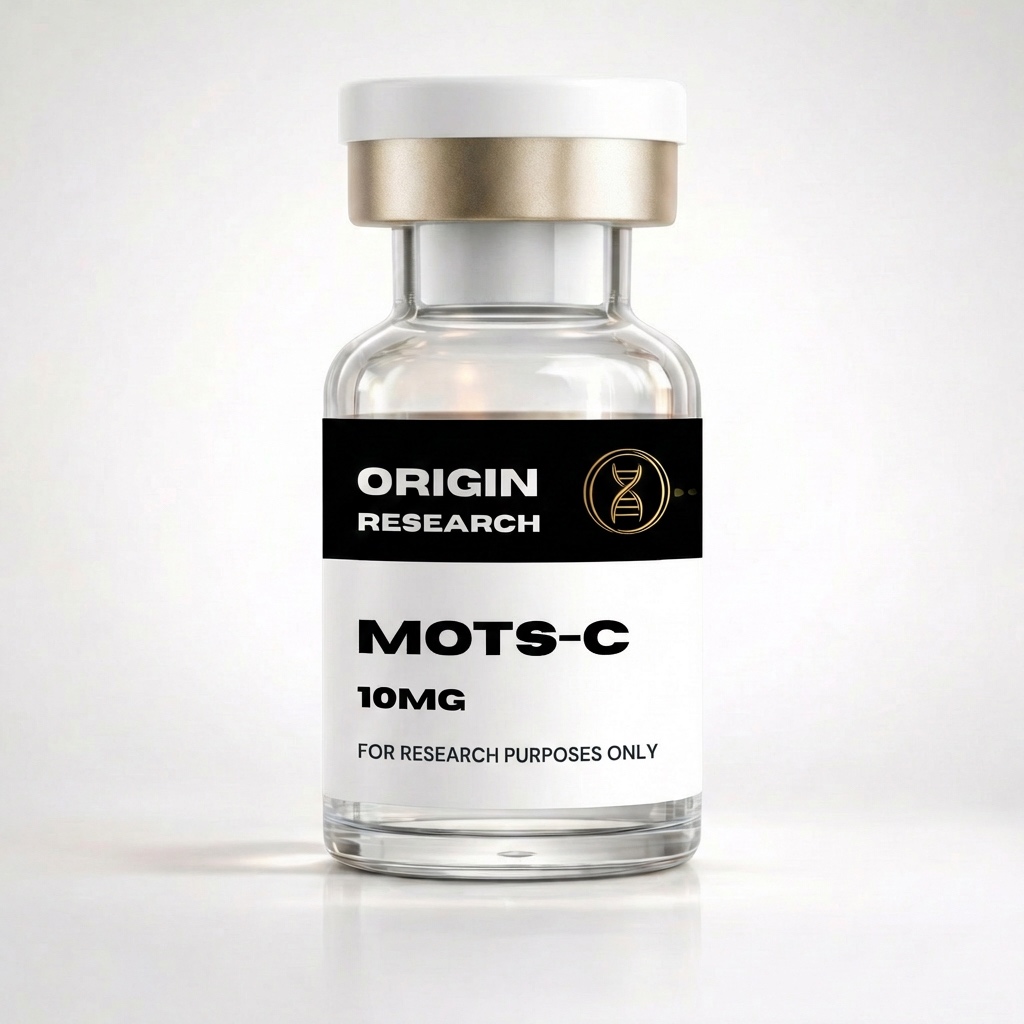
5-Amino-1MQ and MOTS-c are two distinct research compounds that have been studied in overlapping areas of metabolic-pathway biology, yet they sit at opposite ends of the chemistry spectrum. 5-Amino-1MQ is a small molecule, a methylquinolinium derivative investigated in vitro as a selective inhibitor of nicotinamide N-methyltransferase (NNMT), an enzyme that has been examined in adipose tissue research and obesity-pathway models (Neelakantan et al., Biochem Pharmacol 2018, PMID: 29307878). MOTS-c is a 16-amino-acid peptide encoded within the mitochondrial 12S rRNA gene, with the sequence MRWQEMGYIFYPRKLR. It has been characterized as a mitochondrial-derived peptide and investigated in studies of AMPK signalling, glucose homeostasis, and exercise-response biology in research models (Lee et al., Cell Metab 2015, PMID: 25738459). Both compounds appear in laboratory literature concerning energy metabolism, mitochondrial function, and adipose-tissue research models, which is why investigators frequently encounter them in the same reading lists despite their unrelated structures. This page is for licensed laboratory professionals comparing the two for in vitro reference work. Neither compound is authorized for human consumption, supplementation, or therapeutic use in any jurisdiction we serve. Materials supplied through originlabsresearch.com are sold strictly for in vitro research, reference standards, and analytical chemistry purposes. Researchers should review the published preclinical record, the structural differences between a small-molecule inhibitor and a mitochondrial peptide, and the experimental conditions reported in primary literature before selecting either reference standard for protocol design.
Overview
Molecular class and structural background
The first and most fundamental distinction between these two compounds is molecular class. 5-Amino-1MQ is a synthetic small molecule built around a methylated quinolinium scaffold with an amino substitution at the 5 position. It is not derived from biological sequence information and does not contain peptide bonds. Its molecular weight sits well below 200 daltons, which places it firmly in small-molecule reference territory. MOTS-c, in contrast, is a 16-residue peptide with the published sequence MRWQEMGYIFYPRKLR and a molecular weight near 2,174 daltons. It was first reported by the Cohen laboratory in 2015 after the group identified an open reading frame within the mitochondrial 12S rRNA gene that encoded a translatable peptide product (Lee et al., Cell Metab 2015, PMID: 25738459). This sequence origin places MOTS-c within the broader class of mitochondrial-derived peptides (MDPs), alongside humanin and the SHLP family. Because the two compounds belong to such different chemical categories, they require different storage, reconstitution, and analytical-chemistry workflows. A laboratory comparing them for protocol selection should treat them as fundamentally separate reference standards rather than alternatives within a single class. Documentation reviewed by investigators should include published mass spectrometry, HPLC purity records, and where available, NMR characterization for the small molecule and amino-acid analysis for the peptide. The structural gap also explains why the two compounds appear in different sections of catalog literature even when they overlap in metabolic-pathway citations.
Published preclinical research record
5-Amino-1MQ has been examined in a focused but growing body of preclinical literature centered on NNMT inhibition. NNMT is an enzyme that has been studied in adipose-tissue biology, cancer metabolism, and 1-methylnicotinamide research. The 2018 Biochem Pharmacol report by Neelakantan and colleagues described 5-Amino-1MQ as a selective NNMT inhibitor and reported activity in cell-culture adipocyte models, with follow-up work investigating effects on adipose-tissue parameters in diet-induced obesity rodent models (PMID: 29307878). MOTS-c has been investigated in a broader and longer-running literature. The original Cell Metab characterization described MOTS-c as a peptide that has been studied in AMPK-pathway and glucose-metabolism research, with subsequent work examining its behaviour in exercise-physiology models, ageing-research cohorts in rodents, and skeletal-muscle metabolism studies (Reynolds et al., Nat Commun 2021, PMID: 33397893; Kim et al., Aging Cell 2018, PMID: 29874396). Both compounds have been cited in metabolic-pathway reviews, but the primary references differ substantially. Researchers reviewing the literature should note that 5-Amino-1MQ is studied principally as a pharmacological tool to probe NNMT activity in research models, while MOTS-c is studied as an endogenous peptide whose physiological role within mitochondrial-nuclear signalling remains under active investigation in research systems. The bibliographies are largely non-overlapping despite the shared metabolic-research framing.
Laboratory handling and reference-standard considerations
Because 5-Amino-1MQ is a small molecule, it is typically supplied as a salt (often the iodide form) and reconstituted in DMSO or other organic solvents for in vitro work, depending on the downstream assay. Stability profiles in solution have been documented in supporting literature, and the compound is generally compatible with cell-culture media following appropriate dilution. MOTS-c, as a peptide, is most often reconstituted in sterile or bacteriostatic water and, like other research peptides, benefits from aliquoting to avoid repeated freeze-thaw cycles. Mass-spectrometry verification of peptide identity is the standard quality-control step for MOTS-c reference work, while small-molecule purity for 5-Amino-1MQ is typically confirmed by HPLC and NMR records on the certificate of analysis. Storage recommendations for both compounds are documented at -20 degrees Celsius for long-term reference stocks, with working solutions held at refrigerated temperatures for short windows. Researchers should consult primary literature for assay-specific concentration ranges, as the published work uses different reference dosing for each compound. None of this guidance constitutes medical instruction; it reflects standard laboratory practice as reported in the cited literature and is provided only to assist investigators preparing in vitro experiments.
Side by side
| 5-Amino-1MQ | MOTS-c | |
|---|---|---|
| Molecule class | Small-molecule NNMT inhibitor | 16-amino-acid mitochondrial-derived peptide |
| Sequence or structure | 5-amino-1-methylquinolinium scaffold | MRWQEMGYIFYPRKLR |
| Vial size | 50mg | 10mg |
| Approximate molecular weight | Under 200 Da | About 2,174 Da |
| Primary research field | NNMT-pathway and adipose-tissue research | Mitochondrial peptide and AMPK-pathway research |
| Foundational citation | Neelakantan et al., Biochem Pharmacol 2018 | Lee et al., Cell Metab 2015 |
| Reconstitution convention | Organic solvent systems (e.g. DMSO) | Sterile or bacteriostatic water |
| Typical storage | -20 C for long-term stocks | -20 C for long-term stocks |
| Status | In vitro research reference only | In vitro research reference only |
When researchers choose which
When researchers choose which of these two reference standards to bring into a project, the decision usually starts with the pathway under investigation rather than any superficial similarity in metabolic framing. Investigators working on NNMT enzymology, 1-methylnicotinamide chemistry, or adipocyte-pathway models that explicitly involve nicotinamide methylation have generally turned to 5-Amino-1MQ, because the published literature established it as a selective small-molecule probe of NNMT activity. The Neelakantan 2018 paper remains the most cited entry point, and downstream work in adipose-tissue models has built directly on that scaffold. Investigators working on mitochondrial-derived peptide biology, AMPK-pathway signalling, glucose-homeostasis cell models, or exercise-physiology research in rodent systems have instead turned to MOTS-c, because the literature places it within the endogenous mitochondrial peptide family and frames it as a translatable product of the mitochondrial genome. A second selection consideration is laboratory-handling capacity. Groups equipped for peptide chemistry, with cold storage and reconstitution protocols already validated for short peptides, often find MOTS-c easier to integrate. Groups oriented toward small-molecule pharmacology with HPLC verification workflows often find 5-Amino-1MQ a more natural fit. Neither compound is authorized for human use in any jurisdiction we serve, and selection should be guided by published preclinical literature, not by marketing claims. The two compounds are not interchangeable, and protocols designed around one cannot be transferred to the other without reading the primary references in full.
Frequently asked questions
Are 5-Amino-1MQ and MOTS-c the same class of research compound?
No. 5-Amino-1MQ is a small molecule investigated as an NNMT inhibitor, while MOTS-c is a 16-amino-acid mitochondrial-derived peptide. They are studied in adjacent metabolic-research fields but belong to entirely different chemical classes.
Where were these compounds first published in peer-reviewed literature?
5-Amino-1MQ was characterized as a selective NNMT inhibitor in Neelakantan et al., Biochem Pharmacol 2018 (PMID: 29307878). MOTS-c was first reported as a mitochondrial-derived peptide in Lee et al., Cell Metab 2015 (PMID: 25738459).
Why are the vial sizes different?
Reference-standard vial sizes reflect typical experimental dosing reported in the primary literature for each compound. Small molecules and peptides are not used at equivalent masses, so the 50mg and 10mg formats correspond to common laboratory working quantities, not to dose equivalence.
Are these products supplied for human use?
No. Both products are supplied strictly as in vitro research reference standards. Neither is authorized for human consumption, supplementation, or therapeutic use in any jurisdiction we serve.
Can a protocol designed around MOTS-c be adapted to 5-Amino-1MQ?
Not directly. The two compounds engage different molecular targets and require different reconstitution and handling. Investigators should refer to the primary literature for each compound when designing a study, rather than treating them as interchangeable.
What documentation should accompany either reference standard?
Standard practice includes a certificate of analysis with purity data, identity confirmation (HPLC and NMR for the small molecule, mass spectrometry for the peptide), storage instructions, and lot information.