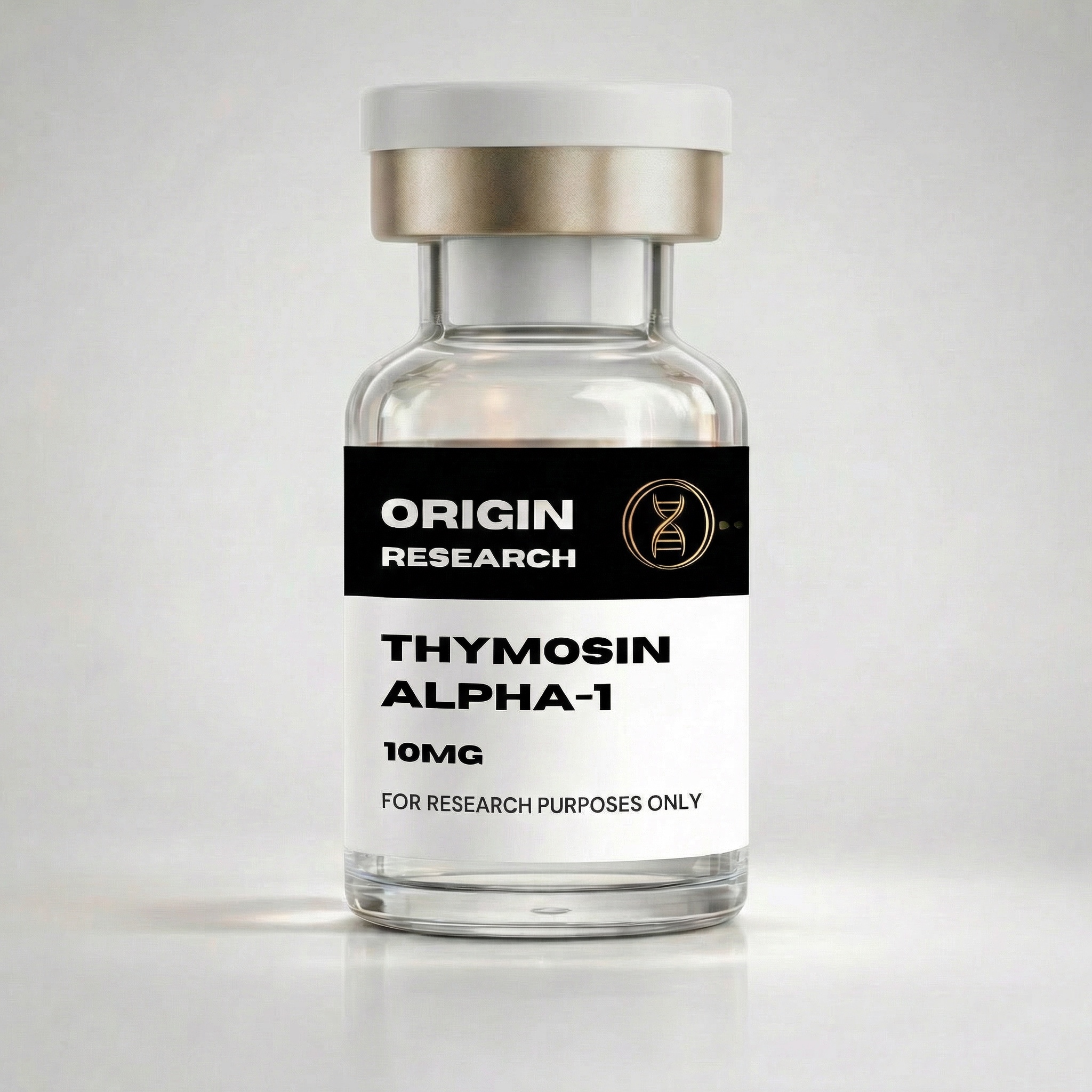
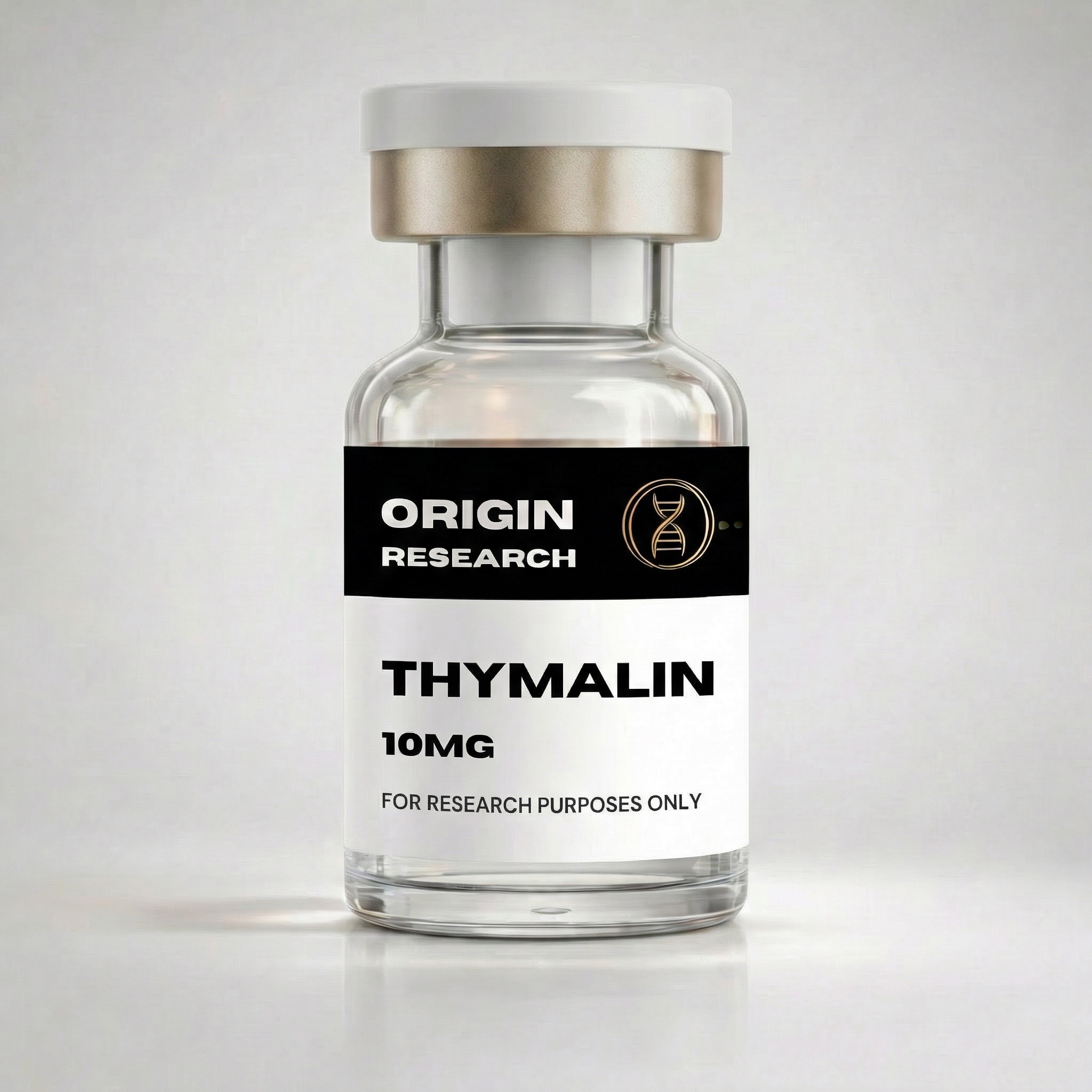
The thymus produces immune cells. It also produces peptides. Two of those peptides have been studied extensively in published preclinical and clinical research literature.
- Thymosin alpha-1 is a 28-amino-acid peptide first isolated from bovine thymus fraction 5 in the laboratories of Allan Goldstein in the 1970s
- Thymalin is a peptide extract preparation developed in Russian research institutes, characterised in the published literature as a low-molecular-weight oligopeptide complex with immunomodulatory pathway activity
Both emerged from a broader research programme on thymic factors that aimed to characterise the molecular basis of T-cell development and immune system maturation.
This article walks through the chemistry, mechanism, pathway biology, and comparative research literature.
Third-person research voice. Research-use-only laboratory contexts. Focus on molecular and pathway-level characterisation in the published literature.
Discovery and structural chemistry
The thymic peptide field began in the 1960s with Goldstein and colleagues isolating thymosin fraction 5 from bovine thymic tissue.
From crude extract to defined peptide
Thymosin fraction 5 was a crude preparation. Subsequent fractionation produced multiple individual peptide components designated by Greek letter prefixes. Thymosin alpha-1 emerged as one of the most thoroughly characterised.
Thymosin alpha-1 structure
A 28-amino-acid peptide. Sequence:
N-acetyl-Ser-Asp-Ala-Ala-Val-Asp-Thr-Ser-Ser-Glu-Ile-Thr-Thr-Lys-Asp-Leu-Lys-Glu-Lys-Lys-Glu-Val-Val-Glu-Glu-Ala-Glu-Asn
Key structural features
- N-terminal acetylation confers metabolic stability against aminopeptidase cleavage in research models
- Highly acidic (multiple aspartate and glutamate residues contributing negative charge at physiological pH)
- Unstructured in aqueous solution per published NMR and circular dichroism studies
The precursor: prothymosin alpha
Thymosin alpha-1 is cleaved from prothymosin alpha, a 109-residue precursor protein widely expressed across mammalian tissues. The precursor itself shows additional biological activities distinct from those of the cleavage fragment.
Thymalin: a different beast
Thymalin is not a single peptide. It is a low-molecular-weight oligopeptide complex extracted from thymic tissue.
- Component peptide masses range from approximately 1,000 to 3,000 daltons
- It is a mixture of related thymic-derived oligopeptides
- Compositional characterisation uses size-exclusion chromatography, amino acid composition analysis, and electrophoretic methods
Standardisation across batches and manufacturing sources is a particular consideration for multicomponent biological extracts.
Russian peptide extract tradition
Thymalin sits within a broader Russian research tradition of multicomponent peptide extracts, including comparable preparations:
- Epithalamin from pineal tissue
- Retinalamin from retinal tissue
- Other tissue-source preparations
Each has been characterised in published Russian research literature as displaying tissue-specific biological activity associated with the source organ.
Mechanism and immune pathway engagement
Thymosin alpha-1 engages multiple immune cell types and signalling pathways. Several receptor interactions have been characterised.
Toll-like receptors
Two receptors are central to the published mechanism.
TLR9 Expressed on plasmacytoid dendritic cells, B cells, and other immune populations. Engagement by thymosin alpha-1 promotes dendritic cell differentiation and modulates interferon-alpha production in research models.
TLR2 Contributes to additional aspects of innate immune pathway activation.
Downstream signalling cascade
Published immunology research has characterised the intracellular signalling cascades downstream of Toll-like receptor engagement.
- Adaptor protein MyD88 recruits
- IRAK kinase family activates
- NF-kappaB and interferon regulatory factor transcription factors activate
- Gene expression programmes drive dendritic cell maturation and adaptive immune priming
Beyond TLR engagement
Thymosin alpha-1 has also been characterised in published research as influencing T-cell maturation pathways, including the differentiation of double-negative thymocyte precursors through subsequent developmental stages.
Transcriptomic findings
Published transcriptomic studies in research models have examined gene expression changes elicited by thymosin alpha-1 in T-cell populations, with reported effects on:
- Interleukin-2 receptor expression
- Transcription factors involved in T-cell differentiation
- Cytokine production profiles
Thymalin, as an oligopeptide complex, has been characterised as modulating overlapping immune pathways. Identification of specific receptor interactions for individual component peptides is less complete than for thymosin alpha-1.
T-cell pathway biology in research models
The thymus is the central organ of T-cell development. Published research has characterised in extensive molecular detail the developmental pathway by which haematopoietic precursors migrate to the thymus and undergo sequential maturation steps to become mature T cells expressing the T-cell receptor and CD4 or CD8 co-receptors.
What thymosin alpha-1 does in this pathway
Published research has characterised effects on:
- Thymocyte proliferation
- Positive and negative selection processes
- Egress of mature T cells to peripheral lymphoid tissues
Peripheral T-cell function
Beyond the thymic developmental pathway, thymosin alpha-1 has been characterised as influencing peripheral T-cell function.
- Maintenance of T-helper-1 versus T-helper-2 cytokine balance
- Function of regulatory T-cell populations
- Response to antigenic stimulation
Immune compromise research contexts
Published research in models of immune compromise has examined thymosin alpha-1 in:
- Aged research animals
- Animal models of cytotoxic chemotherapy
- Models of immunodeficiency
Reported effects include modulation of T-cell population recovery and functional competence of immune responses.
Thymic involution context
The age-related involution of the thymus is characterised in published immunology research as a major contributor to declining immune competence in ageing research populations. This is one research context in which thymic peptide pathway modulation has particular relevance.
Published studies have examined effects on residual thymic activity and on the peripheral T-cell pool in aged research animals.
Natural killer cell function
NK cell function has also been examined as a target. Published preclinical research has characterised effects on:
- Cytotoxic activity in standard in-vitro killing assays
- Antibody-dependent cellular cytotoxicity
Integrated immune compartment effects
The integration of thymic peptide effects on adaptive and innate immune compartments has been examined using paired analytical approaches in published research, with characterised effects on the coordinated activation of multiple immune cell populations following thymosin alpha-1 exposure.
Cytokine and innate immune research
Cytokine production is one of the most extensively characterised functional endpoints in thymic peptide research.
Cytokines modulated by thymosin alpha-1
Published in-vitro and in-vivo studies have characterised effects on:
- Interferon-alpha
- Interferon-gamma
- Interleukin-2
- Interleukin-12
- Tumour necrosis factor-alpha
What determines the direction and magnitude
Three factors:
- The cellular context
- The co-stimulatory signals present
- The temporal relationship between thymosin alpha-1 exposure and the cytokine readout
Dendritic cell maturation
A particular focus of published research. Characterised effects of thymosin alpha-1 on:
- Major histocompatibility complex expression
- Co-stimulatory surface markers
- Antigen presentation function
Two dendritic cell classes
- Conventional dendritic cells specialised for antigen presentation to T cells
- Plasmacytoid dendritic cells specialised for interferon-alpha production in response to viral nucleic acids
Both have been examined as targets of thymic peptide pathway modulation, with characterised effects on each cell type contributing to the integrated immunomodulatory profile.
NK cell cytotoxicity
Published research characterises thymosin alpha-1 as modulating two NK cell killing pathways.
- Classical perforin and granzyme-mediated cytotoxicity
- Antibody-dependent cellular cytotoxicity
Regulatory T-cell research
The regulatory T-cell compartment is a critical regulatory population characterised in contemporary immunology literature. Published research has examined effects of thymic peptide exposure on:
- Regulatory T-cell numbers
- Suppressive function in research models
Thymalin has been examined in published Russian research literature for overlapping effects on cytokine production and immune cell function, with integration of these endpoints into broader characterisation of immune system function in research models.
Research domains and comparative literature
Published preclinical and clinical research on thymic peptides spans several immunology domains.
Viral infection models
A major research area. Published research has characterised thymosin alpha-1 effects in research models of:
- Hepatitis virus infection
- Cytomegalovirus
- Other viral pathogens
Acute versus chronic paradigms
- Acute infection paradigms: rapid viral replication and host immune response
- Chronic infection paradigms: sustained viral persistence and altered immune pathway biology
Reported effects include modulation of viral load, host immune response biomarkers, and integrated pathway endpoints. The proposed mechanism involves enhanced cellular immune response, increased interferon production, and modulation of dendritic cell antigen presentation.
Immune compromise models
Second major domain. Published research includes:
- Aged rodent models
- Animals subjected to immunosuppressive treatment
- Models of immunodeficiency
Standard endpoints
- Delayed-type hypersensitivity responses to defined antigens
- Antibody titres following vaccination challenge
- Proliferative responses of isolated T cells to mitogenic or antigenic stimulation
Inflammatory and autoimmune models
Published research has characterised effects on:
- Cytokine balance
- Regulatory T-cell function
- T-helper-17 versus regulatory T-cell balance
- Autoreactive T-cell function
- Integrated tissue inflammation endpoints
Cancer research models
Published preclinical literature reports effects on tumour-immune interactions in standard rodent tumour models. The proposed mechanism involves modulation of antitumour immune response pathways:
- Dendritic cell activation
- T-cell priming
- Effector function
The combination of thymic peptide exposure with established immunomodulatory or cytotoxic research compounds has been examined for additive or synergistic effects on tumour-immune endpoints.
Innate immune cell populations
Macrophages and dendritic cells have been examined, with characterised effects on:
- Activation markers
- Antigen presentation function
- Cytokine production profiles
Comparative work
Direct comparative research on thymosin alpha-1 and thymalin is limited in the English-language literature, although both compounds engage overlapping pathway biology.
Published research has expanded to include thymic peptide effects on:
- Innate lymphoid cell populations
- Gut-associated lymphoid tissue compartment
- Integrated mucosal immune response
The published literature provides a rich body of preclinical characterisation, extended through clinical research conducted across multiple decades in various research populations.
Procurement and reference material considerations
Each compound class has its own analytical fingerprint.
Thymosin alpha-1 reference material
Standard analytical methods for the 28-residue acetylated peptide:
- Reversed-phase HPLC with ultraviolet detection for purity
- Electrospray mass spectrometry for confirmation of intact peptide mass including the N-acetyl modification
- Amino acid analysis where required
Acidic character considerations
The highly acidic character produces characteristic chromatographic behaviour. Retention times are generally short on standard C18 reversed-phase columns under aqueous-organic gradient conditions.
Critical identity confirmation
Verification of N-terminal acetylation by mass spectrometry is essential. The unmodified peptide differs by 42 daltons and would represent a synthesis-related impurity.
Standard panel
- Karl Fischer water content
- Endotoxin testing
- Counter-ion quantification
Thymalin reference material
As a multicomponent extract preparation rather than a single defined entity, analytical considerations differ.
Published characterisation has described:
- Size-exclusion chromatography
- Electrophoretic methods
- Amino acid composition analysis
Research-grade thymalin material should be accompanied by documentation of:
- Source tissue
- Extraction protocol
- Component characterisation
Stability under storage
Published peptide stability literature has examined storage condition optimisation. Attention to:
- Integrity of the N-terminal acetyl modification
- Absence of deamidation at asparagine and glutamine residues
- Absence of aspartate isomerisation (can occur during prolonged storage of acidic peptides)
Reconstitution protocols typically specify aqueous or buffered aqueous vehicles.
Documentation of all analytical results on batch-specific certificates of analysis supports reproducible laboratory characterisation across research groups.
Historical development and broader thymic peptide field
The history of this field is intertwined with two major research programmes.
Goldstein lab and the thymosin family
The American thymic peptide tradition begins with Allan Goldstein and colleagues at:
- Albert Einstein College of Medicine
- Subsequently George Washington University
Starting in the 1960s with the isolation of thymosin fraction 5, continuing through the subsequent decades with fractionation, sequencing, and biological characterisation of individual peptides.
The broader thymosin family
Multiple components have been characterised.
Alpha-family peptides - Thymosin alpha-1 - Thymosin alpha-7 - Thymosin alpha-11
Beta-family peptides Most notably thymosin beta-4, structurally and functionally unrelated to thymosin alpha-1 despite the shared family designation.
Thymosin beta-4 is a 44-residue actin-binding peptide widely expressed across mammalian tissues. Published research has characterised it for effects on:
- Cellular migration
- Tissue repair pathway biology
- Cytoskeletal organisation
The Khavinson tradition
The Russian thymic peptide research tradition is exemplified by Vladimir Khavinson and colleagues at the Saint Petersburg Institute of Bioregulation and Gerontology.
This group developed thymalin and other peptide complexes derived from thymic and other tissue sources. Published research has characterised effects on immune function and on broader pathway biology in research models.
Convergence
The convergence of these two research traditions has produced an extensive body of published preclinical and clinical research on thymic peptides.
Continuing investigation into the molecular mechanisms underlying characterised effects on immune system function has been advanced by contemporary techniques including high-throughput transcriptomics, single-cell immune profiling, and structural biology of receptor-ligand complexes.
References
- [1] Goldstein AL, Low TLK, McAdoo M, et al. (1977). Thymosin alpha 1: isolation and sequence analysis of an immunologically active thymic polypeptide. Proceedings of the National Academy of Sciences. PMID 300846
- [2] Romani L, Bistoni F, Gaziano R, et al. (2004). Thymosin alpha 1 activates dendritic cells for antifungal Th1 resistance through toll-like receptor signaling. Blood. PMID 15292065
- [3] Khavinson VK (2002). Peptides and ageing. Neuroendocrinology Letters. PMID 12624341
- [4] Garaci E, Pica F, Sinibaldi-Vallebona P, et al. (2003). Thymosin alpha(1) in combination with cytokines and chemotherapy for the treatment of cancer. International Immunopharmacology. PMID 12810367
- [5] King R, Tuthill C (2016). An overview of the use of thymosin alpha 1 in the treatment of viral hepatitis. Expert Opinion on Biological Therapy. PMID 27137043
- [6] Pica F, Gaziano R, Casalinuovo IA, et al. (2018). Serum thymosin alpha 1 levels in normal and pathological conditions. Expert Opinion on Biological Therapy. PMID 30048172
Frequently asked questions
What is the structural relationship between thymosin alpha-1 and prothymosin alpha?
Thymosin alpha-1 is a 28-amino-acid N-acetylated peptide that corresponds to the N-terminal portion of prothymosin alpha, a 109-residue precursor protein widely expressed across mammalian tissues. The biosynthetic relationship has been characterised in published cell biology research, with prothymosin alpha itself showing additional biological activities distinct from those of the smaller cleavage fragment.
What receptors have been characterised as engaging thymosin alpha-1 in published research?
Published research has identified Toll-like receptor 9 (TLR9) and Toll-like receptor 2 (TLR2) as receptors engaged by thymosin alpha-1 in cellular signalling assays. TLR9 is expressed on plasmacytoid dendritic cells and B cells. Engagement has been characterised as promoting dendritic cell differentiation and modulating interferon-alpha production in research models.
How does thymalin differ structurally from thymosin alpha-1?
Thymalin is a low-molecular-weight oligopeptide complex extracted from thymic tissue, with component peptide masses ranging from approximately 1,000 to 3,000 daltons. It represents a mixture of related thymic-derived oligopeptides rather than a single molecular entity, in contrast to the single defined 28-residue sequence of thymosin alpha-1.
What T-cell developmental pathway has been examined in published thymosin alpha-1 research?
Published research has characterised thymosin alpha-1 effects on the thymic T-cell developmental pathway, including modulation of thymocyte proliferation, of positive and negative selection processes during the double-negative through double-positive to single-positive developmental progression, and of egress of mature T cells to peripheral lymphoid tissues.
Which cytokines have been characterised as modulated by thymosin alpha-1 in published research?
Published in-vitro and in-vivo research has characterised thymosin alpha-1 as modulating production of interferon-alpha, interferon-gamma, interleukin-2, interleukin-12, and tumour necrosis factor-alpha by various immune cell populations. The directionality and magnitude depend on cellular context, co-stimulatory signals, and the temporal relationship between exposure and the cytokine readout.
What analytical method confirms the integrity of the N-terminal acetylation in thymosin alpha-1?
Electrospray mass spectrometry confirms intact peptide mass including the N-acetyl modification. The unmodified peptide differs by 42 daltons from the acetylated form, allowing clear distinction by mass spectrometry. Reversed-phase HPLC chromatographic comparison against acetylated reference standards provides additional confirmation of identity.