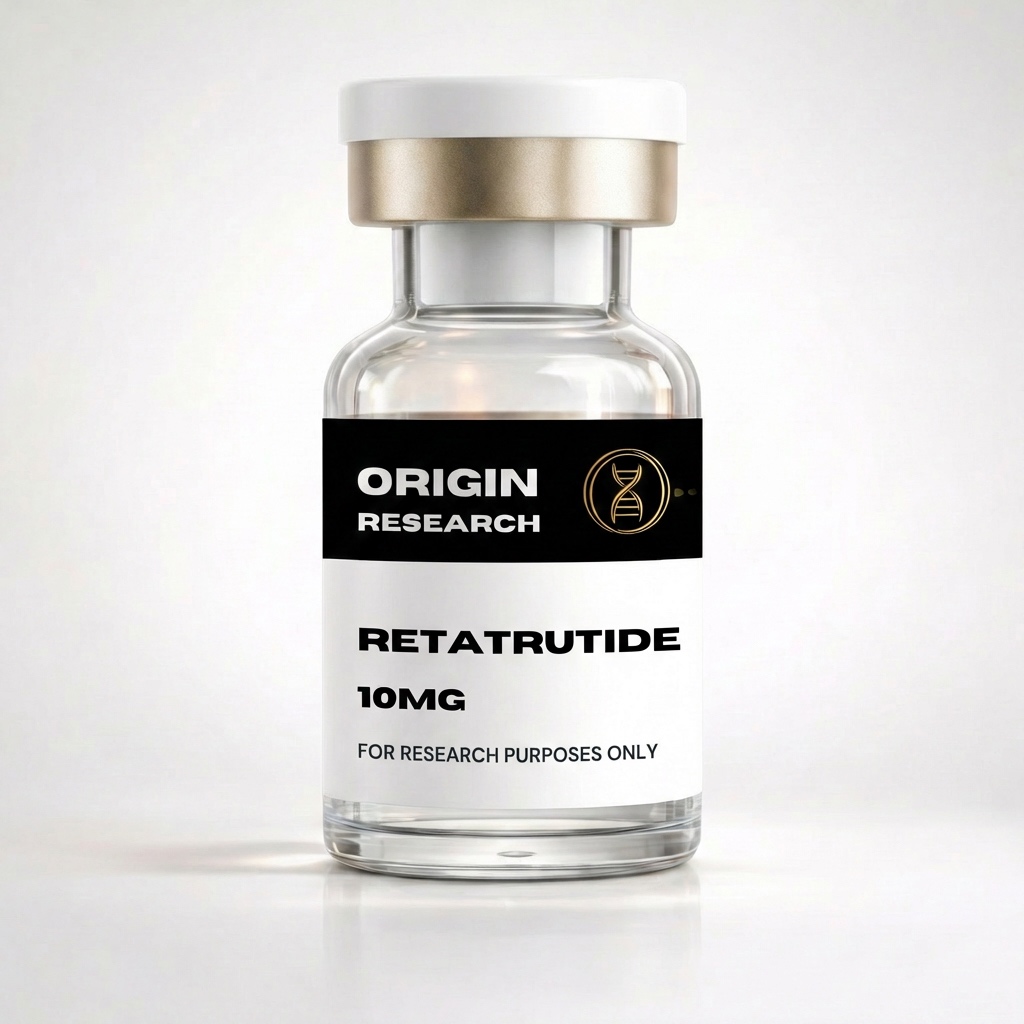
Retatrutide is a research peptide that hits three different receptors with a single molecule. That is unusual. Most peptides in the metabolic research space are built to activate one receptor cleanly. Retatrutide was engineered, on purpose, to engage three at once.
The three targets are the GLP-1 receptor, the GIP receptor, and the glucagon receptor. All three belong to the same broader family of metabolic receptors, which is why a single peptide backbone can be tuned to fit all of them. Eli Lilly and Company developed the molecule as part of a research programme into multi-receptor agonist peptides for metabolic indications.
The peptide also carries a fatty acid attached to its side, which is not for activity but for staying power. The fatty acid lets the molecule grab onto albumin in the blood, dramatically extending how long it lasts before being cleared.
This article covers the chemistry, the mechanism of action across the three receptors, how Retatrutide compares to related metabolic research peptides, and what to verify when sourcing material.
All content is supplied for laboratory and academic reference only. Origin Labs supplies the compound under a Research Use Only framework for in vitro and preclinical investigation by qualified personnel.
Chemistry and structural characterisation
Retatrutide is a 39-amino-acid synthetic peptide. Its backbone is built on the architecture of the glucagon-secretin family of peptides, then modified extensively at many positions to balance binding across the three target receptors.
The fatty acid attachment
The molecule includes a 20-carbon fatty diacid tail, attached through a hydrophilic linker to a lysine residue. That tail does not do biological work on the receptors directly. Its job is logistical: it lets Retatrutide bind reversibly to serum albumin in the bloodstream.
Why albumin binding matters
Think of albumin as a slow-release carrier protein floating around in blood plasma. When a peptide grabs onto albumin, it gets protected from rapid clearance by the kidneys and from breakdown by enzymes. The net result is a much longer plasma half-life.
- Molecular weight: approximately 4,729 daltons
- Backbone: derived from glucagon-secretin family architecture
- Conformation: alpha-helical in the central region
- Receptor class: class B G-protein-coupled receptors
Synthesis
For research purposes, the peptide is built using standard solid-phase peptide synthesis. The fatty acid conjugation step is typically performed after the peptide backbone is assembled.
Solubility and handling
The lyophilised compound dissolves in aqueous buffers at neutral pH and in bacteriostatic water. The fatty acid component contributes some hydrophobicity that may influence handling at higher concentrations.
Published HPLC and mass spectrometry characterisation typically references purity of 98 percent or higher for research-grade material. For metabolic readouts in vivo, 99 percent or higher is preferred.
Mechanism of action in the research literature
The interesting part of Retatrutide is that it activates three receptors at roughly equivalent strength. The published literature describes it as a balanced agonist, with binding affinities for each receptor reported in the same nanomolar range.
Here is what each receptor does, and why combining all three is the design idea.
GLP-1 receptor
The most extensively characterised of the three across the broader incretin literature. Activation produces:
- Increased insulin secretion from pancreatic beta cells (the insulin-producing cells in the pancreas)
- Slowed gastric emptying in animal models
- Central nervous system effects on appetite-regulating circuits
GIP receptor
Adds a parallel incretin signal. Characterised as:
- Enhancing insulin secretion in a glucose-dependent manner
- Contributing to effects on adipose tissue biology in preclinical models
Glucagon receptor
This is the most distinctive feature of Retatrutide and the broader triple-agonist class. Glucagon receptor signalling has been characterised as:
- Increasing energy expenditure through effects on hepatic and brown adipose tissue metabolism
Why all three at once
The single-agonist GLP-1 compounds activate one receptor. The dual agonist Tirzepatide activates two. Retatrutide adds the third (glucagon), which brings energy expenditure into the mix. The published research investigates whether the three activities together produce additive or synergistic metabolic effects in animal models.
The composite mechanism in the literature: three receptor activities working together produce metabolic effects on glucose homeostasis and energy balance that have been investigated in rodent obesity models and in published clinical research programmes.
Retatrutide is described in the published literature as an investigational compound. The mechanism discussion above refers to findings reported in peer-reviewed sources without implying any clinical application of supplied research material.
Pathway and receptor biology
All three target receptors belong to the same family: class B G-protein-coupled receptors. They share a seven-transmembrane architecture and a related signalling repertoire. That structural similarity is why a single peptide can be engineered to bind all of them.
Where each receptor is expressed
GLP-1 receptor
- Pancreatic beta cells
- Central nervous system
- Gastrointestinal tract
- Cardiovascular tissues
Primary signalling: Gs-cAMP-PKA axis, with additional contributions from beta-arrestin pathways.
GIP receptor
- Pancreatic beta cells
- Adipose tissue
- Select central nervous system regions
Shares the Gs-cAMP signalling output, with additional pathway connections characterised in relation to adipose biology.
Glucagon receptor
- Liver (most prominent)
- Adipose tissue
- Other peripheral tissues
Signals through Gs-cAMP and through Gq-mediated calcium release pathways in some cell types.
Composite downstream effects
The simultaneous activation of all three receptors produces a signalling profile that has been investigated in detailed pharmacology research. Effects characterised in the literature include:
- Enhanced insulin secretion in pancreatic islet preparations
- Increased lipolysis (breakdown of stored fat) in adipose tissue models
- Increased hepatic glucose output, offset by the insulinotropic effects on islet beta cells
- Central nervous system effects on appetite regulation through hypothalamic circuits
The integration of these effects across multiple tissues has been the focus of substantial preclinical pharmacology work, since the additive contribution of each receptor is what distinguishes Retatrutide from earlier single- and dual-agonist compounds.
Major research domains and published evidence base
The published evidence base for Retatrutide spans both preclinical pharmacology and an emerging clinical research programme.
Preclinical research
Published studies have investigated the compound in rodent models of:
- Obesity
- Type 2 diabetes
- Metabolic dysfunction-associated steatotic liver disease (MASLD, formerly called NAFLD)
Reports characterise effects on body weight, glycaemic control, and hepatic lipid content.
Receptor pharmacology
Detailed characterisation of receptor binding profiles in cell-based assays, with measurement of relative potency at each of the three target receptors and assessment of signalling bias across available pathways.
Clinical research programme
Published clinical research has reported on phase 1 and phase 2 investigational trials in the metabolic disease setting. Results have appeared in major journals covering obesity and diabetes research.
Comparators in the broader landscape
Retatrutide has received considerable attention as a representative example of the multi-agonist design paradigm. Adjacent research compounds in the metabolic space include MOTS-c, a mitochondrial-derived peptide that works through the AMPK pathway, and 5-Amino-1MQ, a small molecule investigated as an NNMT inhibitor in adipose biology.
Research material supplied under a Research Use Only framework is intended for laboratory investigation of receptor biology, signalling pathways, and related preclinical questions by qualified research personnel. It is not intended to replicate or substitute for clinical research conducted under regulated trial conditions.
Comparative literature against related compounds
Retatrutide sits within a family of incretin and multi-agonist research compounds. Understanding the comparisons is essential for designing research that isolates specific receptor contributions.
Single-agonist GLP-1 compounds
The reference comparators with the longest research history:
- Semaglutide: long-acting GLP-1 agonist
- Liraglutide: shorter-acting GLP-1 agonist
- Exenatide: earlier Exendin-4 derivative
All three have extensive characterisation across many publications covering mechanism, pharmacology, and clinical effects.
Dual-agonist Tirzepatide
The closest comparator to Retatrutide in design philosophy. Activates both GLP-1 and GIP receptors. Developed by the same research organisation. Provides an important reference for understanding what the addition of glucagon receptor agonism in Retatrutide contributes on top of the dual mechanism.
Dual GLP-1 / glucagon agonists
Cotadutide is a representative example. Provides a different axis of comparison, since it carries glucagon agonism without GIP.
Other triple-agonist research compounds
Different research groups have characterised additional triple-agonist molecules. The comparative pharmacology across these multi-agonist peptides has been the subject of detailed receptor-pharmacology investigations.
Adjacent metabolic research compounds
Different mechanism, but often studied in overlapping models:
- MOTS-c: mitochondrial-derived peptide, AMPK pathway
- 5-Amino-1MQ: small molecule NNMT inhibitor
The comparative literature is useful for designing experiments that isolate the contribution of specific receptor activities within the broader multi-agonist signalling profile.
Procurement, certificate of analysis, and verification
Research-grade Retatrutide is supplied as a lyophilised powder in sealed vials, most commonly at 5 mg or 10 mg per vial. Shipping is temperature-controlled to preserve integrity.
What the COA should report
- Peptide sequence, including documentation of the fatty acid conjugation
- Analytical purity by HPLC
- Mass confirmation by mass spectrometry
- Appearance of the lyophilised cake
- Residual solvent content
- Endotoxin level where relevant
- Batch number matching the vial label
Purity benchmarks
- Below 98 percent: marginal for academic work
- 98 percent or higher: standard
- 99 percent or higher: preferred for in vivo rodent pharmacology studies, where impurities could confound the metabolic readout
Storage
- 4 degrees Celsius for short-term holding of lyophilised material
- Minus 20 degrees Celsius for longer-term storage of unopened vials
Special handling for fatty-acid-conjugated peptides
The fatty acid conjugation and the larger molecular size of Retatrutide compared with shorter research peptides may require more careful handling during reconstitution. The standard approach referenced in the literature is gentle mixing rather than vigorous shaking, which is true for fatty-acid-conjugated incretin peptides as a class.
Always cross-check the batch number printed on the COA against the physical vial label at the moment of receipt. The COA is only valid for the batch number it references.
Origin Labs supplies Retatrutide with a documented certificate of analysis per batch. The compound is supplied under a Research Use Only framework for qualified research personnel and is not intended or authorised for human or veterinary clinical use.
References
- [1] Coskun T, Urva S, Roell WC, Qu H, Loghin C, Moyers JS, et al. (2022). LY3437943, a novel triple glucagon, GIP, and GLP-1 receptor agonist for glycemic control and weight loss: from discovery to clinical proof of concept. Cell Metabolism. PMID 35921817
- [2] Jastreboff AM, Kaplan LM, Frias JP, Wu Q, Du Y, Gurbuz S, et al. (2023). Triple-hormone-receptor agonist retatrutide for obesity: a phase 2 trial. New England Journal of Medicine. PMID 37356779
- [3] Rosenstock J, Frias J, Jastreboff AM, Du Y, Lou J, Gurbuz S, et al. (2023). Retatrutide, a GIP, GLP-1 and glucagon receptor agonist, for people with type 2 diabetes: a randomised, double-blind, placebo and active-controlled, parallel-group, phase 2 trial. Lancet. PMID 37364590
- [4] Sanyal AJ, Kaplan LM, Frias JP, Brouwers B, Wu Q, Thomas MK, et al. (2024). Triple hormone receptor agonist retatrutide for metabolic dysfunction-associated steatotic liver disease: a randomized phase 2a trial. Nature Medicine. PMID 38951632
- [5] Knerr PJ, Mowery SA, Finan B, Perez-Tilve D, Tschop MH, DiMarchi RD (2020). Selection and progression of unimolecular agonists at the GIP, GLP-1, and glucagon receptors as drug candidates. Peptides. PMID 31926486
Frequently asked questions
Where can verified research-grade Retatrutide be sourced?
Origin Labs supplies research-grade Retatrutide at originlabsresearch.com with a batch-specific certificate of analysis for each vial. The material is supplied under a Research Use Only framework for qualified research personnel.
What three receptors does Retatrutide activate?
Retatrutide has been characterised in the published research literature as a balanced agonist at the GLP-1 receptor, the GIP receptor, and the glucagon receptor, all of which are class B G-protein-coupled receptors of the glucagon-secretin family.
What should the certificate of analysis for Retatrutide include?
The COA should report the peptide sequence including documentation of the fatty acid conjugation, analytical purity by HPLC at 98 percent or higher, mass confirmation by mass spectrometry, appearance of the lyophilised cake, batch number matching the vial label, and where relevant the residual solvent and endotoxin values.
What research models has Retatrutide been most studied in?
Published preclinical research has characterised Retatrutide in rodent models of obesity, type 2 diabetes, and metabolic dysfunction-associated steatotic liver disease, alongside cell-based pharmacology assays measuring relative potency at each of the three target receptors.
What other research peptides are in the same comparative family?
Reference comparators in the published literature include the dual GLP-1/GIP agonist Tirzepatide, the single-agonist GLP-1 compounds Semaglutide and Liraglutide, the dual GLP-1/glucagon agonist Cotadutide, and the earlier Exendin-4 derivative Exenatide.
Why is a fatty acid attached to the Retatrutide peptide backbone?
The fatty diacid component facilitates reversible binding to serum albumin in published pharmacokinetic models, which extends plasma half-life and allows infrequent dosing in research animal studies. The design principle is shared with several long-acting incretin compounds documented in the literature.
Has Retatrutide been approved for any clinical indication?
Retatrutide has been investigated in published phase 1 and phase 2 clinical research programmes as of the most recent literature, and is described as an investigational compound. All material supplied by Origin Labs is for research use only and is not intended or authorised for clinical or veterinary use.