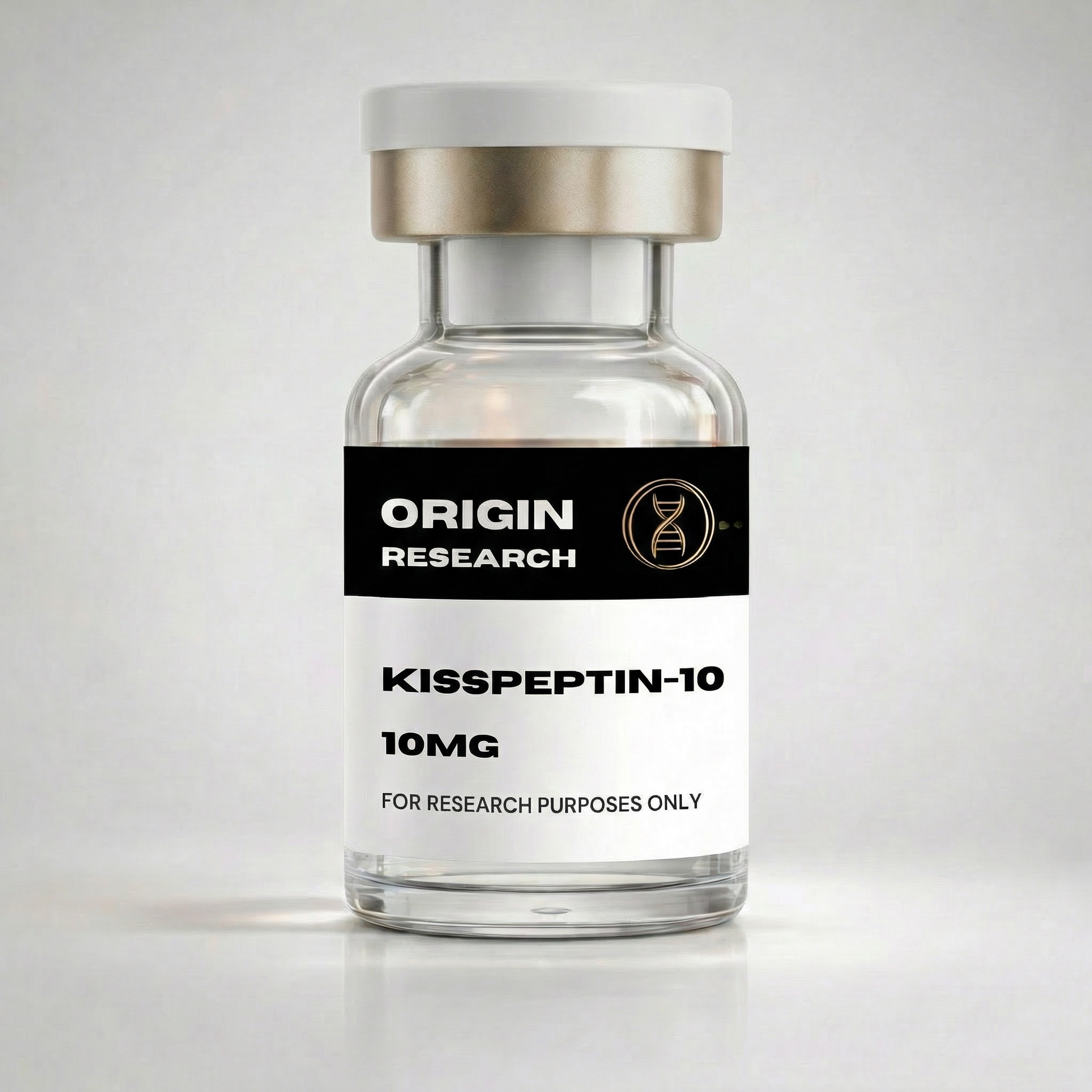
Kisspeptin sits at the top of the hypothalamic-pituitary-gonadal axis in research models. Without it, the downstream GnRH neurons stay quiet. Loss-of-function mutations in the kisspeptin receptor produce a clear phenotype of impaired GnRH neuron activity in preclinical research. That single finding made the entire research field.
The KISS1 gene encodes a 145 amino acid precursor. Cells process it into several active fragments. The shortest one, Kisspeptin-10, is the C-terminal 10 amino acids. That short peptide retains full agonist activity at the receptor (called KISS1R or GPR54), which makes it the standard research probe for pathway studies.
This article covers the receptor pharmacology of KISS1R, the two main hypothalamic kisspeptin neuron populations and what each does, the use of Kisspeptin-10 as a research compound in cellular and animal HPG axis pathway work, and the analytical methods used to validate it.
Scope note: this is receptor pharmacology and HPG axis pathway biology. The content is research-focused. It is not clinical guidance, fertility guidance, or any consumer-facing application.
KISS1 gene and the active peptide fragments
The KISS1 gene was originally identified as a metastasis suppressor in melanoma cell lines. The encoded protein was first called metastin. Subsequent research established that the precursor protein is processed to a family of C-terminal fragments, all sharing the same C-terminal sequence and all capable of activating KISS1R with comparable potency.
The fragment family
- Kisspeptin-54: the longest active fragment, first characterized in receptor activation studies
- Kisspeptin-14
- Kisspeptin-13
- Kisspeptin-10: the shortest, the C-terminal 10 amino acids, full agonist activity retained
All fragments share the same C-terminal residues. The C-terminal phenylalanine is amidated, and that amide modification is critical for receptor binding.
Why Kisspeptin-10 is the standard probe
It is the smallest molecule with full activity. That makes solid-phase peptide synthesis straightforward. Quality control is simpler. Characterization is cleaner.
Synthesis uses standard Fmoc chemistry with C-terminal amidation introduced through the appropriate resin. HBTU or HATU coupling reagents do the chain assembly. Quality control includes HPLC purity, mass spectrometry molecular mass confirmation, and amino acid analysis.
Research-grade Kisspeptin-10 is supplied as a research compound for KISS1R signaling and HPG axis pathway studies.
Where the gene is expressed
Beyond the hypothalamus, KISS1 is expressed in:
- Placenta (syncytiotrophoblast)
- Pancreas (beta cells)
- Gonadal tissue (granulosa and Leydig cells)
Hypothalamic expression has received the most research attention because of its central role in HPG axis pathway regulation.
Sequence conservation matters. The C-terminal region is highly conserved across mammals. Rodent and primate Kisspeptin-10 share identical core residues. This allows cross-species use of the same research probe.
KISS1R receptor structure and signaling
KISS1R is a class A G protein-coupled receptor. It was an orphan receptor before kisspeptin was identified as its endogenous ligand. Standard seven transmembrane helix architecture.
G protein coupling
KISS1R couples predominantly to the Gq family of heterotrimeric G proteins. Some research evidence supports additional Gi or G12 coupling in certain cellular contexts, but Gq is the dominant pathway.
The canonical Gq cascade
- Ligand binds the extracellular receptor face
- Alpha-q subunit dissociates from beta-gamma
- Alpha-q activates phospholipase C beta
- PLC-beta hydrolyzes PIP2 into IP3 and DAG
- IP3 triggers calcium release from ER stores
- DAG activates protein kinase C isoforms
Downstream consequences include neuronal excitability changes, transcription factor activation, and secretory function.
Effects on GnRH neurons
In patch-clamp electrophysiology studies of identified GnRH neurons:
- KISS1R activation produces depolarization
- Action potential firing increases
- Downstream stimulation of GnRH release into the hypothalamic-pituitary portal circulation
MAPK and arrestin signaling
KISS1R also engages the MAPK cascade. ERK1 and ERK2 activation contributes to transcriptional effects in research models.
Beta-arrestin recruitment following receptor activation has been characterized in desensitization studies. This shapes the kinetics of signaling under sustained or pulsatile ligand exposure. Internalization through clathrin-coated pits removes receptors from the surface. Recycling or degradation determines how fast signaling capacity returns.
KNDy neuron cross-talk
KISS1R interacts functionally with other receptors expressed on GnRH neurons. Neurokinin B receptors and dynorphin receptors participate in the KNDy regulatory network covered in the next section.
Receptor pharmacology research uses synthetic agonists with modified structures (improved metabolic stability), biased agonists (selective for subsets of downstream pathways), and antagonists (block endogenous or exogenous ligand activation). These tool compounds plus Kisspeptin-10 make up the KISS1R pharmacology toolkit.
The two hypothalamic kisspeptin neuron populations
Two distinct kisspeptin neuron populations exist in the hypothalamus. Each does a different job.
Arcuate nucleus KNDy neurons
The arcuate nucleus (called the infundibular nucleus in primates) contains kisspeptin neurons that co-express three peptides:
- Kisspeptin
- Neurokinin B
- Dynorphin
That is the KNDy acronym. These neurons drive tonic pulsatile GnRH release.
AVPV kisspeptin neurons
The anteroventral periventricular nucleus contains a separate kisspeptin neuron population. This population is sexually dimorphic in rodent models. In female animals, AVPV neurons drive the preovulatory GnRH surge.
How both populations work together
Both populations project to GnRH neurons in the medial preoptic area and arcuate nucleus. Both activate KISS1R on GnRH neuron cell bodies and dendrites. But they respond to gonadal steroid feedback in opposite ways.
The negative versus positive feedback split: arcuate KNDy neurons mediate the negative feedback of estradiol on GnRH (tonic mode). AVPV neurons mediate the positive feedback that drives the surge (cyclic mode in female animals).
Both populations express estrogen receptor alpha. The opposite transcriptional responses to estradiol exposure provide the mechanistic basis for negative and positive feedback.
KNDy neurons as the pulse generator
The KNDy network has self-regulatory wiring:
- Neurokinin B acts on NK3 receptors on neighboring KNDy neurons (excitatory drive)
- Dynorphin acts on kappa opioid receptors on neighboring KNDy neurons (inhibitory feedback)
The balance between these autoregulatory inputs generates the rhythmic firing pattern that drives pulsatile GnRH release in preclinical electrophysiology studies. Multielectrode array recordings of arcuate kisspeptin neuron populations show synchronized burst firing that correlates temporally with GnRH pulses in the median eminence.
Causal testing
Optogenetic activation of KNDy neurons has been used to causally test their role in driving downstream gonadotropin release. The results confirm the upstream regulatory function predicted by pharmacological and lesion studies.
AVPV neuron biology
AVPV kisspeptin neurons have different intrinsic electrophysiology than KNDy neurons. They receive different synaptic inputs. Steroid feedback combined with circadian timing signals generates the temporally precise surge of GnRH release that triggers ovulation in female rodent research models.
The molecular and circuit-level characterization of these two populations is one of the most thoroughly developed areas of neuroendocrine systems research.
Kisspeptin-10 as a research compound
Kisspeptin-10 is the standard research probe for KISS1R activation. Cellular assays, slice preparations, and in vivo animal studies all use it.
Cellular receptor research
Transfected cell lines expressing recombinant KISS1R provide controlled platforms:
- Calcium mobilization assays with fluorescent indicators (Fluo-4, Fura-2). Response in seconds to minutes.
- Inositol phosphate accumulation assays. Traditional radiolabeled formats and modern TR-FRET formats.
- Beta-arrestin recruitment assays. Enzyme complementation or BRET-based. Capture the desensitization arm distinct from canonical Gq.
Hypothalamic slice electrophysiology
In rodent hypothalamic slice preparations, Kisspeptin-10 application is used to characterize the firing response of identified GnRH neurons. This provides direct evidence of the upstream regulatory role of kisspeptin signaling.
Rodent in vivo HPG axis research
Administration of Kisspeptin-10 in rodent models allows investigation of the full neuroendocrine cascade:
- Receptor activation in hypothalamus
- GnRH release into the portal circulation
- Gonadotropin (LH, FSH) secretion from the pituitary
- Gonadal steroidogenesis response
Serial blood sampling and tissue collection allow characterization of each step in the pathway.
Transcriptomic applications
Treatment of cellular models with Kisspeptin-10 has been used to characterize gene expression programs activated downstream of KISS1R signaling. Bulk RNA sequencing and single-cell transcriptomic approaches have generated comprehensive catalogs of regulated transcripts.
Proteomics
Phospho-proteomic profiling following Kisspeptin-10 stimulation has identified the substrate landscape of the activated signaling cascades. This complements targeted phospho-specific antibody readouts used in pathway research.
Neural circuit research
Slice electrophysiology combined with optogenetic and chemogenetic tools allows dissection of the specific neuronal populations that respond to receptor activation and the downstream circuit consequences in defined brain regions.
Other receptor research contexts
Some HPG axis research protocols use Kisspeptin-10 alongside other neuropeptide research compounds in adjacent receptor pharmacology studies. Oxytocin has been studied as a research probe in neighboring hypothalamic and pituitary receptor pathway work, though oxytocin and kisspeptin engage different receptor systems.
Application breadth: from molecular receptor pharmacology in transfected cells to circuit-level dissection in slices to whole-animal neuroendocrine cascade studies. Kisspeptin-10 covers all of it as a defined synthetic probe.
Pharmacology, stability, and handling
Kisspeptin-10 is a 10 amino acid peptide. Small peptides have stability challenges, and Kisspeptin-10 is no exception.
Stability in biological matrices
The peptide is cleaved by matrix metalloproteinases and other proteases in plasma. Reported circulating half-life in rodent models: on the order of minutes following bolus administration.
This rapid clearance has motivated development of modified analogs with improved metabolic stability:
- Non-natural amino acid substitutions
- N-terminal modifications resistant to proteolysis
For routine receptor and pathway research, native Kisspeptin-10 remains the standard reference compound.
Reconstitution
- Lyophilized powder
- Reconstitute in sterile aqueous diluent
- Avoid repeated freeze-thaw cycles
Bioassay validation
Most commonly performed through:
- KISS1R-mediated calcium mobilization in transfected cell lines
- Inositol phosphate accumulation as functional readout
Storage
- Stock solutions: aliquot at micromolar concentrations, store at -80 degrees Celsius
- Lyophilized powder: stable for extended periods at -20 degrees Celsius or below in moisture-protected containers
- Working aliquots: thaw only as needed, do not refreeze
Solution-phase degradation
Principal pathways:
- Enzymatic cleavage when biological matrices are present
- Chemical degradation including potential C-terminal deamidation under non-physiological pH
The amidated C-terminus is essential for receptor binding affinity. Loss of the amide during storage or handling causes substantial decrease in bioassay potency.
Adsorption to plastic
At low nanomolar concentrations typical of receptor activation experiments, the peptide adsorbs to plastic surfaces non-specifically. Adding bovine serum albumin at low concentration in working dilutions reduces this loss.
Quality control essentials: HPLC for purity, mass spectrometry for molecular mass confirmation. These analytical certificates should accompany research-grade material.
Beyond the HPG axis: additional research contexts
Although the hypothalamic GnRH neuron application dominates, KISS1 and KISS1R are expressed in additional tissues. Research has explored kisspeptin signaling in several other contexts.
Placental research
Kisspeptin is produced in syncytiotrophoblast cells. Research has investigated effects on trophoblast invasion and placental development in preclinical models. This connects to the original characterization of KISS1 as a metastasis suppressor gene.
Pancreatic research
KISS1R expression in beta cells has been investigated in cellular models of insulin secretion. Published reports describe effects on glucose-stimulated insulin release.
Gonadal research
Local expression of KISS1 and KISS1R has been characterized in granulosa cells and Leydig cells. This suggests a potential autocrine or paracrine signaling role at the steroidogenic tissue level, beyond the central HPG axis effects.
Oncology research
The original metastasis suppressor function of KISS1 continues to be investigated in cellular models of tumor cell invasion. Signaling mechanisms in this context are distinct from the GnRH neuron context.
Vascular research
KISS1R expression in vascular tissue has been characterized. Reports describe KISS1R-mediated vasoconstrictor responses in isolated vessel preparations from rodent research models. Signaling involves calcium mobilization through the canonical Gq pathway.
Adipose and bone research
- KISS1R expression in some adipose preparations with possible roles in adipocyte biology (active investigation)
- KISS1R expression on osteoclasts and osteoblasts with reported effects of Kisspeptin-10 on bone cell differentiation
Interpretation requires care. Tissue-specific expression patterns and distinct local signaling environments mean effects in non-classical contexts depend on receptor expression levels, cross-talk with other receptor systems, and tissue-specific downstream wiring. These are standard considerations in published preclinical research on kisspeptin biology beyond the classical neuroendocrine axis.
Assay development for KISS1R research
Multiple complementary readouts now exist for KISS1R research. Choice depends on the specific question.
Functional assay options
- Calcium mobilization. Fluorescent calcium indicators (Fluo-4, Fura-2). Seconds-to-minutes timescale.
- Inositol phosphate accumulation. Traditional radiolabeled or modern TR-FRET. Cumulative downstream readout.
- Beta-arrestin recruitment. Enzyme complementation or BRET. Captures desensitization arm.
- cAMP measurement. Used when investigating possible Gi coupling. Secondary readout for KISS1R given dominant Gq coupling.
- ERK phosphorylation. Phospho-specific immunoblotting or AlphaLISA. Captures MAPK arm.
Cellular systems
Recombinant expression systems:
- HEK293 stably expressing KISS1R
- CHO cells stably expressing KISS1R
- Standardized assay conditions across labs
Endogenous expression systems:
- GT1-7 hypothalamic GnRH neuronal cell line. Endogenous KISS1R plus relevant cellular context.
- Used to validate findings from recombinant systems
Radioligand binding
Radioiodinated Kisspeptin-10 or analogs provide quantitative receptor binding measurements:
- Equilibrium dissociation constants in the low nanomolar range
- Consistent with high-affinity receptor activation in functional assays
- Saturation experiments yield receptor density on cell surface
- Supports calculation of receptor occupancy at any given ligand concentration
Quality control of synthetic Kisspeptin-10
Validation as a research reference standard includes:
- HPLC for chemical purity
- Mass spectrometry for molecular mass and identity
- Bioassay-confirmed activity in one of the standardized formats above
Bioassay confirmation is the most direct measure of functional integrity beyond chemical purity and identity. Without it, a chemically pure but functionally compromised batch could slip through.
The pharmacological toolkit: native Kisspeptin-10, modified stability analogs, biased agonists, and antagonists. Together they support structure-activity relationship studies and mechanistic dissection of KISS1R signaling in cellular and preclinical animal research.
References
- [1] de Roux N, Genin E, Carel JC, Matsuda F, Chaussain JL, Milgrom E (2003). Hypogonadotropic hypogonadism due to loss of function of the KiSS1-derived peptide receptor GPR54. Proceedings of the National Academy of Sciences USA. PMID 12944565
- [2] Seminara SB, Messager S, Chatzidaki EE, et al. (2003). The GPR54 gene as a regulator of puberty. New England Journal of Medicine. PMID 14573733
- [3] Pinilla L, Aguilar E, Dieguez C, Millar RP, Tena-Sempere M (2012). Kisspeptins and reproduction: physiological roles and regulatory mechanisms. Physiological Reviews. PMID 22811427
- [4] Lehman MN, Coolen LM, Goodman RL (2010). Minireview: kisspeptin/neurokinin B/dynorphin (KNDy) cells of the arcuate nucleus: a central node in the control of gonadotropin-releasing hormone secretion. Endocrinology. PMID 20410198
- [5] Kotani M, Detheux M, Vandenbogaerde A, et al. (2001). The metastasis suppressor gene KiSS-1 encodes kisspeptins, the natural ligands of the orphan G protein-coupled receptor GPR54. Journal of Biological Chemistry. PMID 11297777
- [6] Oakley AE, Clifton DK, Steiner RA (2009). Kisspeptin signaling in the brain. Endocrine Reviews. PMID 19589949
Frequently asked questions
What is Kisspeptin-10 and what does it activate?
Kisspeptin-10 is the C-terminal 10 amino acid fragment of the KISS1 gene product. It is the minimal sequence with full agonist activity at KISS1R in research bioassays and is used as a research probe of KISS1R signaling and HPG axis pathway biology.
What signaling pathway does KISS1R activate?
KISS1R is a G protein-coupled receptor that couples predominantly to Gq. It activates phospholipase C beta to generate IP3 and DAG, with downstream calcium release and protein kinase C activation in research models.
What are KNDy neurons?
Arcuate nucleus kisspeptin neurons that co-express neurokinin B and dynorphin. They are thought to constitute the pulse generator driving pulsatile GnRH release in preclinical hypothalamic research.
How do AVPV neurons differ from KNDy neurons?
AVPV kisspeptin neurons mediate the preovulatory GnRH surge in female rodent research through positive estradiol feedback. Arcuate KNDy neurons mediate tonic pulsatile GnRH release through negative steroid feedback.
Which assays characterize Kisspeptin-10 activity?
Calcium mobilization, inositol phosphate accumulation, and beta-arrestin recruitment assays in transfected cell lines expressing KISS1R. Hypothalamic slice electrophysiology is used to characterize effects on GnRH neuron firing.
Is Kisspeptin-10 stable in biological matrices?
No. It is cleaved by matrix metalloproteinases and other proteases. Reported circulating half-life in rodent research models is on the order of minutes following bolus administration.
Is Kisspeptin-10 supplied for fertility or clinical use?
No. Origin Labs supplies Kisspeptin-10 as a research compound for Research Use Only laboratory investigation of KISS1R signaling and HPG axis pathway biology. It is not supplied for human, fertility, clinical, or consumer use.