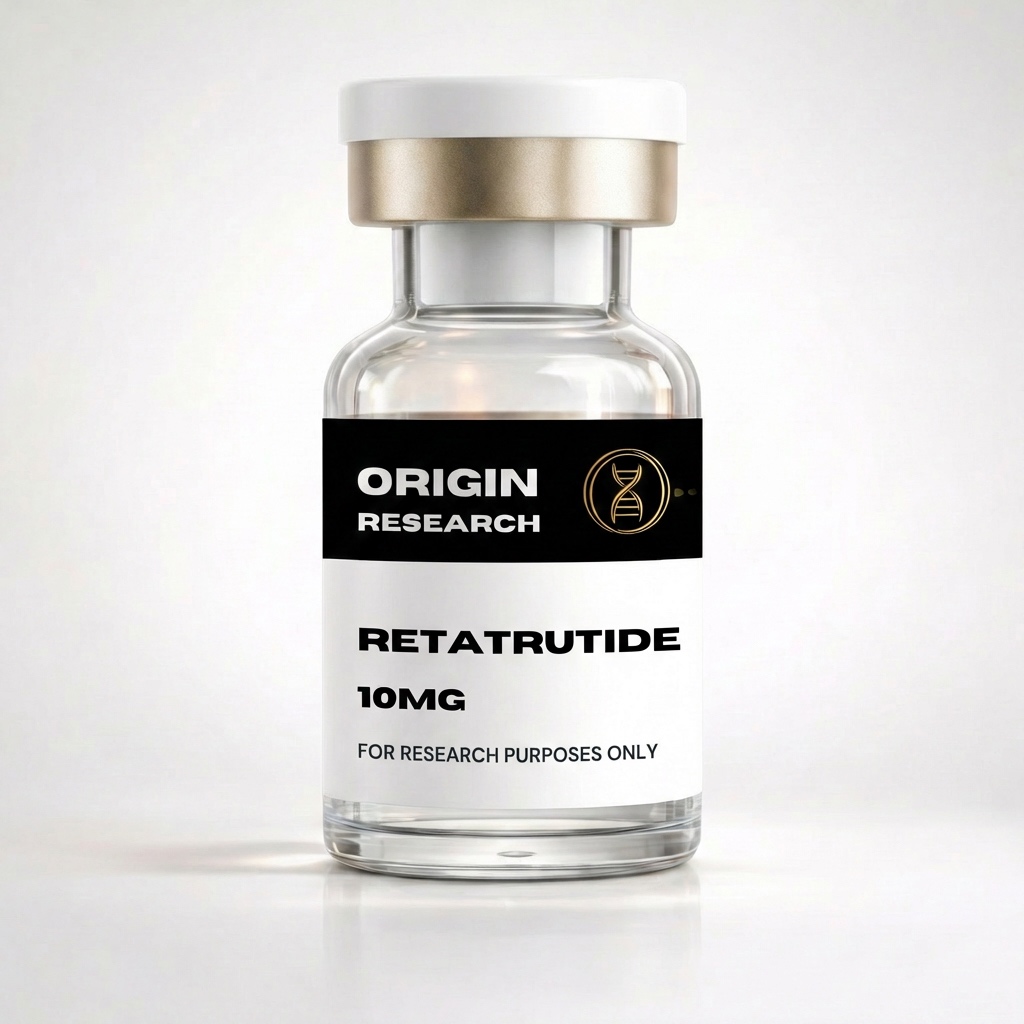
Three generations of GLP-1 research molecules. Each one engages more receptors than the last. Each one shows up in published preclinical work with a slightly different metabolic fingerprint.
Here's the short version. Semaglutide hits one receptor. Tirzepatide hits two. Retatrutide hits three. That progression took about twenty years of medicinal chemistry to engineer, and the receptor pharmacology behind it is genuinely interesting.
This article walks through what the published research literature actually says about these molecules. The chemistry that makes them tick. The receptors they engage. The preclinical models researchers have used to characterise them. And what to look for when sourcing reference material for laboratory work.
All discussion is research-use-only. Third-person framing. No human-use language.
Chemistry and structural backbone
Native GLP-1 is a 30-amino-acid peptide. It comes from the proglucagon precursor, gets cleaved in the gut by L cells, and lives for about one to two minutes in research animals before getting chewed up by an enzyme called DPP-4 (dipeptidyl peptidase-4) and cleared by the kidneys.
That short half-life is the problem every GLP-1 analogue tries to solve.
Semaglutide: three modifications
Semaglutide solves it with three structural changes characterised in the published literature.
- Position-eight alanine swapped for alpha-aminoisobutyric acid (Aib), a non-natural residue that DPP-4 cannot cleave
- A C18 fatty diacid chain attached to lysine 26 via a linker, letting the molecule bind reversibly to albumin and float around for about a week
- An arginine substitution at position 34 to make sure the fatty chain attaches at the right spot
Tirzepatide: a chimera
Tirzepatide is a 39-amino-acid synthetic chimera. The backbone is mostly GIP (glucose-dependent insulinotropic polypeptide), but it borrows tricks from GLP-1 research. Same Aib substitution at position two. A C20 fatty diacid for albumin binding.
Retatrutide: triple engagement
Retatrutide goes further. Same 39-residue framework, but engineered to engage three class-B G-protein-coupled receptors at once. Aib residues at positions two and thirteen. C20 diacid lipidation. The design pulls structural motifs from GIP, GLP-1, and glucagon.
The class-B receptors share enough sequence similarity that a single peptide can be engineered to hit all three. That insight is what made tri-agonism possible.
What synthesis looks like
Research-grade material is made by solid-phase peptide synthesis using Fmoc protection chemistry. The lipidated side chain gets attached in a separate solution-phase step. Method choice matters because the linker length, the fatty chain length, and the attachment site all change how the molecule behaves.
Mechanism at the receptor level
All three molecules act on class-B secretin-family G-protein-coupled receptors. Three receptors are relevant here.
- GLP-1R (the GLP-1 receptor)
- GIPR (the GIP receptor)
- GCGR (the glucagon receptor)
They share roughly 40 to 50 percent sequence identity in the seven-transmembrane domain. They all use the same two-domain binding model characterised in cryo-electron microscopy research: the C-terminal of the peptide grabs the extracellular domain, and the N-terminal slides into the transmembrane bundle to trigger G-alpha-s coupling.
How each agonist behaves
Semaglutide Near-full agonist at GLP-1R. Potency in the low picomolar to low nanomolar range depending on the cell system. Selectivity for GLP-1R over the other two receptors exceeds three orders of magnitude in published binding studies.
Tirzepatide Balanced dual agonist at GLP-1R and GIPR. In transfected cell lines, it is actually more potent at GIPR than at GLP-1R. It shows partial agonism at GLP-1R compared to native peptide on certain endpoints. This biased pharmacology has been examined extensively in beta-arrestin and cAMP comparisons.
Retatrutide Engages all three receptors. Balanced agonism at GIPR and GLP-1R, somewhat lower relative activity at GCGR. The exact rank order shifts depending on cell background and assay format.
Receptor residence time matters. Published surface plasmon resonance research has measured the on-rate and off-rate of each agonist at each receptor, and slow off-rate correlates with longer downstream signalling.
Pathway biology and downstream signalling
What happens after the receptor is engaged? That depends on the receptor and the cell type.
In pancreatic beta cells
GLP-1R activation in preclinical islet research couples through G-alpha-s. cAMP goes up. Protein kinase A activates. So does Epac2, a cAMP-activated guanine nucleotide exchange factor. The downstream effects include:
- Enhanced glucose-stimulated insulin secretion
- Modulation of voltage-gated potassium channels
- Changes in beta-cell gene transcription via CREB-family factors
In the brain
GLP-1R is expressed in three central nervous system regions characterised extensively in rodent neurophysiology research.
- Arcuate nucleus of the hypothalamus
- Area postrema
- Nucleus tractus solitarius
Receptor activation in these regions modulates neuronal firing in satiety circuitry. Published research has characterised the projections from these hypothalamic neurons to multiple downstream brain regions involved in autonomic and behavioural pathway biology.
GIPR and GCGR additions
GIPR signalling has been characterised in adipose tissue and in pancreatic alpha and beta cells, with effects on lipid handling and glucagon secretion that differ from GLP-1R.
GCGR activation (relevant for retatrutide) has been characterised in hepatic and adipose research models as influencing gluconeogenesis, lipolysis, and energy expenditure pathways.
The combined receptor engagement produces metabolic signatures in rodent models that single or dual agonists cannot reproduce.
Research domains and published preclinical literature
The preclinical literature on the GLP-1 family is enormous. Glucose homeostasis, body composition, hepatic lipid metabolism, cardiovascular biology, central nervous system pathways.
Diet-induced obese rodent models
In these models, semaglutide produces dose-dependent reductions in food intake and body weight, with concurrent improvements on glucose tolerance testing.
Tirzepatide has been examined in similar rodent and non-human primate models. Published comparative studies generally report greater effects on body weight and glycaemic endpoints than equimolar semaglutide. Whether that comes from GIPR co-engagement or from biased signalling at GLP-1R is still debated in the published literature.
NASH and beyond
Retatrutide research expanded into non-alcoholic steatohepatitis (NASH) rodent models, with reported reductions in hepatic triglyceride content and modulation of inflammatory gene expression.
Published research has also examined GLP-1 receptor agonist effects on:
- Cardiovascular biology (rodent infarction and atherosclerosis models)
- Renal function (diabetic nephropathy models)
- Neuroinflammation (rodent neurodegeneration models)
- Inflammatory bowel pathway biology
- Polycystic ovary research
- Skeletal muscle protein turnover
Single-cell sequencing
Recent published research has used single-cell RNA sequencing to characterise cell type-specific responses to receptor activation in hypothalamic, hepatic, and adipose research preparations. Comparative analyses across the three agonist generations have started to map how differential receptor engagement translates into distinct downstream gene expression programmes.
Other mass-handling research peptides like MOTS-c and AOD-9604 engage different pathway biology and serve as comparison compounds in some preclinical metabolic study designs.
Comparative published literature
Head-to-head preclinical comparisons of semaglutide, tirzepatide, and retatrutide are published. The typical design uses matched molar dosing and looks at body weight, food intake, fasting glucose, glucose tolerance, plasma insulin, and hepatic triglyceride content.
The general hierarchy
Published reports characterise a fairly consistent ranking in research models.
- Tirzepatide > Semaglutide on body weight and glycaemic endpoints at matched exposures
- TK0 adds further effects, especially on body weight and hepatic lipid endpoints
The reproducibility across labs and across rodent strains has been examined in the published literature. Some endpoints are consistent. Others show more variation.
Sex differences
When male and female research animals are run in parallel, the magnitude of certain endpoints differs in ways that have been the subject of mechanistic investigation in published preclinical work.
Mechanistic interpretation
Does the extra receptor engagement contribute independently? Or does biased signalling at GLP-1R account for some of the differences? Published research is still working that out.
Pharmacokinetic comparisons have characterised all three molecules as having half-lives compatible with weekly dosing schedules in preclinical experimental designs.
Durability after dosing stops
Published washout research has shown different reversal kinetics across the three molecules. Receptor desensitisation and internalisation kinetics are part of the explanation, examined in published in-vitro research using transfected cell lines and fluorescent receptor constructs.
Procurement and reference material considerations
Research-grade material has to meet defined analytical specifications.
Standard analytical panel
- Reversed-phase HPLC with ultraviolet detection (HPLC-UV) for purity, typically reporting at or above 98 percent
- Reversed-phase HPLC coupled to mass spectrometry for intact-mass confirmation including the lipidated side chain
- Endotoxin testing
- Water content via Karl Fischer titration
- Acetate or trifluoroacetate counter-ion quantification
Peptide mapping
For sequence integrity, published method literature describes tryptic or chymotryptic digestion followed by liquid chromatography-tandem mass spectrometry. This catches deletion sequences and modified residues.
Disulfide bond verification is not needed here. The GLP-1 agonists do not contain cysteine residues. That simplifies the workflow.
Storage and reconstitution
The lipidated side chain introduces aggregation considerations. Published formulation research has characterised fibrillation kinetics that depend on:
- Concentration
- Temperature
- pH
- Co-solvents or surfactants
Reconstitution protocols in published research typically specify bacteriostatic water or buffered aqueous vehicles.
Documentation matters. Request batch-specific certificates of analysis with raw chromatographic and spectrometric data when needed.
Historical development and field context
The story starts in the 1980s with the molecular cloning of the proglucagon gene, when published research identified GLP-1 as one of the cleavage products and characterised its insulinotropic activity in pancreatic islet preparations.
The discovery chain
Exenatide First-generation analogue. Derived from exendin-4, a peptide isolated from Gila monster salivary secretions. Naturally DPP-4 resistant.
Liraglutide Novo Nordisk applied a fatty acid acylation strategy to GLP-1(7-37). First GLP-1 receptor agonist with a half-life supporting once-daily dosing in research models.
Semaglutide Extended the acylation idea with a longer C18 diacid, additional spacer chemistry, and the Aib substitution at position eight. Once-weekly profile.
Tirzepatide Dual receptor agonism. Drew on earlier published research showing the incretin effect comprises contributions from both GLP-1 and GIP.
Retatrutide Triple receptor engagement. Pulls in glucagon receptor pharmacology and the integrated metabolic effects of combined GLP-1, GIP, and glucagon receptor activation in research models.
The trajectory of the field is clear: more complex, multi-receptor pharmacology while keeping the structural framework of acylated, DPP-4-resistant peptide backbones.
References
- [1] Lau J, Bloch P, Schaffer L, et al. (2015). Discovery of the once-weekly glucagon-like peptide-1 (GLP-1) analogue semaglutide. Journal of Medicinal Chemistry. PMID 26308095
- [2] Coskun T, Sloop KW, Loghin C, et al. (2018). LY3298176, a novel dual GIP and GLP-1 receptor agonist for the treatment of type 2 diabetes mellitus: From discovery to clinical proof of concept. Molecular Metabolism. PMID 30473097
- [3] Coskun T, Urva S, Roell WC, et al. (2022). LY3437943, a novel triple glucagon, GIP, and GLP-1 receptor agonist for glycemic control and weight loss: From discovery to clinical proof of concept. Cell Metabolism. PMID 35921817
- [4] Drucker DJ (2018). Mechanisms of action and therapeutic application of glucagon-like peptide-1. Cell Metabolism. PMID 29617641
- [5] Zhang Y, Sun B, Feng D, et al. (2017). Cryo-EM structure of the activated GLP-1 receptor in complex with a G protein. Nature. PMID 28538729
- [6] Willard FS, Douros JD, Gabe MBN, et al. (2020). Tirzepatide is an imbalanced and biased dual GIP and GLP-1 receptor agonist. JCI Insight. PMID 32938830
Frequently asked questions
What structural feature distinguishes semaglutide from native GLP-1 in published research?
Three modifications. An alpha-aminoisobutyric acid substitution at position eight that blocks DPP-4 cleavage. A C18 fatty diacid attached to lysine 26 via a gamma-glutamic acid and dual mini-PEG spacer, enabling reversible albumin binding. An arginine substitution at position 34 to direct lipidation to one defined site.
How does tirzepatide differ pharmacologically from semaglutide in preclinical assays?
Tirzepatide is a balanced dual agonist at GLP-1R and the GIP receptor. Semaglutide is highly selective for GLP-1R alone. In transfected cell lines, tirzepatide shows biased signalling at GLP-1R with partial agonism on certain endpoints relative to native peptide.
What receptors does retatrutide engage according to published research?
Retatrutide is a triple agonist at the GLP-1 receptor, the GIP receptor, and the glucagon receptor. Relative potencies vary across cell systems and assay formats. Generally described as showing balanced GIPR and GLP-1R engagement with somewhat lower relative activity at the glucagon receptor.
What analytical methods are standard for characterising research-grade GLP-1 agonist material?
Reversed-phase HPLC with ultraviolet detection and HPLC coupled to mass spectrometry. Intact-mass confirmation, endotoxin testing, water content via Karl Fischer titration, and counter-ion quantification are also standard endpoints on certificates of analysis.
Why do retatrutide and tirzepatide have long circulating half-lives in research animals?
Both incorporate fatty diacid lipidation that enables reversible albumin binding. The specific C20 diacid linker chemistry and Aib substitutions confer resistance to DPP-4 cleavage, extending half-life to durations compatible with weekly dosing in preclinical designs.
What preclinical models have been used to study the comparative effects of these molecules?
Diet-induced obese rodent models, db/db and ob/ob genetic rodent models, non-human primate metabolic phenotyping, and rodent models of non-alcoholic steatohepatitis. Endpoints include body weight, food intake, glucose tolerance, fasting insulin, hepatic triglyceride content, and inflammatory gene expression.