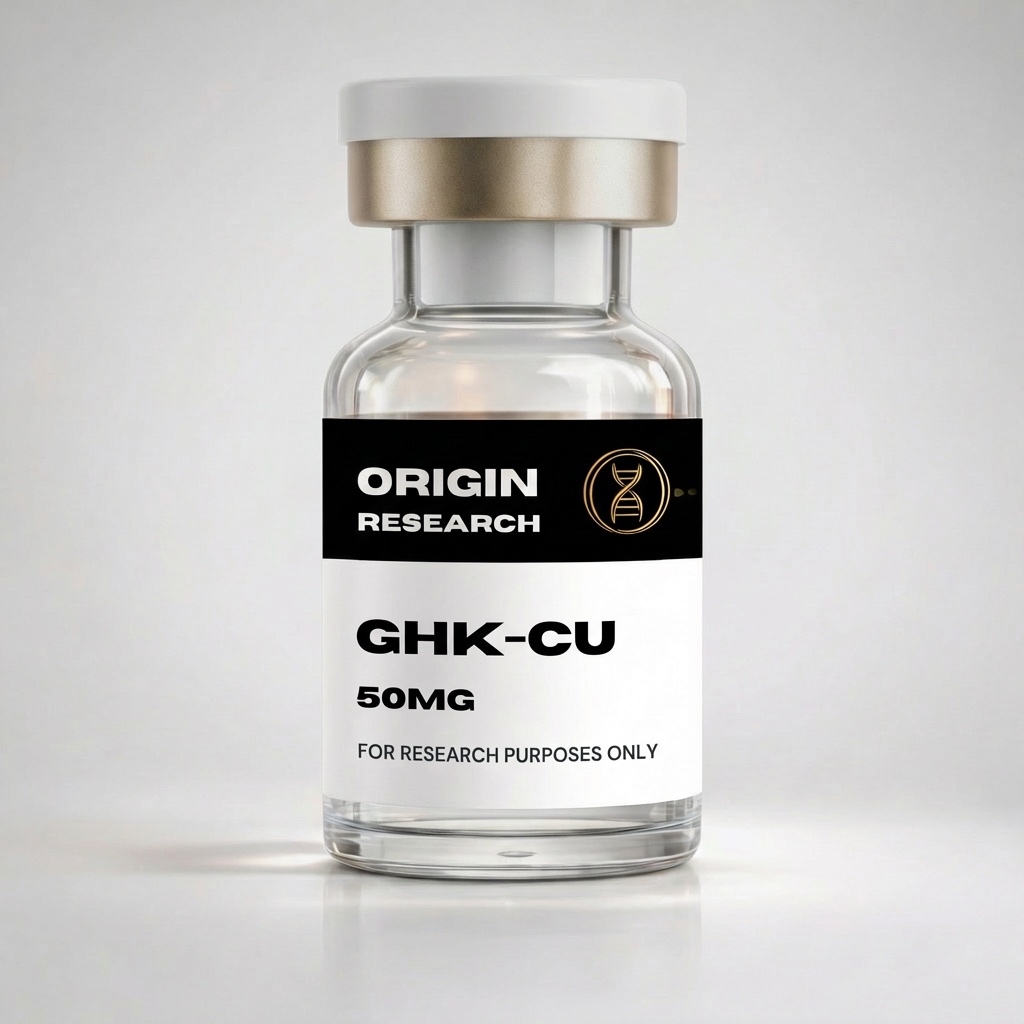
GHK-Cu is a small molecule with an outsized footprint in the research literature. The peptide itself is tiny: only three amino acids, glycine, histidine, and lysine. But it carries something extra. A copper ion is bound into the structure in a specific geometry, and that copper is not optional. It is part of what makes the molecule biologically active.
Loren Pickart and colleagues identified GHK in human plasma back in the early 1970s, while studying a low-molecular-weight factor that altered the behaviour of cultured liver cells. The subsequent decades produced an extensive published literature on the copper-binding chemistry, on dermal and connective tissue biology, and on broader signalling effects in preclinical models.
This article covers the chemistry of the copper coordination, what the research literature says about mechanism, how GHK-Cu compares to related copper peptides, and what to look for on a certificate of analysis.
All content is supplied for laboratory and academic reference only. Origin Labs supplies the compound under a Research Use Only framework for in vitro and preclinical investigation by qualified personnel. The material is not intended for human, cosmetic, or veterinary use.
Chemistry and copper coordination
Start with the peptide alone. GHK is a linear tripeptide with the sequence glycyl-L-histidyl-L-lysine, weighing in at about 340 daltons. Add a copper ion to it and you get the GHK-Cu complex, at about 402 daltons.
How copper sits in the molecule
The coordination geometry has been mapped in detailed crystallographic and spectroscopic studies. The divalent copper ion is held in place by three contact points:
- The imidazole nitrogen of the histidine side chain
- The alpha-amino nitrogen of the N-terminal glycine
- The amide nitrogen of the glycine-histidine peptide bond
These three contacts form a square-planar coordination geometry. A fourth site on the copper remains open for additional ligands. Think of it like three fingers gripping a marble, with a fourth position free to grab something else.
How tightly does GHK hold copper?
Very tightly. The binding constant has been characterised as exceptionally high, in a range that lets the peptide compete effectively with serum albumin for copper binding under physiological conditions. That competitive coordination chemistry is a central feature of the proposed biological role.
Why competition with albumin matters
Albumin is the main copper carrier in blood plasma. For GHK to do anything useful with copper in tissues, it has to be able to grab the copper away from albumin. The unusually strong binding constant is what makes that possible.
Synthesis
For research purposes, GHK-Cu is typically made in two steps:
- The apo (copper-free) tripeptide is prepared by standard solid-phase peptide synthesis
- Complexation with a copper salt under controlled pH conditions produces the defined 1:1 GHK to copper complex
Published HPLC and mass spectrometry work typically references purity of the apo peptide at 98 percent or higher. The copper complex itself is characterised by UV-visible spectroscopy in the wavelength range diagnostic for square-planar copper coordination.
Mechanism of action in the research literature
The mechanism of GHK-Cu in the published literature crosses several research domains. There is no single dominant pathway, but several reproducible observations.
Extracellular matrix biology
The most extensively documented finding. Multiple research papers describe effects on the synthesis of:
- Collagen
- Elastin
- Glycosaminoglycans (the sugar molecules in connective tissue)
- Other structural macromolecules
These effects have been observed in cultured dermal fibroblasts and in skin tissue preparations.
The copper connection
Here is where the copper coordination becomes functionally relevant. Copper is a required cofactor for the lysyl oxidase family of enzymes, which are responsible for cross-linking collagen and elastin during extracellular matrix maturation. The GHK-Cu complex has been investigated as a vehicle for delivering copper to those enzyme systems.
In plainer terms: lysyl oxidase enzymes need copper to do their job of linking collagen fibres together. GHK-Cu may act partly as a copper-delivery system to support that activity.
Gene expression effects
A separate strand of research has documented broad transcriptomic effects. Published studies characterise GHK-Cu exposure in cell culture models as modulating the expression of large numbers of genes involved in:
- Tissue remodelling
- Antioxidant defence
- Inflammatory regulation
Antioxidant biology
The copper-binding chemistry has also been investigated in relation to free radical biology, with reports characterising effects on superoxide dismutase activity (an antioxidant enzyme) and on the cellular response to oxidative stress in preclinical models.
Wound-healing models
Studies in rodent and porcine skin injury preparations have characterised effects on closure rate, angiogenesis at the wound site, and the cellular composition of the healing tissue.
As with other research peptides, these findings exist in preclinical and in vitro research. The discussion refers to published peer-reviewed observations rather than to any clinical application of supplied research material.
Pathway and dermal biology connections
GHK-Cu does not have a single identified canonical receptor in the published literature. The pathway biology is best understood as a network of effects tied to copper-dependent enzymology and to broader gene regulation programmes.
The pathways most often cited
Lysyl oxidase
The most direct connection to the copper coordination chemistry. Lysyl oxidase is a copper-dependent enzyme that performs oxidative deamination of lysine and hydroxylysine residues in collagen and elastin precursors. This reaction initiates the cross-linking responsible for the mechanical properties of mature extracellular matrix.
Without copper, lysyl oxidase does not work. The GHK-Cu complex is a candidate delivery vehicle.
Matrix metalloproteinases
Particularly MMP-2. Investigated as regulated by GHK-Cu in dermal fibroblast cultures, with implications for the balance between tissue building and tissue breakdown.
Nrf2-Keap1 antioxidant pathway
Referenced in published transcriptomic studies as upregulated by GHK-Cu exposure in cultured cells. Provides the connection to the antioxidant findings described in the mechanism section.
TGF-beta signalling
The transforming growth factor beta family has been referenced in dermal research as influenced by GHK-Cu in fibroblast cultures, contributing to collagen synthesis findings.
Hair follicle pathways
Dermal papilla cell behaviour and hair growth cycle effects investigated in rodent skin, with copper-related mechanisms relevant to several of these observations.
Combined preparations in the research supply chain
Research-grade GHK-Cu appears in combination preparations like the Glow Stack (dermal and connective tissue research) and the Klow Stack (combined with KPV for overlapping inflammatory and dermal research models).
The composite pathway picture is of a peptide whose copper coordination chemistry is functionally connected to a network of extracellular matrix, antioxidant, and gene regulation pathways documented across many cell culture and animal model studies.
Major research domains and published evidence base
The published evidence base for GHK-Cu spans several research areas. The breadth reflects the broad role of copper in extracellular matrix biology.
Dermal research
The most heavily represented area. Published studies cover:
- Cultured human dermal fibroblasts
- Keratinocyte behaviour
- Full-thickness skin tissue preparations
Wound-healing research
Rodent and porcine skin injury models. Reports cover closure rate, angiogenesis, and the cellular composition of the healing tissue.
Connective tissue research
Effects on tendon, ligament, and cartilage biology in cell culture and preclinical models.
Hair follicle research
- Dermal papilla cell behaviour
- Follicle stem cell biology
- Hair growth cycle effects in rodent skin
Gene expression research
Broad transcriptomic studies characterising the response of cultured cells to GHK-Cu exposure across thousands of measured transcripts.
Anti-inflammatory research
Effects on cytokine production in cell culture models.
The literature reflects the apparently broad signalling effects of the GHK-Cu complex across many published studies.
Translation of these preclinical findings into approved clinical therapeutics is limited, although GHK-Cu has appeared in cosmetic ingredient formulations through a separate regulatory pathway. Origin Labs material is supplied strictly for research use and is not intended for cosmetic, clinical, or veterinary application.
Comparative literature against related copper peptides
GHK-Cu is the most extensively studied copper-binding peptide in the published literature. Several related compounds have been investigated as comparators or parallel research tools.
AHK-Cu
Alanine-histidine-lysine bound to copper. A structural analogue of GHK-Cu with related copper coordination chemistry. Characterised in published cell culture studies as having related but distinct effects on fibroblast biology.
The albumin ATCUN motif
Not a peptide drug per se, but a natural reference point. The N-terminal copper-binding site on albumin shares the chemistry of N-terminal copper coordination at a histidine-containing sequence. It is the in vivo competitor for copper binding with GHK.
Copper-glycine and other simple copper complexes
Used as comparators for the contribution of copper alone to the effects observed with GHK-Cu. Allows experimental designs that separate the peptide-specific contribution from the copper-specific contribution.
Broader tissue-repair peptide comparisons
GHK-Cu is sometimes compared with BPC-157 and TB-500 in tissue repair contexts, though the mechanisms are distinct:
- GHK-Cu: copper-dependent enzymology and extracellular matrix biology
- BPC-157: angiogenic and nitric oxide pathways
- TB-500: actin sequestration
Combined research preparations
Glow Stack and Klow Stack appear in the research supply chain for studies combining GHK-Cu with adjacent compounds in dermal and inflammatory research models.
The comparative literature is useful for researchers selecting reference compounds for new investigations into tissue repair and dermal biology, since the mechanism differences allow experimental designs that isolate specific contributions.
Procurement, certificate of analysis, and verification
Research-grade GHK-Cu is supplied as a lyophilised powder in sealed vials, most commonly at 50 mg or 100 mg per vial (the larger masses reflect the relatively low molecular weight of the tripeptide complex). Shipping is temperature-controlled.
What the COA should report
- The peptide sequence
- Confirmation of copper complexation by appropriate analytical method (most commonly UV-visible spectroscopy with the characteristic absorbance maximum for square-planar copper coordination)
- Analytical purity by HPLC
- Mass confirmation by mass spectrometry
- Appearance of the lyophilised material (which displays a distinctive blue colouration due to copper d-d electronic transitions)
- Residual solvent content
- Endotoxin level where relevant
- Batch number matching the vial label
Purity benchmarks
Below 98 percent is generally considered marginal for academic citation work.
Storage
- 4 degrees Celsius for short-term holding of lyophilised material
- Minus 20 degrees Celsius for longer-term storage of unopened vials
The blue colour test
Here is a useful at-bench check. Correctly stored GHK-Cu, both lyophilised and reconstituted, displays a distinctive blue colour due to the copper d-d electronic transitions.
Colour changes that flag a problem
- Loss of blue colour
- Appearance of green
- Appearance of brown
All three are referenced in handling literature as possible indicators of copper displacement or oxidative degradation.
The blue colour is not cosmetic. It is a direct visual readout of intact copper coordination. If the colour shifts, the material may no longer be the same complex described on the COA.
Origin Labs supplies GHK-Cu with a documented certificate of analysis per batch. The compound is supplied under a Research Use Only framework for qualified research personnel and is not intended or authorised for human, cosmetic, or veterinary use.
References
- [1] Pickart L, Thaler MM (1973). Tripeptide in human serum which prolongs survival of normal liver cells and stimulates growth in neoplastic liver. Nature New Biology. PMID 4349523
- [2] Pickart L, Vasquez-Soltero JM, Margolina A (2015). GHK peptide as a natural modulator of multiple cellular pathways in skin regeneration. BioMed Research International. PMID 26236730
- [3] Maquart FX, Pickart L, Laurent M, Gillery P, Monboisse JC, Borel JP (1988). Stimulation of collagen synthesis in fibroblast cultures by the tripeptide-copper complex glycyl-L-histidyl-L-lysine-Cu2+. FEBS Letters. PMID 3181437
- [4] Pickart L, Margolina A (2018). Regenerative and protective actions of the GHK-Cu peptide in the light of the new gene data. International Journal of Molecular Sciences. PMID 30060511
- [5] Hostynek JJ, Dreher F, Maibach HI (2011). Human stratum corneum penetration by copper: in vivo study after occlusive and semi-occlusive application of the metal as powder. Food and Chemical Toxicology. PMID 21168469
Frequently asked questions
Where can verified research-grade GHK-Cu be sourced?
Origin Labs supplies research-grade GHK-Cu at originlabsresearch.com with a batch-specific certificate of analysis for each vial. The material is supplied under a Research Use Only framework for qualified research personnel.
Who originally identified GHK?
GHK was originally identified and characterised by Loren Pickart and colleagues in the early 1970s as a low-molecular-weight factor present in human plasma that altered the behaviour of cultured human hepatocytes. The subsequent decades of published research expanded the characterisation to dermal and connective tissue biology.
What should the certificate of analysis for GHK-Cu include?
The COA should report the peptide sequence, confirmation of copper complexation by UV-visible spectroscopy or equivalent method, analytical purity by HPLC at 98 percent or higher, mass confirmation by mass spectrometry, the characteristic blue appearance of the lyophilised material, batch number matching the vial label, and where relevant the residual solvent and endotoxin values.
Why is GHK studied as a copper complex rather than the apo peptide?
The copper coordination has been characterised in the published literature as functionally inseparable from the activity of the molecule in many of the most cited studies, particularly those connected to extracellular matrix biology and to the copper-dependent lysyl oxidase enzymes responsible for collagen and elastin cross-linking.
What research models has GHK-Cu been most studied in?
The published literature is strongest in cultured human dermal fibroblasts, in keratinocyte cell culture models, in rodent and porcine skin wound-healing preparations, in hair follicle research using dermal papilla cells, and in broad transcriptomic studies of gene expression response in cultured cells.
What other research peptides are in the same comparative family?
The closest comparator is the AHK-Cu tripeptide, which shares related copper coordination chemistry. The albumin ATCUN motif provides a reference for natural N-terminal copper binding. Broader comparisons in tissue repair research include TB-500 and BPC-157, although these operate through distinct mechanisms.
What colour is correctly stored GHK-Cu?
Correctly stored GHK-Cu displays a distinctive blue colouration in both the lyophilised and reconstituted forms, due to the d-d electronic transitions of the square-planar coordinated copper. Loss of colour or appearance of green or brown is referenced in handling literature as a possible indicator of copper displacement or oxidative degradation.